The entire Army is to focus on improving the quality of training and combat readiness
Enhancing training and combat readiness is a crucial and regular task, one of the main solutions identified in the Resolution of the 12th Military Party Congress, creating a solid foundation for building a “revolutionary, regular, elite, and modern” Army, meeting the requirements of national defence in the new situation. Therefore, Party committees and commanders of agencies and units of the Army are required to continue to lead and direct this important task effectively.
In 2025, thoroughly grasping the Party's military and national defence guidelines, the resolutions and directives of the Central Military Commission and the Ministry of National Defence, the entire Army focused on drastic leadership and direction, and deployed a number of solutions synchronously to improve the quality of training and combat readiness, and gained many important results.
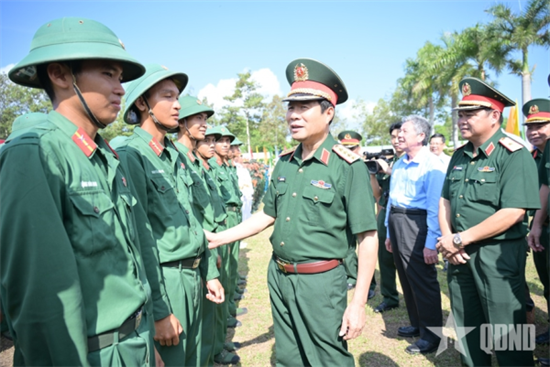 |
| General Nguyen Tan Cuong meets with and encourages cadres and soldiers of Regiment 320, Dong Thap Military Command prior to their new training season of 2026 (Photo: qdnd.vn) |
Notably, the entire Army maintained combat readiness seriously; controled airspace, maritime and border areas, inland and outlying areas, and cyberspace carefully; protected independence, sovereignty, unity, and territorial integrity firmly without being made passive or unattended. Besides, it actively reviewed, supplemented, and refined operational plans and tasks; relocated some units to suit practical realities; promoted research on military art and combat methods for hi-tech warfare. Training, exercises, education and training were conducted thoroughly with many innovations and creative approaches in content, form, and methods, ensuring compatibility with the development of military science and technology and adjustments in organisational structure and equipment. Moreover, it proactively held training to improve the quality of cadres to meet the operational requirements of the two-tier local government system; strengthened investments for the consolidation of training grounds, facilities and equipment; promoted the application of technology in training, exercises, and combat readiness... to meet the requirements of Military building, national defence strengthening, and Fatherland defence in the new situation.
Currently, the world and regional situations are forecast to have complex and unpredictable evolutions; strategic competition among major powers, territorial and border disputes, and armed conflicts will continue to be intense; forms of warfare and armed conflict will undergo profound changes. Domestically, the success of the 14th National Congress of the Party provides a solid foundation for the country to enter a new era of development; the Army is entering a period of modernisation, with new policies and guidelines being implemented. The tasks of national defence strengthening and Fatherland protection pose increasingly high demands, with many difficulties and challenges. Hostile forces continue to intensify their sabotages aiming for internal “self-evolution” and “self-transformation” and “Military depoliticisation”. Given this situation, in order to further improve the quality of training and combat readiness, and to meet the requirements of national defence in the new situation, the entire Army needs to focus on implementing the following contents and solutions effectively:
Firstly, strengthening the leadership and guidance of Party committees and commanders at all levels regarding training and combat readiness tasks. Building on the achievements, Party committees and commanders at all levels should continue to strengthen leadership and guidance to further improve the quality of this important work. First and foremost, emphasis should be placed on thoroughly understanding the resolutions, directives, and guidelines from higher echelons on training and combat readiness, especially the Resolution of the 12th Military Party Congress; and Resolution No. 1659-NQ/QUTW, dated 20 December 2022, of the Central Military Commission on improving training quality in the period 2023-2030 and beyond; Resolution No. 290-NQ/QUTW, dated 7 January 2026, of the Central Military Commission on breakthroughs in the development of education and training in the Army; the Chief of the General Staff's directive on military and defence work in 2026,... On this basis, they should issue specialised resolutions and concretise them into scientific, appropriate and practical action plans and programmes.
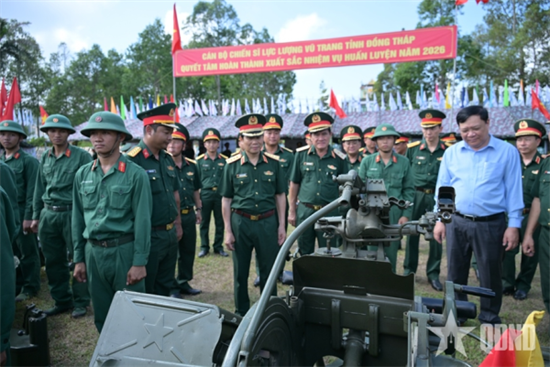 |
| General Nguyen Tan Cuong examines training equipment of Regiment 320, Dong Thap Military Command (Photo: qdnd.vn) |
Secondly, making thorough preparation for training, especially in terms of personnel. Accordingly, before conducting training, agencies and units should focus on thorough preparation, i.e. developing training plans and programmes, making lesson plans, teaching aids, facilities, training grounds, and personnel training. Training plans and programmes should be standardised and scientific to improve the overall level and capabilities of troops, closely following the directives and guidance of the General Staff and relevant agencies, and are consistent with the functions and tasks of the forces. Promote investment in research and improvement of training models, teaching aids, equipment, and facilities towards modernity, high applicability, and user-friendliness; apply science and technology in preparing lesson plans and lectures, and make sure they are approved by relevant levels before training. Simultaneously, manage, utilise, and make the most of the newly-invested and modern simulation equipment, shooting range, and training grounds.
Regarding personnel – the decisive factor for quality of training – agencies and units should conduct thorough reviews and accurately assess their qualifications and capabilities, thereby, making effective plans of use and deployment, ensuring that officers directly involved in training possess good qualities, all-round capabilities, experience, and strong pedagogical skills. Priority should be given to newly merged or established units, units stationed in key areas, and those performing combat readiness tasks. Simultaneously, effective on-the-job training and professional development for officers should be prioritised, focusing on platoon and company-level officers, young and newly graduated officers. Training should focus on new and challenging content, as well as addressing limitations and shortcomings, and prioritising the transmission of training experience. Regularly encourage officers to conduct self-study and exchange experiences to enhance their knowledge, military pedagogical methods, and ability to conduct and manage training.
Thirdly, continuing to vigorously innovate training contents, programmes, and methods. In the current context, the tasks of national defence strengthening and Fatherland protection are placing increasingly high demands with various types of combat, traditional and non-traditional defence and security situations. This requires that training closely follows the realities of modern warfare and the mission requirements of each force and unit. Therefore, agencies and units are required to continue to thoroughly understand and implement the guiding principles, viewpoints, and combinations in training; strengthen research and firmly grasp the trends in the development of weapons, equipment, organisational structure, and combat tactics of adversaries to innovate the content and methods of training accordingly. In training, it is necessary to adhere to the motto “basic, practical, and solid”; and prioritise comprehensive and in-depth training in the modern direction. Training is to focus on both existing, and modern and high-tech weapons; closely integrate military training with political education, physical training, and the transmission of combat skills and experience of our Army, with selective adoption of training contents from foreign militaries. Strengthen night training, mobile training, and high-intensity training under all conditions; training should be made relevant to actual combat situations, targets, tasks, and geographical areas; regularly hold competitions and contests after each training module; and effectively carry out defence diplomacy in the implementation of training tasks.
In addition, there is a need to continue to innovate and promote the application of information technology and digital transformation in the direction, management, and operation of training, exercises, and combat readiness, ensuring uniformity, synchronisation, efficiency, and avoiding duplication. Proactively innovate the content and methods of holding exercises at all levels, especially joint force exercises, defence combat exercises in military regions and defensive area exercises, etc.,; strengthen training, exercises, and practice of combat readiness using simulation methods, real-time command automation, and cyber warfare, thereby improving the organisational, command, and coordination capabilities of forces. Agencies and units, especially military training agencies at all levels, should strengthen inspection work before, during, and after training, focusing on the compliance with safety regulations and training evaluation.
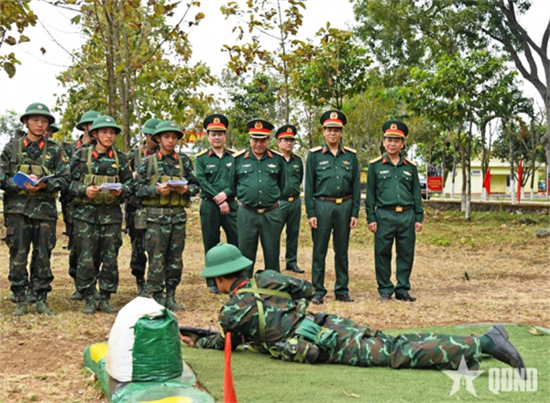 |
| Leader of the General Staff checks training work of Regiment 584, Dak Lak Military Command (Photo: qdnd.vn) |
Fourthly, closely combining training with disciplinary training and regularity building; strictly maintaining discipline and combat readiness. Party committees and commanders at all levels of the Army should focus on leading, directing, and effectively building military and defence work plans, plans for training and exercises for troops. During implementation, it is necessary to closely adhere to the set goals, requirements, and content; focus on Drill Regulations, Troop Management Regulations, and guiding documents on regularity building and discipline observance. Attention should be further paid to the models, such as: building exemplary training units; building regular, bright, green, clean, and scenic barracks; and model units in regulations and discipline, etc. Regular reviews and summaries should be conducted, and advanced models in training and adherence to laws and regulations should be replicated, while shortcomings and weaknesses should be promptly addressed, and solutions should be developed to further improve the quality of this work in the future.
Maintain discipline and combat readiness seriously, closely control the airspace, sea areas, borders, inland areas, and cyberspace; keep control of the situation round the clock, promptly advise on and effectively handle situations related to national defence and security, and firmly protect the sovereignty and territory of the country. Continue to review, adjust, and supplement combat readiness plans and strategies, and conduct rigorous training to promptly respond to non-traditional security challenges. Coordinate with other forces closely to maintain political security and social order in the area, especially where major political events of the country and the Army take place. Closely coordinate with the Ministry of Public Security to advise and propose to the Government amendments and additions to Decree No. 03/2019/ND-CP dated 05 September 2019 of the Government to suit the functions and tasks of each force. Actively monitor the situation and effectively advise on handling incidents, natural disasters, search and rescue operations, epidemics, and environmental catastrophes.
Finally, conducting logistical and technical support for training and combat readiness tasks successfully. Agencies and units should continue to thoroughly understand and effectively implement the resolutions and directives of the Central Military Commission and the Ministry of National Defence on logistics and technical support, and effectively conduct logistical and technical support for training and combat readiness tasks. They are to continue to develop and improve methods for ensuring logistical support for combat readiness and training activities conducted far from units, in long time, harsh weather conditions, and during exercises. Besides, it is necessary to improve the living conditions of soldiers; actively prevent and control epidemics, improve the physical strength of soldiers, striving that over 98.5% of troops have good health.
Furthermore, there is a need to focus on ensuring the sufficient and synchronised supply of weapons and equipment for training, exercises, and combat readiness tasks; promote research and application of science and technology, and digital transformation in the provision, storage, preservation, recovery, and repair of weapons and equipment, especially those used in training and exercises, harsh environments, and in maritime and island areas. Strengthen management and strictly maintain the discipline and procedures of technical work; make full list and inventory of weapons, ammunition, and technical means before, during, and after training and exercises; strictly comply with safety regulations, preventing any unsafe incidents during training and exercises.
By means of strong political resolve, coupled with the regular and close attention and guidance of the Central Military Commission and the Ministry of National Defence, and the tireless efforts of Party committees, commanders at all levels, and all officers and soldiers, it is expected that all agencies and units throughout the Army will excellently fulfill their training and combat readiness tasks, contributing to the firm protection of the Socialist Republic of Vietnam.
General NGUYEN TAN CUONG, Member of the Central Committee of the Communist Party of Vietnam, Member of the Standing Committee of the Central Military Commission, Chief of the General Staff of the Vietnam People's Army, Deputy Minister of National Defence