Management of digital archival records within the Ministry of National Defence - an inevitable requirement of the national digital transformation process
Management of digital archival records within the Ministry of National Defence (MND) is a new issue and a critical step of digital technology application, contributing to developing modern administration, providing timely, accurate information, enhancing the effectiveness and efficiency of leadership, command, management, and combat power. This task requires strong leadership and direction from party committees and commands at all levels to ensure coordinated, effective implementation in line with an appropriate road map.
Today, advances in science and technology, the 4th Industrial Revolution, and the national digital transformation process have created breakthroughs across many fields, opening up new spaces for development. In this context, the archival sector is undergoing significant changes in both management processes and professional practices, shifting from traditional document archiving to digital archival systems. Effective archiving, management, and exploitation of digital documents and data will contribute to building streamlined, transparent, modern administration, giving timely, accurate information to users, and raising the effectiveness and efficiency of state management across all sectors.
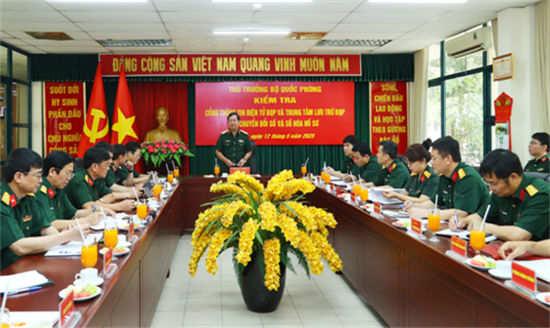 |
| Leader of the MND inspects digital transformation work at the MND’s Web Portal and Archives Centre (photo: bqp.vn) |
Within the MND, archival records constitute an authentic, accurate source of information reflecting leadership and direction activities over military and defence tasks, as well as the process of building, combat, and development of the Vietnam People’s Army (VPA) in general and its agencies and units in particular throughout different historical periods.
Digital archiving greatly helps automate many professional workflows, ensure information safety, minimise damage and loss, and extend the lifespan of original records. It provides timely, accurate information to support leadership, command, and management across the VPA, preserving and promoting the historical, military scientific, and legal values of archival records, facilitating historical research and education and the preservation of military and defence documentary heritage, enhancing electronic document exchange and data interconnection, reducing paperwork, stepping up administrative reforms, contributing to building modern military administration. Besides, these are indispensable materials for technological application in research and summarisation of military and defence work, assisting the Central Military Commission (CMC), the MND, and commands at all levels in closely managing and effectively allocating resources, producing correct situational forecasts, exercising sound leadership and direction, and making appropriate decisions, thereby improving the VPA’s task performance in the new period. Hence, management of digital archival records within the MND is both inevitable and strategic in nature, representing a crucial step in developing science and technology, promoting innovation, and modernising the VPA.
Over the years, under the policy of national digital transformation, the CMC, the MND, and party committees and commands at all levels across the VPA have focused their leadership and direction on grasping and concretising resolutions, programs, and plans by the Party and State regarding information technology and digital data platform development for military and defence tasks. The MND has promulgated a synchronised system of documents on information technology application, administrative reform, the building of e-Government, and digital transformation suitable to the particularities of military and defence missions. Typical examples include the Strategy for Information Technology and Military Communications Development towards 2025, with orientations towards 2030, the Project on Building E-Government in the MND, in line with the National E-Government Project, towards the building of a military digital Government, as well as regulations on clerical and archival work in the VPA.
With reference to clerical and archival work, a gradual shift from manual management to electronic management, from independent, compartmentalised, discrete systems to integrated, synchronised, unified digital systems capable of effectively sharing and exploiting data and serving state management of military and defence affairs has been required. In this regard, digital archival work must simultaneously meet two requirements: (i) it must be scientific and modern, ensure convenient storage, retrieval, and exploitation, and opportunely serve leadership and command; (ii) it must guarantee absolute security, prevent all risks of leakage, intrusion, or sabotage from outside, and protect military and state secrets.
The MND has mobilised and utilised resources to develop information technology infrastructure for digital document management and processing. It has built digital archival repositories, issued regulations on electronic file and document management, procedures for paper document digitalisation, mechanisms for information security in cyber environment, and standardised its databases. It has established mechanisms for data connection and synchronisation between the document management and administration system and the digital archival system across the entire VPA, synchronously, uniformly archiving and managing documents, promoting the use of electronic documents, thus improving the efficiency and lifecycle of electronic documents. Military computer network systems and solutions for information monitoring and safety have been adopted to 100% of level-3 units; digital signatures and encryption, security, and cipher solutions have been widely integrated and applied across all key information systems and document management software connected to the military data transmission network, thereby ensuring interconnectivity and effectively serving leadership, direction, and administration across the VPA.
Up to now, the whole VPA has adopted a synchronised, unified digital archival system with interconnected data from the MND to military regions, corps, and services, collecting, classifying, processing, and digitalising over 335 million pages of A4-sized archival files and documents in accordance with the provisions of the Law on Archives, signing, sending, and receiving documents in the electronic environment (via internal networks) for non-classified documents, thereby forming a large electronic database of archived records. The work of exploiting and using archival materials has been carried out closely and in accordance with regulations. Annually, there are more than 50,000 lookups and nearly 800,000 file and document retrievals. Many agencies and units have applied artificial intelligence (AI) in file processing, successfully adopting technologies for automatic document recognition and classification, using digital signatures in the authentication, transmission, and receipt of non-classified and confidential documents. Security, cipher, and cybersecurity work has been conducted synchronously in the stages of document collection, digitalisation, storage, and exploitation. Measures for data backup, network system protection, access authorisation, and information safety management have been enhanced, thus initially meeting the requirements for managing digital documents in the military environment, ensuring safety, confidentiality, accuracy, and reliability.
As a result, the accuracy, security, and efficiency in electronic document processing, storage, and exchange have been raised, considerably saving time for handling administrative procedures.
However, as this is a new issue without any precedent, digital archival record management within the MND faces shortcomings. The causes stem not only from technical and technological factors, but also from awareness, legal frameworks, organisational aspects, and managerial and operational capacity of party committees, commands, and professional employees at all levels.
At present, breakthroughs in science and technology development, innovation, and national digital transformation, administrative reforms, digital ecosystem development, and the building of e-Government are identified by our Party and State as the main driving force to bring the country towards prosperity and civilisation. In that context, accelerating the application of science and technology, digitalising, managing, and exploiting archival materials, handling administrative procedures, stepping up work processing in the electronic environment, and enhancing the effectiveness and efficiency of state management in the military and defence field for modernising the VPA and meeting the requirements of Fatherland protection in the new situation are inevitable. To that end, it is necessary to comprehensively implement various solutions, with a focus on the following.
First, continuing to grasp and seriously implement the lines and directions of the Party, State, CMC, and MND on breakthroughs in science and technology development, innovation, and national digital transformation. Emphasis should be placed on the Politburo’s Resolution 57-NQ/TW, dated 22 December 2024, the Government’s Resolution 71/NQ-CP, dated 1 April 2025, and the CMC’s Resolution 3488-NQ/QUTW, dated 29 January 2025. It is important to proactively study, amend, supplement, and perfect institutional frameworks and professional regulations, and manage digital archival records in accordance with the provisions of the 2024 Law on Archives. It is essential to develop, promulgate, and strictly implement Project on processing and digitalising archival materials across the VPA for the period of 2025 - 2030, Procedures for processing, digitalising, preserving, and exploiting digital archival materials, and documents regulating system management standards, digital archival material preservation, use, and disposal, and standards for digital archival repositories and other electronic archival materials. Besides, standards for data and metadata formats, encryption, and metadata transmission should be established in a close, proper, synchronised manner across the VPA.
Second, processing digital archival materials in a scientific, unified fashion to facilitate storage, retrieval, and exploitation as well as command and management work. Agencies and units across the VPA should proactively review and classify documents to ensure that processed documents will be acceptable for transfer to current archives or historical archives of the defence sector. They should selectively digitalise archival materials under procedures and regulations; they should only digitalise documents with permanent archive periods or determined archive periods as well as confidential or secret documents; they shall not digitalise top-secret documents. Electronic copies of documents must ensure legal validity, integrity, and accuracy; there should be cipher solutions, rapid access capability, and long-term storage capacity. Great value should be attached to selecting proper, effective digital storage means, especially their structure, capacity, data transmission speed, and lifespan, as well as technological conversion and upgrade capability, and accompanying hardware.
Third, developing a unified, specialised database and infrastructure system for digital archiving across the VPA. Competent agencies should continue to give advice on standardising infrastructure for storing military digital materials at MND Data Centre, partitioning storage areas and access rights according to security levels and authority, and designing dedicated spaces for digital archiving. Due attention should be paid to developing MND-level backup data centres and digital archival repositories to ensure safe, centralised storage and synchronised connection with the document management and administration system. Security and information safety should be strengthened throughout the entire digital archiving process. Digital archival management software should be used on the existing infrastructure of data centres. It is vital to flexibly establish management and operation models with centralised monitoring, expand interconnection and internal sharing, apply defence cybersecurity standards, implement multi-layer access control, and avoid connecting confidential and secret documents to public networks or to other networks that lack cipher solutions.
Fourth, building a “both red and expert” digital archival workforce with adaptability to digital technologies. To that end, training should be fostered to improve the digital capacity of cadres and employees, especially those engaged in clerical and archival work, enhance their professional qualifications and capabilities in digital document management, preservation, and exploitation, and gradually develop a contingent of military digital archival experts. Apart from political qualities and ethics, emphasis should be placed on training cadres and employees to enhance their capacity in digital information management, data creation and management, digital document arrangement, and software utilisation. Training work should be linked with the practical digital archiving process within units. Due regard should be paid to building specialised digital archival teams at agencies and units across the VPA, who may concurrently undertake information and clerical tasks. Besides, proper remuneration and reward policies should be implemented to attract and retain human resources committed to long-term engagement in management of digital archival records.
Fifth, promoting the application of science and technology to improve the quality and effectiveness of digital archival work. It is essential to build digital archival models that ensure confidentiality, security, safety, privacy from the design stage, and compatibility with cipher systems, military data transmission networks, and state management regulations in the archival field. Synchronised technological solutions should be adopted and closely linked to national and military digital transformation and administrative reform strategies; common information technology infrastructure for digital archival work across the VPA should be developed. New technologies, such as blockchain, optical character recognition (OCR), intelligent character recognition (ICR), handwriting recognition (HWR), AI integrated into electronic document management systems (EDMS), natural language processing (NLP), and machine learning in the processing and management of digital archival materials, should be applied to minimise risks and ensure system safety.
Management of digital archival materials within the MND is an important task and duty of party committees and commands at all levels, as well as every cadre, employee, and soldier, especially those engaged in clerical and archival work across the VPA. Well performing this task will practically contribute to accelerating the national digital transformation process, building a revolutionary, regular, elite, modern VPA, and making all-people national defence strong, modern, and capable of Fatherland protection in the new period.
Lt. Gen. NGUYEN VIET TUYEN
Chief of the Office of the MND