Thoroughly grasping the Party’s strategic lines on building provinces and cities into strong defensive zones, Lam Dong province has been synchronously implementing various solutions and bringing into play the combined strength of all forces to effectively carry out this important task.
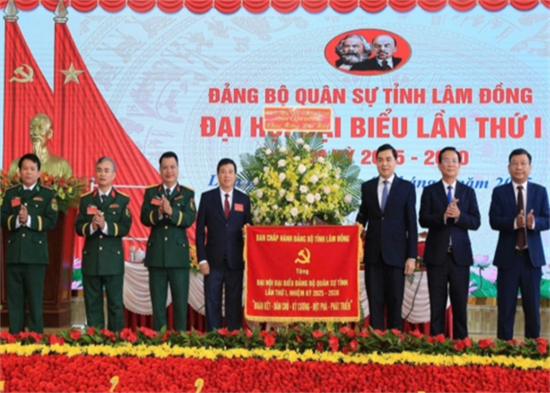 |
| Lam Dong provincial leaders offer congratulations to the 1st Congress of the Provincial Military Organisation (2025 - 2030 term) |
On 12 June 2025, the 15th National Assembly passed Resolution 202/2025/QH15 on the reorganisation of provincial-level administrative units, under which Dak Nong province and Binh Thuan province were merged into Lam Dong province, with the name Lam Dong being retained. Since 1 July 2025, the new Lam Dong has become the largest province in the country by area, holding a strategic position in terms of politics, economy, defence, security, and external relations for the Central Highlands and Military Region 7.
With its new administrative boundaries, Lam Dong possesses numerous advantages and an ample room for socio-economic development and defence - security consolidation. Notably, the results achieved in defence and military tasks, especially in the building of defensive zones in the three provinces prior to the merger, have been highly encouraging, laying an important foundation for Lam Dong to continue carrying out this crucial work in the new situation. However, the province still faces many difficulties and challenges stemming from hostile forces’ sabotage activities, particularly in isolated, remote, and extremely disadvantaged areas. Besides, administrative boundary adjustments and the adoption of a two-tier local government model have been posing many new issues to defence and military work in general, the building of defensive zones in particular.
To build Lam Dong into a strong defensive zone capable of meeting the task requirements in the new situation, the province will continue grasping and concretising guidelines of the Party and State, as well as directives and guidance of the Military Region on this issue, focusing on the following key solutions.
First, strengthening communication and education to raise awareness and a sense of responsibility among cadres, Party members, and the people regarding the building of defensive zones. Effective implementation of this crucial solution will help achieve unity in awareness and action and promote the combined strength of all forces in the process, serving as a direct measure to build political - spiritual potential and “people’s hearts and minds posture” within a defensive zone. Hence, the Provincial Military Party Committee and the Provincial Military Command (PMC) will closely work with departments, sectors, and agencies to give advice to the Provincial Party Committee, the Provincial People’s Council, and the Provincial People’s Committee on stepping up propagation and education to render cadres, Party members, and citizens fully aware of the importance of building a strong defensive zone and raise their sense of responsibility in defence, military, and security tasks in general, defensive zone construction activities in particular. Emphasis will be placed on disseminating higher-level resolutions, directives, and guiding documents regarding the two strategic tasks of Fatherland construction and protection, the lines of all-people national defence and the people’s war, and the policy on building defensive zones.
In the process of communication and education, forms and methods will be flexibly, creatively applied in accordance with each target group and locality. In addition to propagation and education via briefings, meetings, and centralised training sessions, coordination with central and local press agencies will be strengthened to disseminate information across various platforms and develop specialised pages and columns on military, defence, and security affairs. These efforts aim to provide positive information, prevent and combat false, harmful information, and unmask hostile forces’ plots to “depoliticise our Military” and undermine our great national unity. At the same time, propagation and education will be integrated into local cultural, artistic, and traditional activities. Great value will be attached to nurturing love for the homeland and country, as well as pride in the nation and the Military among younger generations. Coordination with schools will be enhanced to organise field trips to revolutionary relics for students.
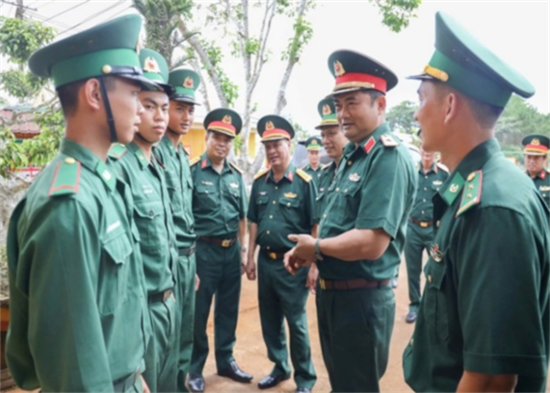 |
| Military Region 7 Command and the PMC inspect Dak Tien border guard post in July 2025 |
Second, building increasingly strong political - spiritual potential within the defensive zone. The PMC will closely cooperate with competent agencies to advise the province on strengthening the leadership of Party committees and the management of authorities at all levels over defence and military work. It will continue thoroughly grasping and effectively realising the Party’s viewpoints and lines on building all-people national defence posture associated with the people’s security posture, creating breakthroughs in building the defensive zone, especially in building political bases and cementing the “people’s hearts and minds posture”. Consideration will be given to making Party organisations, authorities, and political - social organisations pure, strong, and capable of leading, managing, and performing defence and security tasks, and building the defensive zone. Great weight will be added to realising action programmes and plans for the Resolution of the 1st Provincial Party Congress (2025 - 2030 term), well preparing for and successfully organising the election of deputies to the 16th National Assembly and People’s Councils at all levels for the 2026 - 2031 term.
Bringing into play its role as the Standing Agency of the Provincial Council for Defence and Security Education, the PMC will coordinate with departments and sectors to review, formulate, and effectively implement plans on defence and security education for target groups. At the same time, it will step up cultural information work, with a focus on preserving and promoting the cultural identities of ethnic groups across the province, preventing the infiltration of harmful cultural products, and building a healthy cultural and spiritual life within the defensive zone. It will actively advise the province to direct border localities to promote people-to-people diplomacy activities in accordance with the Party’s foreign policy lines and on the basis of international law and mutual respect and understanding, contributing to the firm protection of the Fatherland in the new situation by peaceful means.
Third, accelerating economic, scientific, and technological development to create a foundation for building a solid defensive zone. After the merger, Lam Dong acts as the northern shield of Military Region 7, holding a strategic position. As it encompasses forests, mountains, sea, and islands, connecting directly with the Southeast region, the Central Highlands, and the South Central Coast, bordering Mondulkiri province of Cambodia, it has a lot of advantages for socio-economic development to become a fairly developed province and one of the region’s dynamic growth poles. Accordingly, the PMC will closely work with departments and sectors to advise the province on adjusting the master plan for defence deployment in combination with socio-economic development. Emphasis will be placed on closely appraising socio-economic development plans and projects in the area and advising the province to mobilise all resources to build and develop a synchronous, modern infrastructure system, especially strategic, inter-regional transport lines, such as Tan Phu - Bao Loc, Bao Loc - Lien Khuong, and Gia Nghia - Chon Thanh expressways, upgrade and construct Lien Khuong and Phan Thiet airports and seaports, and proposing specialised mechanisms and policies for Phu Quy special zone in socio-economic development linked with defence and security. Digital infrastructure, science, technology, and innovation, especially information technology infrastructure and digital transformation for defence and security tasks will be developed to ensure that each step of socio-economic development will be a step forward in defence and security consolidation. The PMC will give advice to the province on directing localities to renew the economic growth model towards sustainability, apply science and technology, step up innovation, improve productivity and competitiveness, foster the development of digital economy, green economy, circular economy, and sharing economy, and build an open spatial economy linked with the province’s urban development axes, in order to turn Lam Dong into a high-quality national tourism centre with renowned destinations and strong brands.
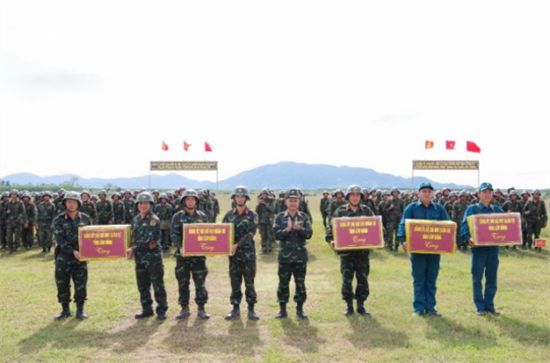 |
| The PMC gives rewards to forces taking part in the field exercise with Division 309 of Military Region 7 |
On the basis of socio-economic development, the PMC will advise the province on reviewing and completing the planning of the military posture of the defensive zone, allocating budgetary resources to construct and upgrade military works in line with the new operational resolution, administrative boundary adjustments, and the adoption of the two-tier local government model. Priority will be given to key works, such as command headquarters, rear bases, key defensive areas, coastal fortification systems, and border combat posts, as well as dual-use works, such as reservoirs, dams, transport, telecoms, and healthcare infrastructure, urban infrastructure, coastal residential clusters, seaports, and sea dykes. Doing so will enable the province to form an inter-connected, solid, in-depth military posture for socio-economic development and handling of defence and security situations. Additionally, the PMC will direct regional defence commands and commune-level military commands to take over and protect combat works, coastal strongpoints, seaports, airports, border militia posts, and cave systems that have been renovated and repaired.
Fourth, bringing into play the armed forces’ core role in building the defensive zone. The PMC will closely cooperate with the Provincial Public Security to advise the province to continue building adept, compact, strong armed forces as the loyal, reliable political and combat forces of local Party committees, authorities, and people. Military forces will continue to be consolidated in terms of organisational structure in strict accordance with guidance of the Ministry of National Defence and their assigned functions and tasks. In particular, the standing force will be streamlined to ensure a reasonable structure and composition, great synergy, and high combat readiness; the reserve force will be made strong in quantity, correctly organised by military specialities, and ready for mobilisation when ordered. Militia and self-defence units will be re-organised under higher-level guidance, with high quality, relevance to local characteristics, and great capability to handle defence and security situations. At the same time, the project on “building residential clusters adjacent to border militia posts” will be implemented to form residential areas and clusters along the province’s land border. Moreover, the provincial armed forces will continue promoting their function as an army ready for work, participating in building grass-roots political systems, helping the people with economic development, poverty reduction, and natural disaster response, thereby building a firm “people’s hearts and minds posture”.
Efforts will be stepped up to improve the operational quality of commune-level military commands and bring into play the role of regional defence commands in helping commune-level military commands with defence and military tasks. Plans for training and fostering advanced political theory for military cadres at all levels will continue to be executed to ensure that they will meet prescribed standards and task requirements in the new situation. Military forces will be directed to strengthen coordination with public security forces in effectively implementing the Government’s Decree 03/2019/ND-CP, dated 5 September 2019, with a focus on grasping and managing activities at border gates, border lines, seaports, and territorial waters, contributing to maintaining political security and social order and safety within the province.
In the new era of development, the tasks of Fatherland construction and protection in general, the building of defensive zones in particular necessitate resolute participation of all sectors and the entire political system, with the armed forces as the core. With high political resolve and great potential and advantages of a new province, the armed forces of Lam Dong, together with local Party committees, authorities, and people, will continue to uphold unity and generate synergy for building the province into an increasingly strong defensive zone, contributing to firmly safeguarding the Fatherland early, from afar, and right at grass-roots level.
Maj. Gen. DINH HONG TIENG
Member of the Provincial Party Committee Standing Board
Commander of the PMC