Engineering Corps advances science - technology development and digital transformation
“Science - technology development, innovation, and digital transformation” constitute one of the central political missions and breakthroughs of the entire Military today. Grasping that spirit, the Party Committee and Command of the Engineering Corps have focused their leadership and direction on this important task via synchronous, proper measures, laying the groundwork for building a modern Corps capable of excellently fulfilling all assigned missions.
Fully understanding the importance of science, technology, and digital transformation, the Engineering Corps’ Party Committee and Command have, over the years, attached great importance to promoting science - technology research and application and digital transformation. Alongside efforts to streamline the force in an “adept, compact, strong” manner and build “exemplarily, typically” comprehensively strong units, these initiatives have provided the foundation for raising the quality and effectiveness of leadership, command, training management, combat readiness, construction, bomb and mine clearance, natural disaster response, and search and rescue.
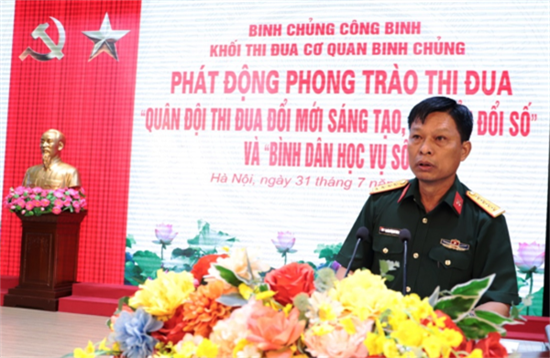 |
| Launching emulation movement on innovation, digital transformation, and digital literacy across the Corps |
It is worth noting that right after the issuance of Resolution 3488-NQ/QUTW, dated 29 January 2025, by the Central Military Commission (CMC), on breakthroughs in science - technology development, innovation, and digital transformation within the Military, the Corps’ Party Committee has organised courses for all cadres and soldiers to study the Resolution, while making Plan 845-KH/ĐU, dated 25 February 2025, on realising the Resolution, forming a Steering Board, launching “Digital Literacy” Movement across the entire Corps, and directing the building of role models to improve troops’ knowledge and skills of digital transformation and technology. The Corps has directed its offices and units to actively develop and use document management software integrated with digital signature, online meeting systems, military email services, and other software applications for manpower, finance, and social insurance management.
Thanks to its political resolve and comprehensive measures, the Corps has achieved remarkable results in its science, technology, and digital transformation efforts. Notably, since 2020, it has completed hundreds of science research and technical innovation projects; many of them at national and Ministry of National Defence (MND) levels have been applied in practice. These efforts have significantly enhanced the quality and progress of defence construction projects, DK1 Platform systems, National Action Program on settling post-war unexploded ordnance (UXO), natural disaster prevention and mitigation, and search and rescue operations. The Corps has also ensured safety for national and international events in Vietnam, especially the 80th Anniversary of the National Day of the Socialist Republic of Vietnam, earning great recognition from the Party, State, CMC, and MND.
In the upcoming time, the tasks of defence consolidation, Military building, and Fatherland protection will have new developments and face numerous challenges. The 4th industrial revolution, Artificial Intelligence (AI), Big Data, Internet of Things (IoT) will bring about a major change in military and defence issues, together with new opportunities and challenges. Our entire Party, people, and Military are vigorously implementing the “Strategic Quartet” generating a strong driving force to advance the country in the new era. Hence, the Corps’ Party Committee and Command will continue taking synchronised measures to foster science - technology development and digital transformation, with a focus on the following.
First, raising awareness, fostering strong political resolve, creating a new momentum for science - technology development and digital transformation across the entire Corps. The Resolution of the Corps’ 15th Party Congress for 2025 - 2030 tenure affirms that science, technology, and digital transformation serve as a strategic breakthrough, a key driving force, and a foundation for enhancing the Corps’ development potential in new, diverse, and complex conditions. Therefore, in the time to come, the Corps will continue grasping higher echelons’ resolutions, directives, and guidance on science - technology development and digital transformation. Its offices and units will be required to review, supplement, and include science, technology, and digital transformation tasks in their annual and periodic action programs and work plans. Based on the results and experience in the “Digital Literacy” Movement at Engineering Officer College, Engineering Technology Institute, and Logistics and Technical Department, it will continue to promote “Digital Literacy”, “Digital Learning”, and “Digital Soldiers” Movements to ensure that every service member will be a “digital soldier” capable of mastering digital platforms and skills to successfully fulfil all assigned tasks.
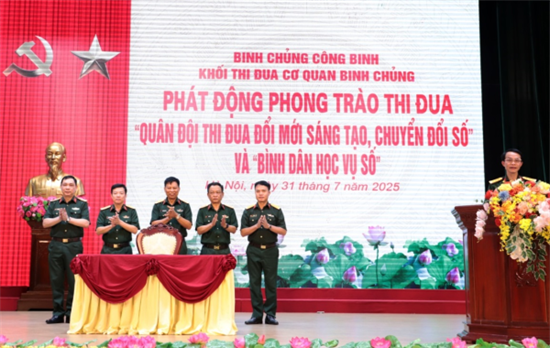 |
| The launch of the emulation movement on innovation, digital transformation, and digital literacy within the Corps Command |
Furthermore, commanding officers of the Corps’ Command, offices, and units will serve as a role model in digital transformation; offices and units will encourage innovation and the spirit of daring to think, daring to do, and daring to take responsibility among cadres and party members in science research and digital transformation, improve the quality of science research and technical innovation projects, and regard the outcome of this task as a criterion for yearly emulation and commendation work.
Second, increasing investment in technical infrastructure to facilitate the development of science, technology, and digital transformation. Adhering to Plan 845-KH/ĐU of the Corps Party Committee on executing the CMC’s Resolution 3488-NQ/QUTW, dated 29 January 2025, in the coming time, the Corps will coordinate with the Signal Corps in realising the Strategy for Military Communications System Development in the period of 2021 - 2030, with a vision towards 2045; the military communications system will be developed synchronously in terms of scale and method, with advanced technologies and diverse services to allow military data transmission across the Corps. Priority will be given to building information technology infrastructure compatible with integrated command and management systems to enable data sharing among units by open standards.
Additionally, the Corps will apply digital technologies to facilitate command and management in training and combat readiness as well as the management of weapons and equipment of the entire military engineering force; management software systems will also be applied to allow online monitoring of equipment, improve accuracy, save resources, and effectively provide engineering support in all situations. The Corps will actively mobilise resources to develop cybersecurity and information encryption systems to prevent cyberattacks and ensure confidentiality and data safety in all military activities. It will continue investing in modern facilities and equipment for its science research units, with emphasis on modernising specialised laboratories and advanced production lines for military schools, research institutes, and factories to accomplish the Corps’ specialised tasks.
Third, building high-quality human resources capable of meeting the requirements of science - technology development and digital transformation. Human resources are the decisive factor in the quality and effectiveness of the revolution in science, technology, and digital transformation. Hence, the Corps will continue to promote personnel training, recruitment, and professional development in close association with the planning, assignment, utilisation, and building of a pool of technical officers and specialists with improved quality, uniformity, and balanced development across specialities. Accordingly, managerial and commanding cadres must be able to employ 3D simulation software and virtual reality technology in the construction of roads, bridges, obstacles, and works for river crossing, camouflage, training, exercises, and other engineering missions; they must be capable of applying AI in staff work, political work, and logistics and technical support.
For science research and information technology cadres, emphasis will be placed on increasing their capacity to research and develop specialised engineering weapons and equipment, and apply electronic, automation, and digital technologies (AI, Big Data, IoT, cloud computing, Blockchain, etc.) within each engineering speciality. To attract high-calibre and specialised personnel, the Corps will continue studying and promulgating preferential treatment policies. It will effectively leverage the contingent of technical cadres and employees in its offices, units, and factories to create a powerful human resource network that can promptly support one another in all science, technology, and digital transformation activities.
Fourth, focusing on researching, developing, and producing modern engineering weapons and technical equipment. From the realities of recent military conflicts and the MND’s strategic orientations, the Corps will strengthen coordination and cooperation in researching, developing, and producing specialised engineering equipment, such as bomb and mine detection and clearance systems, engineering robots, remotely operated multi-purpose vehicles, UAVs for engineering reconnaissance, camouflage equipment, and smart engineering weapons in accordance with Vietnam’s conditions and modern warfare. It will research into and apply new materials, such as ultra-lightweight concrete, rapidly assembled modular structures, multi-spectral camouflage materials, and 3D-printing technology in field constructions. Additionally, AI and sensor systems will be applied for reconnaissance, detection of obstacles, underground works, digital camouflage devices, and digitalised command-and-control systems. The Corps will continue updating data for Vietnam’s National Mine/UXO Contamination Map using digital technologies, developing an integrated database with geographic information system (GIS), including remote sensing data and AI to analyse explosive density, types of bombs and mines, terrain, weather, climate, hydrology, and population. Digital maps will be built to support situational forecasting and assessment as well as force command and control in the field during post-war bomb and mine clearance, natural disaster response, and search and rescue operations.
Apart from the above tasks and measures, under the motto “schools’ training quality is the combat readiness capacity of units”, offices, units, and schools across the Corps will step up the application of science, technology, and digital transformation in training management, testing, and evaluation of soldiers’ training and ideology. They will also incorporate 3D simulation, virtual reality, and online training platforms into teaching and training, especially in specialised fields, such as bridge and road construction, river crossing, military engineering works, bomb and mine clearance, search and rescue, and collapse response operations.
The Corps will further organise exercises combined with 3D simulation technology and automated command systems to be relevant to modern warfare. It will devote efforts to draw lessons from recent wars and conflicts around the world to perfect engineering support projects in accordance with Vietnam’s practical conditions, operational characteristics, and terrain, thereby meeting the requirements of building the Corps, modernising the Military, and safeguarding the Fatherland in the new era.
Maj. Gen. TRAN TRUNG HOA
Commander of the Engineering Corps