In response to the increasingly demanding requirements of training, combat readiness, regularity building, and discipline management, the Party Committee and Command of Brigade 214 have synchronously implemented various solutions to improve the work of legal dissemination and education, creating clear improvements in law-abiding awareness and action among officers and soldiers.
Brigade 214, under Military Region 3, is an air defence unit tasked with training troops, maintaining combat readiness, managing and protecting the airspace of the Northeastern region.
Due to its operational requirements, subordinate units of the Brigade are stationed in dispersed urban areas and frequently affected by multi-dimensional information flows, especially in cyberspace. To successfully fulfil its assigned political tasks, the Brigade has identified legal dissemination and education as one of the key tasks and breakthroughs, directly contributing to fostering political steadfastness and respect for the rule of law and discipline across itself.
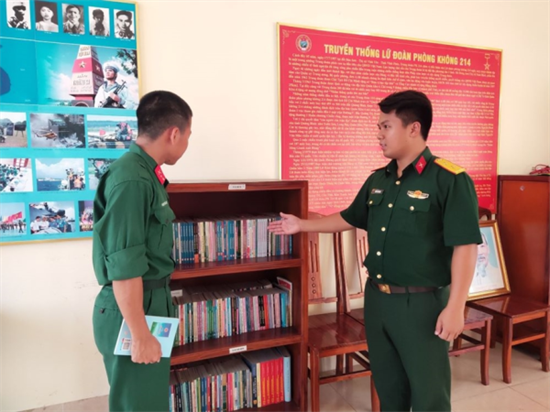 |
| Giving guidance on how to use a Law Bookcase |
Grasping and implementing guidance and direction from higher echelons, directly from Military Region 3’s Party Committee and Command regarding legal dissemination and education, the Brigade’s Party Committee and Command have developed and strictly executed specialised resolutions and action plans at all levels. The content of legal dissemination and education has been specified in terms of forms, timing, and target groups to ensure practical relevance and integration with political education, troop management, and task implementation. The Brigade has seriously maintained the Legal Study Day, diversifying forms of legal dissemination and education such as seminars, forums, and legal knowledge contests, developing and replicating effective models and creative approaches. Emphasis has been placed on improving the knowledge and communication skills of cadres at all levels, especially legal reporters and communicators. Coordination with local party committees, authorities, and competent forces has been strengthened in troop management and education and legal dissemination for the people, thereby contributing to building safe units and localities as a solid foundation for the Brigade to successfully accomplish its assigned tasks.
Currently, the world and regional situation continues to develop in complicated and unpredictable ways; hostile forces are intensifying sabotage efforts in cyberspace; the robust development of information technology and social networks regularly affects troop awareness and action. The building of a revolutionary, regular, elite, modern Vietnam People’s Army (VPA) increasingly demands improvements in the quality and effectiveness of legal dissemination and education. Hence, the Brigade has identified several key solutions as follows.
First, strengthening the leadership and direction of party committees and commands over legal dissemination and education. To that end, all-level party committees and commands have continued thoroughly grasping legal documents, especially newly promulgated ones on military - defence affairs, realising the breakthrough: “Leadership over political and ideological education to create firm changes in awareness and observance of state law, military discipline, and safety assurance, putting an end to serious disciplinary violations”. The content and targets of legal dissemination and education have been included in resolutions and work plans at each level and closely linked with troop management, regularity building, discipline management, and political tasks within each agency and unit.
The core role of political agencies and political cadres in grasping, forecasting, and orientating troop ideological developments, as well as in promptly proposing measures of leadership and direction appropriate to practical conditions has been promoted. Party committees, political commissars, political officers, and commanders at all levels have regularly stayed close to the grass-roots level, firmly grasping ideological developments, promptly detecting, preventing, and handling violations under regulations. Inspection, supervision, preliminary reviews, and final reviews have been strengthened, while the results of legal dissemination and education has been seen as a criterion for evaluating the task performance of party organisations, cadres, and party members.
Second, intensifying innovation in the content and forms of legal dissemination and education. Based on the classification of its troops, the Brigade has determined the content and forms of legal dissemination and education appropriate for each target group, especially new soldiers, non-commissioned officers, and professional servicemen, ensuring they are easy to understand, easy to remember, and easy to implement. Emphasis has been placed on regulations directly governing troop behaviour in training, combat readiness, regularity building, and safety assurance. Due attention has been paid to issues related to the use of social networks, protection of state secrets, information security, prevention of violations in the digital environment, working relations, and daily life. At the same time, troops have been equipped with skills to identify and refute malicious and toxic information in cyberspace, thereby strengthening their “immunity” against negative influences and forming mechanisms of self-management, self-training, self-compliance, and early prevention of violations at grass-roots level.
 |
| Officers and soldiers study legal topics at Ho Chi Minh hall |
To improve the attractiveness and effectiveness of legal dissemination and education, the Brigade has focused on detecting, building, and replicating effective models and approaches. It has continued widely implementing its “five-proactive, four-flexible, three-timely” model1, standardising the content and methods of adopting the model across its affiliates, promoting the application of information technology, digitalisation of documents, development of digital lectures, and use of digital platforms for legal dissemination and education. Direct education has been combined with visual, vivid forms relevant to unit practice, thus contributing to building a healthy military cultural environment, strengthening respect for the rule of law, maintaining discipline and order.
Third, building a strong pool of legal reporters and communicators capable of meeting their task requirements. The Brigade’s Party Committee and Command have advocated “taking force building as the centre, operational mechanisms as the key, and communication effectiveness as the measure”, focusing on building a contingent of legal reporters and communicators and psychological - legal advisory teams towards standardisation, compactness, and efficiency. Consideration has been given to reviewing, selecting, and consolidating personnel to ensure great “political qualities, legal knowledge, communication proficiency”, and prestige within units, and building a successor force from young cadres with good legal knowledge, pedagogical capacity, and practical experience. The Brigade has regularly held training and refresher courses in a practical, task-orientated manner for these cadres, encouraging self-study and self-improvement to enhance their legal thinking, communication skills, and ability to grasp, analyse, and orientate troop awareness.
Management and utilisation mechanisms have been improved towards clearly defined personnel, tasks, and responsibilities; duties have been assigned in association with the areas of responsibility of each person. Inspection and evaluation have been strengthened; the effectiveness of legal dissemination and education and the degree of improvement in troops’ awareness and compliance have been taken as the measure; the outcomes of legal dissemination and education have been linked with the annual evaluation and classification of cadres and party members. Conditions and policies have been sufficiently ensured to encourage legal reporters and communicators to well perform their role, thereby contributing to raising the quality and effectiveness of legal dissemination and education across the Brigade.
Fourth, strengthening coordination with agencies, units, and localities in legal dissemination and education. The Brigade has proactively coordinated with competent agencies inside and outside the VPA, especially Military Region 3’s Military Procuracy and Military Court, to select and disseminate new legal regulations, provide information and analysis on violations, crimes, and disciplinary issues within the armed forces, thus promptly orientating troop ideology and raising law-abiding awareness among officers and soldiers. Regular exchanges have been maintained to reach agreement on the content and methods of dissemination and opportunely provide guidance on emerging legal issues, thereby helping improve the effectiveness of troop education and management.
The Brigade has fostered coordination with local party committees, authorities, and political - social organisations in legal dissemination and education and troop management. It has continued to widely implement the model “Joint management of localities - joint dissemination of law” under the mechanism of coordination between military units - police - local unions. It has effectively executed the project “Promoting the VPA’s role in participating in legal dissemination and education and encouraging the people to comply with the law at grass-roots level in the 2021 - 2027 period” via flexible forms suitable to each locality. At the same time, it has promoted the role of military - civilian legal dissemination groups in grasping situational developments and supporting legal dissemination work; it has well implemented policies for military families, providing assistance for troops in difficult circumstances, contributing to cementing internal solidarity and military - civilian unity in its stationed areas.
Amid its increasingly demanding task requirements, raising the effectiveness of legal dissemination and education work is of direct importance to enhancing Brigade 214’s regularity building and strength. With close leadership and direction and appropriate approaches, this work will continue achieving firm, substantive positive changes and contribute to stabilising troop ideology and improving the Brigade’s overall quality and combat readiness for successfully accomplishing all assigned missions.
Sr. Col. NGUYEN DUY TOAN
Political Commissar of the Brigade
________________
1 - “Five-proactive”: (1) proactive grasp of troop ideological situation, (2) proactive identification of risks and signs of violation, (3) proactive forecast about ideological developments according to tasks and periods, (4) proactive orientation via communication and education, (5) proactive support for troops in difficult circumstances or with ideological fluctuations. “Four-flexible”: (1) flexible educational methods, (2) flexible timing, (3) flexible forms of communication, (4) flexible coordination between units, troop families, and localities. “Three-timely”: (1) timely detection of ideological issues, (2) timely handling within authority, (3) timely reporting under regulations.