Dak To I Campaign was one of the quintessential campaigns conducted by our Military and people on the Central Highlands battlefield; it inflicted heavy attrition on enemy manpower and destroyed numerous enemy war machines. The victory of the Campaign marked a developmental stride in operational art for offensive combat against the enemy outside fortifications on mountainous and forested terrain, most notably the art of shaping the battlefield.
In late 1967, following the failure of the second dry-season strategic counter-offensive by the US and puppet forces on the Southern battlefield, they continued to reinforce their troops, adjust their strategic deployment, and plan to launch a third counter-offensive. On the Central Highlands front, upon discovering our preparations to launch a campaign in Northern Kon Tum, the US directed its 4th Division to swiftly conclude Operation MacArthur and regroup to operate in Dak To area. Here, the 4th Division established an operational command post and two combat groups in an attempt to turn Dak To into a formidable military base on the primary defensive line in the Northern Central Highlands.
On our side, fully grasping the task assigned by the Central Military Commission and the General Headquarters, the Party Committee and Command of the Central Highlands Front concentrated forces and resources, deciding to launch Dak To I Campaign. The objective was to annihilate a significant portion of the US and puppet forces, draw the enemy’s mobile main units to the Central Highlands, and create conditions for coordinated combat operations across other fronts, thereby stepping up the offensive throughout the South. With a courageous, resourceful, and creative fighting spirit, alongside a flexible operational art, we inflicted heavy losses on the enemy in terms of personnel and equipment, causing them to misjudge our subsequent strategic operational activities.
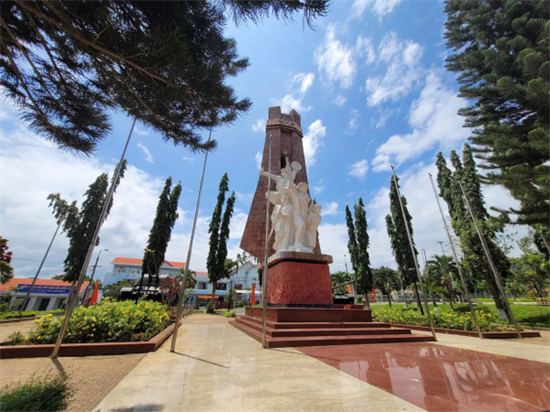 |
| The monument dedicated to the victory of Dak To - Tan Canh (photo: quangngai.gov.vn) |
The victory of the Campaign not only affirmed the maturity of our armed forces on the Central Highlands front but also left behind many distinctive lessons on operational art. This is especially true regarding the art of shaping the battlefield to engage the enemy outside fortifications on mountainous and forested terrain, which is demonstrated as follows.
First, the accurate determination of the Campaign’s operational areas - a crucial foundation for operational plan formulation, force deployment and organisation, and battlefield preparation. Firmly grasping the enemy’s plans and tactics, the Campaign Command identified the primary operational area as South-West Dak To (stretching from Ngok Bo Bieng through Ngok Kom Liet to the south of Hill 875). This decision demonstrated the sharp military thinking and the art of selecting operational terrain by the Campaign Command and its staff. This area featured treacherous terrain with numerous high mountain ranges of both tactical and operational value, most notably Ngok Bo Bieng range (1,262 m high, roughly 7 km from Dak To); “If we capture this high ground, the entire Dak To valley will fall within the control range of our artillery fire”. Furthermore, during this phase, the enemy was still stepping up their “search and destroy” strategy; if we employed our forces reasonably and generated a large enough impact to bait them, the enemy would certainly sally out to counter-attack. Additionally, Hills 782, 823, and 875 held significant tactical value. By organising defensive strongpoints and clusters of strongpoints here, we would gain a combat advantage, forcing the enemy to attack uphill.
Not only that, the terrain in Dak To area featured many fragmented valleys with steep slopes, which limited the enemy’s mechanised counter-attack capabilities. This created conditions for us to concentrate forces and resources to engage their ground and airborne counter-attacks. Moreover, this was an area where we had never conducted large-scale operational activities; therefore, choosing this axis to launch the campaign would create an element of surprise. Reality showed that selecting South-West Dak To as the primary operational area restricted the enemy’s strength and forced them to deploy forces in small clusters across high ground, meaning their advantages in firepower and heliborne transport could not be as effectively utilised as in the midlands and plains. Conversely, our forces were able to maximise their capabilities and preferred fighting methods. In addition to identifying South-West Dak To as the primary operational area, the Campaign Command selected North-East Dak To as the secondary operational area, whilst using Gia Lai and Dak Lak as deceptive, coordinated directions to lure, disperse, and stretch the enemy’s forces across the entire Central Highlands battlefield, creating favourable conditions for the primary axis of advance.
Exactly as anticipated, when we used Battalion 6, Regiment 24, and two 75 mm artillery pieces at Ngok Bo Bieng to shell Dak To 2 airfield to initiate the campaign, the enemy immediately deployed forces from the 1st Brigade, 4th US Division. They conducted air assaults to occupy Hill 882 and Ngok Do Lang for a counter-attack, but suffered heavy casualties. It can be affirmed that correctly determining the operational areas, particularly the primary operational area, enabled us to formulate an effective operational plan, rationally organise, employ, and deploy forces and battlefield installations, and shape a solid and formidable combat posture. Thereby, we were able to hold the initiative from the outset, forcing the enemy to fight according to our plan and enhancing our combat performance.
Second, organising “engagement zones” and employing forces rationally. Grasping characteristics of the enemy’s counter-attack - which typically involved committing small to medium-sized contingents before deploying stronger ones - alongside their helicopter air assault tactics of “wide envelopment” and “deep leapfrogging” into the flanks and rear of our formations, the Campaign Command organised appropriate “engagement zones” to shape a formidable, interlocking, and in-depth combat posture. Within this, the Campaign’s strongpoint zone at Ngok Bo Bieng, Ngok Tang, etc., was manned by Battalion 6, Regiment 24, and one 75 mm artillery company; it had the mission of provoking, threatening, and forcing the enemy to counter-attack, creating opportunities for us to annihilate them outside fortifications. The first engagement zone (the middle zone), situated immediately adjacent to the Campaign’s strongpoint zone at Hills 782, 843, etc., was manned by Regiment 320, with the objective to engage the enemy’s counter-attacks, and manipulate, bait, and force the enemy to commit larger counter-attacking forces deeper into our positions. The second engagement zone (the decisive battle zone) at Ngok Kom Liet, Bai Le, Hill 875, etc., was manned by Regiments 66 and 174; within this, Hill 875 was designated as the anticipated site for the decisive key battle.
The organisation of engagement zones within the primary operational area demonstrated the sharp thinking and the distinctive art of shaping the battlefield by the Campaign Command and its staff. Each engagement zone had a distinct objective but was closely linked, supporting and propelling the campaign to develop according to a unified plan, gradually luring the enemy into a disadvantageous position. When the campaign’s strongpoint zone executed its mission of provoking, threatening, and forcing the enemy to counter-attack, it created conditions for operations in the first engagement zone; the first engagement zone both protected the strongpoints and set the stage for the second engagement zone (the decisive battle zone) to execute the decisive key battle. In reality, as the Campaign unfolded, on the secondary axis, Regiment 24 (minus Battalion 6) in the East and North-East of Dak To directly wore down enemy manpower, threatened Tan Canh, and controlled Route 14; on the deceptive and coordinated axes, the local armed forces of Gia Lai and Dak Lak provinces fought to stretch, lure, and force the enemy to disperse their forces; as a result, when we launched our offensive, the enemy was unable to concentrate a superior force in the primary operational area. By organising engagement zones and employing forces rationally, we successfully shaped an in-depth, robust, interlocking, multi-layered combat posture, with forces to provoke engagements, forces to engage the enemy in the middle zone, forces to fight in the decisive battle zone, and reserve forces. Throughout the combat operations, our forces consistently maintained the initiative and maximised their strengths, ensuring that combat activities proceeded seamlessly and effectively. Conversely, the enemy was passive and caught off guard from the very beginning and throughout the engagement, continuously surrounded, divided, and forced to disperse their troops and firepower, ultimately leading to their defeat.
Third, applying tactical forms flexibly and creatively. In Dak To I Campaign, our operational art was elevated to a new level with the advent of many new tactical forms, most notably the tactics of strongpoint defence and mobile offensive combined with strongpoint defence. Facing an adversary with superiority in mobility and fire support, the Campaign Command directed Battalion 6, Regiment 24 to construct a series of strong fortifications in the Campaign’s strongpoint zone; each hill was organised into a cluster garrisoned by one company, and within the cluster, there were platoon- and squad-level strongpoints. Thanks to the organisation of interlocking and robust strongpoint clusters, when the 1st Brigade, 4th US Division attacked our positions, they suffered heavy losses, which forced them to dispatch the 173rd Airborne Brigade to join the battle.
Furthermore, the Campaign Command developed the tactic of “mobile offensive” into “mobile offensive combined with strongpoint defence”. This tactical form was a combination of combat actions of the force defending strongpoints and the mobile offensive force, in which the strongpoint defence force not merely defended its position, but also pinned down the enemy, shaped the battlefield, and created opportunities for the mobile offensive force to attack effectively. The employment of the “mobile offensive combined with strongpoint defence” tactical form enabled the participating combat units to proactively select the battle space, devise plans, set up formations, and actively draw the enemy into the anticipated operational space, shaping a favourable battlefield and creating prime opportunities for our force to eliminate them. In reality, during the decisive key battle at Hill 875, the adversary deployed two battalions from the 503rd Regiment of the 173rd US Airborne Brigade, along with some ranger and reconnaissance units, to attack from two directions; both were repelled by our defensive strongpoints here, creating the opportunity for Regiment 174 to launch a mobile offensive into the flanks and rear of their formations, annihilating hundreds of American troops and capturing numerous pieces of technical equipment, securing victory for the decisive key battle.
Dak To I Campaign marked an important step forward in operational art for engaging the enemy outside fortifications on mountainous and forested terrain, shifting from the mindset of waiting for the enemy to fall into our array before fighting, to proactively shaping the battlefield and luring the enemy into a pre-prepared battlefield. Those lessons retain their full theoretical and practical value, requiring continuous study, application, and development in a (potential) people’s war to defend the Fatherland.
Sr. Col. LE VAN TUONG, PhD
Deputy Commander of Division 10
Army Corps 34