On improving on-site logistics and technical support during military region defensive operations
Logistics and technical support during military region defensive operations is highly demanding and complex. Therefore, improving on-site logistics and technical support plays a particularly important role, as it directly determines and maintains the combat power of the armed forces within the region. This article discusses a number of solutions to enhance on-site logistics and technical support capabilities and ensure readiness for military region defensive operations in a (potential) war of Fatherland protection.
Military region defensive operations are highly comprehensive, with a combination of combat and other forms of struggle conducted by the military and people within the region from the outset and throughout the duration of the war. In this context, the military region flexibly applies various combat forms and methods and mobilises a large number of forces and equipment. Consequently, the task of operational support, especially logistics and technical support, is extremely demanding. It must simultaneously support multiple forces over a broad area with massive volumes of materiel and urgent requirements, all under conditions of fierce enemy strikes and rapidly unfolding, complex situations.
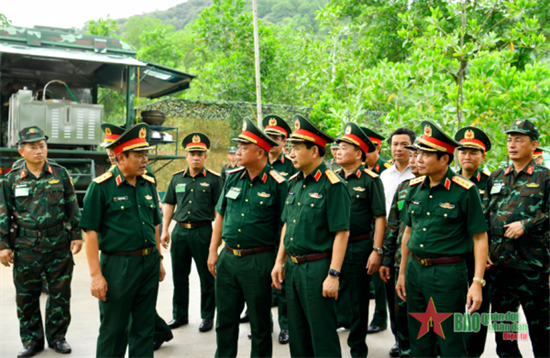 |
| Leaders of the Ministry of National Defence inspect Military Region 3's fortification system during an exercise (photo: qdnd.vn) |
To ensure adequate and timely logistics and technical support for operations, the military region command must apply flexible, creative support methods and measures, closely combining on-site support with mobile support from other areas. Among these, on-site support plays a primary and decisive role. Enhancing on-site logistics and technical support capabilities to form a complete regional support system - with extensive civilian logistics and technical resources as the basis, the logistics and technical capacities of provincial-level defensive zones as the foundation, and the military region’s logistics and technical units as the core - creates an interconnected, solid network capable of providing independent support in each direction and area under all circumstances.
Our past national liberation wars and recent global conflicts have affirmed the key position and role of on-site logistics and technical support, leaving behind valuable lessons that can be further applied, inherited, and developed. In a (potential) war of Fatherland protection, military region defensive operations will be conducted within the country’s overall defensive posture. The logistics - technical posture and resources at all levels, particularly the system of logistics - technical bases of military regions and provincial-level defensive zones, are prepared in advance during peacetime; this constitutes a fundamental advantage in providing logistics and technical support for operations. To improve on-site logistics and technical support for military region defensive operations, this article proposes several fundamental solutions for joint study and discussion as follows.
First, promoting economic development in conjunction with building the logistics and technical potential of defensive zones within the region. This is a crucial solution that determines the capacity to mobilise material resources and ensure readiness to support forces in combat. First and foremost, party committees and commands at all levels must thoroughly comprehend the doctrine of people’s war and theories about all-people, comprehensive logistics and technical support, alongside the lines and policies of the Party, the State, and the Military regarding military region defence and defensive zone building. Military regions must actively build their logistics and technical capacity, while promoting socio-economic development coupled with national defence. Military regions’ logistics and technical branch should proactively advise military region commands on participating in the appraisal of planning for regional and local industrial projects and zones. There must be close coordination with various sectors and fields in investing in and producing goods and services that not only foster socio-economic development but are also ready to be mobilised and converted into logistics and technical materials for operational support. Concurrently, logistics and technical agencies at all levels should proactively advise local party committees and authorities on formulating plans to mobilise local logistics and technical potential for military and defence tasks. This includes strengthening coordination mechanisms and signing partnership programmes between military units and local enterprises and industrial facilities, aiming to maintain the readiness of manpower, equipment, and material resources for national defence. Furthermore, based on the logistics and technical material requirements set by operational plans, military regions’ logistics and technical branch must advise military region commands on formulating material reserve plans tailored to the characteristics of the locale, operational tasks, and the support capacity of each specific area.
Second, building extensive, specialised, standardised, modern logistics and technical forces. This solution is of pivotal significance in mobilising adequate, timely logistics and technical human resources that possess high expertise and a strong sense of discipline, meeting the demands of operational support tasks. For the logistics and technical forces at all levels within a military region, these are the core forces in organising logistics and technical support; hence, they must be built in an “elite, compact, modern” direction. It is essential to build support agencies with a rational organisational structure to ensure high quality, leaning towards modernisation and command automation, to effectively fulfil their functions and tasks of advising, directing, and guiding logistics and technical work. Logistics and technical support units under the command of military regions, localities, and other detachments act as the core forces directly supporting the military region armed forces. Thus, they must be built as robust, standardised, modern units from peacetime, with a rational organisational structure, high professional and operational proficiency, and effective working mechanisms.
Regarding the mobilised reserve forces for logistics and technical support, they must be built, managed, and trained to ensure sufficient quantity, high quality, correct specialisation, and uniformity. Furthermore, they must be closely linked to the local area and territory in order to facilitate management and mobilisation in the event of combat. In particular, provincial-level military agencies must take the lead in giving advice to local party committees and authorities on accelerating the development and quality enhancement of these logistics and technical mobilised reserve forces. They must closely monitor, register, and manage human resources and technical equipment across local economic sectors. Additionally, they should advise local party committees and authorities on developing civilian logistics and technical forces and align this work with socio-economic development to ensure readiness for national defence mobilisation. At the same time, they should give advice on the consolidation, operational efficiency enhancement, and role promotion of defensive zone organisations, especially supply councils of military regions and defensive zones. This is crucial for advising, coordinating, and carrying out the development, mobilisation, and utilisation of on-site civilian logistics and technical resources to ensure comprehensive support for combat operations.
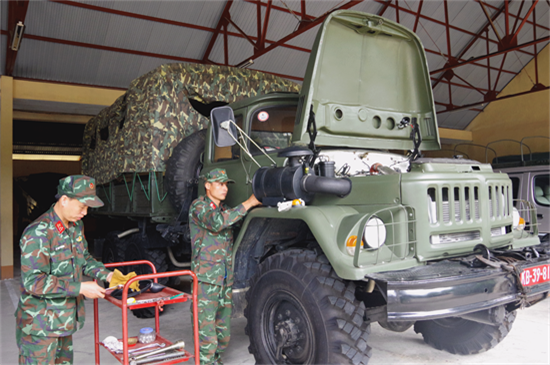 |
| Technical Day at Brigade 543, Military Region 2 |
Third, building an interconnected, solid logistics and technical posture. To that end, it is necessary to continue reviewing, adjusting, and perfecting the planning of an interconnected, solid logistics and technical posture of military regions and provincial-level defensive zones. This must align with administrative boundary adjustments and the requirements of defensive operations in modern warfare. First of all, the planning of the system of logistics and technical bases, sub-bases, depots, stations, and support facilities must be reviewed and adjusted to suit socio-economic development planning and the new operational and strategic deployment posture. Support facilities must be rationally deployed between the rear and the operational areas, with a combination of fixed and mobile installations to ensure the ability to maintain operations even if certain localities or areas are bombarded. Besides, an interconnected, multi-layered, multi-directional logistics and technical support system must be established to provide mutual support across different directions, areas, and forces. Logistics and technical material reserve depots must be organised into a rational network to enable them not only to meet on-site requirements but also possess the mobility to reinforce units due to operational situation changes. At the same time, the logistics and technical posture of the military region main forces must be closely integrated with the local logistics and technical potential within defensive zones. This involves the effective exploitation of local transport networks, production facilities, and reserve depots for national defence tasks when necessary. Closely combining military logistics and technical planning with socio-economic development planning will contribute to creating a solid logistics and technical posture. Furthermore, attention must be paid to consolidating protective works, trench systems, and fortifications for logistics and technical facilities, closely integrating the construction of physical infrastructure with force organisation and protection plans. On the other hand, military regions’ logistics and technical branch must prepare plans for posture transformation. Should an operational situation arise, they must rapidly adjust the organisation and deployment of logistics and technical bases, mobilise and receive forces in accordance with the wartime establishment, and execute mobility plans to transition combat readiness levels and promptly deploy logistics and technical bases to guarantee operational support.
Fourth, emphasising the building of mobile logistics and technical support forces. In conditions of high-intensity modern warfare, weapons and technical equipment are highly susceptible to damage due to continuous operations, environmental impacts, and enemy firepower. Therefore, this solution is of vital importance to rapidly restoring damaged weapons and technical equipment, maintaining the technical coefficient, and ensuring the combat readiness of units. Accordingly, military regions need to increase investment in and upgrade the system of technical repair stations and workshops within defensive zones. This should be directed towards combining uniformed, multi-functional, modern fixed facilities with mobile ones, ensuring the capability to rapidly repair common damage right within the operational area. First and foremost, the system of technical stations and workshops must be planned to ensure commonality from the military region down to the provinces (municipalities) and units. This planning must conform to the characteristics and decentralisation of maintenance and repair for weapons, vehicles, and equipment in combat. At the same time, they must be fully equipped with modern inspection, diagnostic, and repair equipment, and staffed with highly qualified personnel to promptly handle incidents arising during the use of weapons and technical equipment.
Emphasis must be placed on the routine maintenance, technical inspection, and stockpiling of materials and spare parts, in order to minimise major damage that would otherwise require transfer to the rear echelons. It is vital to accelerate the application of modern technologies in the maintenance, repair, and technical support of weapons and equipment, such as technical diagnostic technology, automated testing equipment, simulation technology, and artificial intelligence (AI). This will assist technical forces in quickly detecting damage and devising appropriate repair plans. Furthermore, military regions’ logistical and technical branch must conduct surveys and researches to give advice on mobilising and utilising local garages, mechanical workshops, and manufacturing plants in industrial zones for the maintenance and repair of weapons, vehicles, and technical equipment to support operations. On the other hand, it is necessary to build and consolidate mobile repair teams and squads capable of rapidly reaching combat units to carry out maintenance and repairs directly at the battlefield or at assembly areas for weapons and technical equipment. Mobile technical units must be organised to be compact and lean, equipped with specialised transport vehicles and suitable repair tools to ensure flexible deployment across various terrain conditions. Simultaneously, there must be enhanced training and professional development for logistics and technical cadres and employees.
On-site logistics and technical support is the decisive factor in ensuring that the armed forces maintain their continuous and prolonged combat power in military region defensive operations. In response to many complex developments and the conditions of modern warfare, proactively building a comprehensive, solid, modern on-site logistics and technical support system is an urgent and vital requirement that requires further research and perfection.
Maj. Gen. NGUYEN QUANG DUNG, PhD
Deputy Director of the Military Academy of Logistics