Enhancing the digital competence of lecturers at military schools is an objective, urgent requirement carrying long-term strategic significance, stemming from the demands of education, training, and the building of a modern military in the digital era. This article proposes several solutions to effectively implement this task.
The digital competence of military school lecturers encompasses a combination of knowledge, skills, attitudes, and the ability to apply digital technology creatively, flexibly, and securely, enabling them to effectively carry out the missions in education, training, and scientific research. Resolution No. 71-NQ/TW, dated 22 August 2025, by the Political Bureau regarding breakthrough developments in education and training, clearly identifies that: “Enhancing the standards of digital competence and artificial intelligence for learners and the teaching workforce at all levels”. This is a critical orientation and an urgent requirement for lecturers in general, and those in military schools, in particular.
Enhancing digital competence for lecturers in military schools involves comprehensive activities by various subjects and forces aimed at equipping lecturers with knowledge and skills in information technology and digital technology to effectively utilise digital products and ecosystems for teaching and research; building and developing digital learning resources suitable for modern pedagogical methods and military specifics; understanding and adhering to regulations on information security and military data security; training skills for self-protection of systems against cyber threats and information warfare; knowing how to apply digital technology to resolve emerging issues in teaching practice. Specifically, the digital competence of lecturers is directly reflected in the ability to scientifically and effectively integrate digital technology into the entire teaching process, from designing lessons, carrying out training activities to testing and evaluating learners within the digital environment, etc.
Thoroughly grasping and implementing the guidelines of the Party and State, as well as the direction of the Central Military Commission and the Ministry of National Defence, military schools in recent years have adopted various solutions to gradually enhance digital competence for cadres and lecturers, achieving initial results. However, due to various subjective and objective causes, the implementation process still faces limitations, inadequacies, difficulties, and challenges. Notably, information technology (IT) knowledge among cadres and lecturers is uneven and fails to keep pace with development requirements; IT infrastructure, material facilities, and technical equipment remain unsynchronised; and there is still a sense of self-deprecation, stagnation, and reluctance to innovate in learning, applying, and utilising scientific and technological achievements in professional activities. To address the above limitations and shortcomings, the author discusses several solutions for research and application:
Firstly, enhancing the awareness and responsibility of all subjects and forces regarding the importance of digital transformation and the requirements for digital competence among lecturers in the new context. Digital transformation is a process of profound change in mindset and working methods, which can only succeed when stemming from a strong shift in awareness by each subject. Accordingly, military schools must continue to thoroughly grasp the viewpoints and guidelines of the Party, the Central Military Commission, and the Ministry of National Defence regarding digital transformation, thereby ensuring that cadres and lecturers firmly understand that the essence of digital transformation in education and training is not merely the digitisation of documents, but a fundamental change in the teaching and learning model, taking technology as a foundation to optimise and improve the quality of education and training. It is necessary to clearly recognise the objective inevitability and urgent requirement of enhancing digital competence and building digital citizens and digital soldiers amidst the current rapid development of science and technology; as this is the decisive factor measuring the effectiveness and results of task completion by each individual and collective. Clearly identify the roles and responsibilities of each level, sector, and individual, particularly the pioneering and core role of the teaching staff during this process.
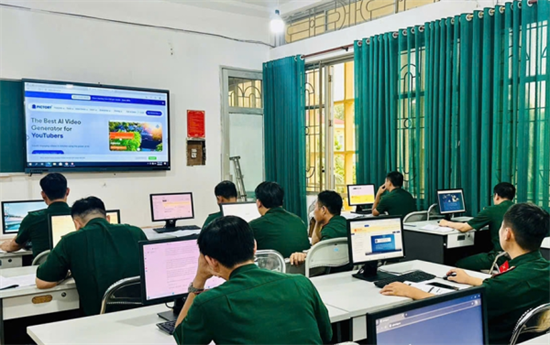 |
| Cadres and lecturers of the Army College No.1 participate in digital transformation training |
Simultaneously, Party committees at all levels must incorporate the leadership contents regarding digital transformation and the enhancement of digital competence into their periodic leadership resolutions, while formulating specific, scientific, and appropriate plans and action programmes. In particular, commanders, political commissars, and political officers at all levels within military schools must be exemplary leaders in learning and applying digital technology in their work while also directly guide, inspect, and push the implementation within their agencies and units to create a widespread development for the “Digital Literacy Campaign” movement, aimed at popularising and enhancing scientific, technological knowledge, and digital skills in the schools. Furthermore, the results of the digital transformation task execution will be linked to the evaluation and classification of the quality of Party organisations and Party members, as well as annual emulation appraisals and rewards, thereby creating motivation to sustainably promote the transformation of awareness.
Secondly, building and deploying a digital competence framework linked to the planning, training, cultivating, and evaluating of lecturers. The digital competence framework serves as the foundation and condition to guide and promote the process of learning, research, and enhancement of digital competence for lecturers. Accordingly, it is necessary to research, design, and construct a comprehensive and specific digital competence framework for military lecturers that is suitable for the reality of Vietnam and the military environment. This framework must be scientifically structured and detailed into specific component competencies. In particular, the content of the framework must integrate and emphasise military-specific elements, such as skills in using military simulation software; information security capabilities within the defence environment; the ability to apply technology in exercises, tactical and operational training, and political mettle when operating in cyberspace, etc.
Building and deploying the digital competence framework requires comprehensive investment in intellectual resources and capabilities, ensuring scientific validity, practicality, openness, and regular updates to align with the specific education and training missions of each academy and school. The digital competence framework must be integrated, become criteria and benchmarks for professional standards, while also serving as a mandatory standard for the appointment of lecturers and education management officials at all levels. This also helps to develop programmes and select content for annual training and upskilling; provides a basis for cadres and lecturers to self-study and self-improve their competence and proficiency, thereby meeting teaching requirements and tasks in the digital era.
Thirdly, modernising information technology infrastructure, alongside the construction of a digital learning resource ecosystem. The digital competence of personnel and modern technology infrastructure are two inseparable sides of a unified entity. No matter how knowledgeable or skilled a lecturer may be, they cannot fully utilise their competencies without the necessary tools and resources. Therefore, investing in infrastructure and digital learning resources constitutes a substantive investment, creating a solid material - technical foundation that provide the lecturer team with the best possible conditions to innovate and be creative in teaching and scientific research, directly determining the pace and quality of the education and training modernisation process within the Military.
To achieve high efficiency in the investments in information technology infrastructure and building a digital learning resource ecosystem, it is necessary to focus on two main pillars: hard infrastructure and the digital content ecosystem. Regarding hard infrastructure, it is necessary to prioritise investment in building modern data centres, and safety assurance work; upgrading internal network systems (LAN); and synchronously investing in smart classrooms, virtual laboratories, and simulation training centres. Regarding the digital content ecosystem, it is necessary to build a comprehensive and long-term strategy. Continue to implement regulations correctly, ensuring the quality and effectiveness of the Plan on “Digital transformation in education and training in Military schools for the 2022-2025 period, towards 2030”. The focus is on creating favourable conditions for lecturers and education management officers to effectively exploit the military data transmission network and the internet; training educators and management officers in digital application skills; and strengthening the development of digital learning materials and electronic lecture databases on the military data transmission network… to serve the work of research, exchange, and utilisation, thereby contributing to enhancing the quality of education, training, and scientific research for cadres, lecturers, and cadets.
Fourthly, perfecting mechanisms and policies, creating motivation and a favourable environment for lecturers to leverage their digital competence. Reality indicates that mechanisms and policies serve to both promote, support, and protect new factors and creative ideas, creating a fair and transparent playing field where dedication and real competence are valued. Concurrently, perfecting mechanisms, policies, and the environment is a key factor to unleash the potential of the lecturer team. Therefore, it is necessary to concretise the application of digital technology and innovation in teaching methods into quantitative criteria in annual assessments and emulation evaluations. A system of rewards, salary increases, and early promotion in rank should be established for lecturers with outstanding achievements in this field. High-quality electronic lectures and simulation software need to be recognised as equivalent to scientific works. Lecturers should be encouraged and facilitated to participate in scientific conferences as well as domestic and international cooperation and exchange programmes. At the same time, regulations on intellectual property rights for digital products created by lecturers must be formulated to protect their interests and encourage creativity. Professional technical support units can be established within the schools (or through collaboration and coordination with other schools and centres possessing deep expertise in digital technology) to train, develop, and support lecturers when they encounter difficulties.
To achieve depth and solidity, the renovation of mechanisms and policies must be carried out resolutely, comprehensively, and with top-down unified direction. Based on the mechanisms and policies of higher levels, academies and schools must be proactive and innovative in concretising them into specific regulations and rules aligned with the characteristics and missions of each school. Regularly hold dialogues and seminars between leadership, commanders, and the lecturer team to listen to their thoughts and aspirations, thereby timely addressing difficulties and obstacles. Concurrently, conduct periodic preliminary, final reviews and draw lessons from policy execution; eliminate outdated and unsuitable regulations and continue to perfect the policy system, thereby creating a truly democratic, innovative, and modern military pedagogical environment.
Enhancing the digital competence of lecturers in the current context is an urgent, fundamental, and long-term issue. Therefore, military schools must research and implement solutions synchronously and effectively to meet the requirements of promoting digital transformation, thereby contributing to enhancing the quality of education and training in the new era.
Colonel, Ph.D. LE VAN CUONG, Lecturer, Department of Party and Political Work, The Political Academy