Issues on combat coordination between mobile and local forces in the key engagement to destroy enemy airborne landing during a counter-offensive Campaign
The key battle to destroy an enemy airborne landing during a counter-offensive Campaign is of vital importance. To secure victory, the Campaign Command must resolve numerous issues on combat preparation and performance; among these, combat coordination between mobile and local forces to generate combined strength is a matter requiring thorough study from both theoretical and practical perspectives.
Airborne landing represents a crucial combat manoeuvre frequently employed by the enemy to encircle, cut off, and capture primary targets, thereby disrupting our tactical posture. In a counter-offensive Campaign, engaging enemy airborne landings is identified as one of the critical engagements of great significance for seizing and maintaining the initiative on the battlefield, creating a turning point to turn the table, and determining the Campaign’s outcome. The scale of the enemy’s airborne forces is determined based on the scale of the counter-offensive campaign and the specific opposing force. In a medium-scale counter-offensive campaign, the enemy’s airborne forces typically comprise roughly an infantry brigade belonging to a mechanised infantry division conducting ground assaults, or airborne landing is carried out by the enemy’s operational-level airborne forces.
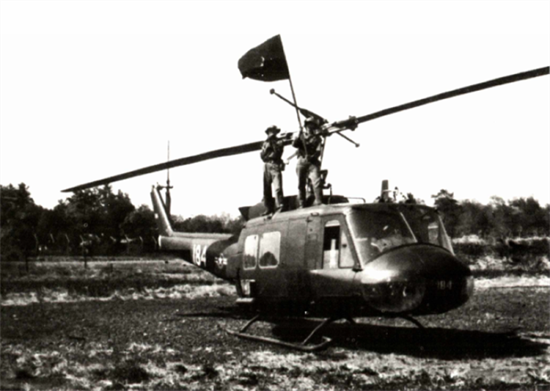 |
| Our soldiers occupy Hoa Binh airfield in Buon Ma Thuot town in March 1975 (file photo) |
The decisive engagement to destroy an enemy airborne landing during a counter-offensive Campaign may be conducted as a single major engagement or multiple engagements fought simultaneously or sequentially. Based on an analysis of the enemy’s airborne combat intentions and manoeuvres, alongside the capabilities of our campaign personnel, weaponry, and topographical and weather conditions, the sequential attack method is likely to be more commonly applied. This engagement typically takes place after the enemy’s ground assault forces have been intercepted, worn down, and halted by our forces; subsequently, the enemy concentrates all efforts on organising an airborne landing to capture advantageous terrain and establish a springboard to attack our vital targets.
Facing an enemy with superiority in weaponry, overwhelming firepower, modern reconnaissance, extensive electronic and cyber warfare capability, high mobility, and flexible adaptation, combat will be exceedingly fierce, rapidly changing, highly complex, and unpredictable. Therefore, to win this key engagement, in addition to capitalising on the results of the preparatory phase, the Campaign Command must harness the combined strength of all forces, flexibly and creatively employ combat methods and tactical manoeuvres, and organise combined arms operations. Within this, particular emphasis must be placed on close combat coordination between mobile and local forces. This aims to transform the tactical posture, build up a solid battle array and strong momentum, and seize the opportunity to promptly attack and destroy the enemy’s primary airborne forces. This coordination encompasses a comprehensive range of components and solutions executed in accordance with a unified synchronisation plan by the Campaign Command.
First, coordination in shaping the tactical posture, conducting deception operations, manoeuvring forces, and deploying attack formations. This is a crucial task during the phase of carrying out the assault on enemy airborne forces, aimed at transforming and completing the tactical posture prior to the assault. Under severe time constraints, with the units under the Campaign Command having to simultaneously counter the enemy both in the air and on the ground, the mobile force must coordinate with and rely upon the local force to conduct posture shaping and deception operations. This allows seamless, effective, and covert force manoeuvres and deployments.
Based on combat objectives for the key engagement, alongside the orders from the Campaign Commander and headquarters, the two forces coordinate to conduct posture shaping and deception operations such as: feigning and tricking the enemy to land troops in our designated areas, encircling, pinning down and dividing the enemy formation following their landing. Accordingly, units participating in the key engagement capitalise on the results of the deception and shaping efforts, as well as the local armed forces in the area. By coordinating directly or via a synchronised plan, they actively execute posture shaping, deception, and luring operations, compelling the enemy to land and deploy their formations within the area where our counter-offensive plan has been prepared. While the enemy is landing, or has just completed their drop, their formations remain unstable and vulnerable. At this moment, a detachment of our mobile force will coordinate with the local force to continue intercepting, inflicting casualties on, encircling, and pinning them down. This prevents the enemy from expanding their landing zones, consolidating and stabilising their formations, linking their fortifications and firepower with obstacles.
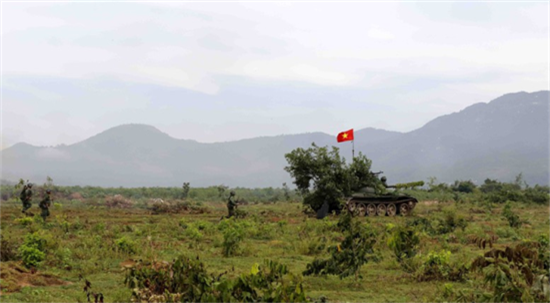 |
| Troops and tanks of Military Region 5 during an exercise (photo: baochinhphu.vn) |
Firmly grasping the opportunity, the mobile force coordinate with the local force to fight the key engagement, combining sequential and simultaneous manoeuvres to deploy into attack formations in accordance with the tactical intent and stipulated timeframe. The forces leverage the combat results of the shaping operations, terrain, and topographical features to maintain operational security; they increase their speed of movement when crossing open terrain and bypass areas heavily bombarded by the enemy. They maximise the effectiveness of local pathfinder teams in the area to enable the mobile force to take the correct routes and directions, maintain speed and spacing, and avoid casualties from enemy firepower, while promptly handling any emerging situations. Upon reaching positions in close proximity to the enemy, the forces covertly deploy their formations within their designated sectors under the established plans and schemes. This forms a posture of encirclement and division, establishing superiority over the enemy right from the outset.
Coordination in carrying out the assault to capture objectives is decisive to the victory of the key engagement as this is the phase where the mobile force engages in direct combat coordination with the local force to generate superior combat power over the enemy, rapidly capturing objective clusters and completing the mission. Grounded on the deployed tactical posture, the two forces maintain coordination to conduct a series of successive engagements, organise an assault on the initial objective cluster, and encircle the subsequent objective cluster.
Attacking the initial objective cluster and encircling the subsequent objective cluster: Upon the conclusion of the brief preparatory fire, maintaining a firm grasp of the enemy situation and the effectiveness of the operational fire support, the local force in the area encircle, divide, and pin down the landed enemy troops. They hold their footholds firmly, creating favourable conditions for the forces engaged in the key engagement to assault and destroy the objective. Capitalising on this posture, the mobile force coordinates closely with the local force to organise an assault to destroy the initial objective cluster. The forces flexibly employ combat manoeuvres, encircling, dividing, conducting deep thrusts, interlocking deployment, establishing blocking positions; they continuously wear down and destroy the enemy, preventing them from regrouping, retreating, or establishing defensive lines. Maximising the effectiveness of operational artillery, air defence, and air force support, the mobile force tasked with encircling the subsequent objective cluster coordinate closely with the tank and local forces to enforce a tight encirclement, pin the enemy down, sever their links, and disrupt any support to the enemy force currently under our attack. The firepower of the mobile force and the Campaign Command suppresses the command posts and fire positions of the enemy infantry battalion at the subsequent objective cluster, limiting their ability to provide fire support to the initial objective cluster. Following the destruction of the initial objective cluster, both forces must firmly grasp their missions, synchronise actions, ensure reinforcements and resupply, and transform their tactical posture to press the attack on the subsequent objective cluster.
Attacking the subsequent objective cluster: After our attack on the initial objective cluster, the remaining enemy forces incapable of further resistance will typically retreat towards objective clusters not yet under our attack. At this juncture, the enemy will employ their air force, missiles, and artillery to blanket-bomb the lost area and objectives, suppressing our fire support positions; meanwhile, enemy armed helicopters will provide covering fire to intercept our formations pursuing the retreating enemy troops. The enemy forces at the subsequent objective cluster will consolidate their formations and mount a fierce resistance; they may call for heavy fire support from higher echelons and request rear forces to manoeuvre forward for relief and extraction. Seizing the opportunity, the mobile and local forces across all attack directions and axes must rapidly replenish their ranks, readjust their formations, transform their tactical posture, and deploy in close proximity to the enemy. They will participate in the brief preparatory fire alongside the Campaign’s general support artillery. Upon receiving the order to assault, the forces will coordinate closely with tank and artillery forces to conduct the assault and destroy the objective cluster within their assigned mission scope, while effectively handling any emerging situations.
Coordination in concluding the battle. This is the final phase of executing the key engagement to destroy the enemy airborne landing during a counter-offensive campaign. The more complex the combat developments are, the more difficult the issue of combat coordination between the mobile and local forces to conclude this key engagement becomes. Based on the practical situation on the battlefield, the engagement may conclude under favourable or difficult conditions.
Favourable scenario: The key engagement achieves its intended purpose and assigned missions; the enemy airborne forces have been destroyed or fundamentally destroyed, and the remaining enemy troops may exploit the terrain and weather conditions to retreat. Upon receiving the order to conclude the engagement from the Campaign Commander, the two forces maintain coordination to conduct psychological operations calling for enemy’s surrender, or to destroy enemy troops mounting a stubborn resistance, and pursue retreating enemy troops within their designated sectors and effective firing ranges. The forces focus on grasping the troops’ morale and implementing policies regarding wounded soldiers, fallen soldiers, prisoners of war (POWs), and surrendered enemy troops. The mobile force either remains to garrison the objective or hand it over to the local force to defend; capitalising on the opportunity and the results of the Campaign Command’s fire support, they then manoeuvre back to their post-combat deployment areas, standing ready to receive subsequent missions.
Unfavourable scenario: When the mission to attack the enemy airborne landing is fundamentally complete but our forces and equipment have suffered significant losses, resulting in diminished offensive capabilities. The remaining enemy forces organise defensive lines, employing firepower to mount a fierce resistance and block our attack directions and axes. Simultaneously, to support the previously landed forces currently under encirclement, the enemy may continue to drop troops on a large scale, exerting direct pressure and compelling the Campaign Command to disperse its efforts in response. Maintaining a firm grasp of the situation, the mobile force coordinates with the local force to continue engaging the enemy, remaining ready to coordinate with the engagement’s reserve forces or the Campaign’s reserve forces to destroy enemy troop clusters and pursue retreating enemies. Grounded on the enemy and friendly situations, as well as the terrain, the forces transition into appropriate tactical forms to destroy the remaining enemy troops or newly landed reinforcements. Subsequently, they rapidly manoeuvre back to post-combat deployment areas to consolidate personnel and stand ready to receive subsequent missions.
In a (potential) war to defend the Fatherland, enemy airborne operations will evolve towards the utilisation of high-tech, modern weapons and equipment; thus, the key engagement to destroy an enemy airborne landing during a counter-offensive Campaign will take place under increasingly difficult and complex conditions. To achieve victory in combat, it is necessary to comprehensively study all related issues, including combat coordination between mobile and local forces, in order to perfect the theoretical framework under new combat conditions.
Col. NGUYEN TRUNG HIEN, MA
PhD Candidate - Army Academy