On the protection of logistical and technical support in defensive campaigns during wars of national defence
The protection of logistical and technical support, and the preservation of supplying capacity, are of vital, indeed decisive, significance to the combat effectiveness of forces and to the overall outcome of operations in general, and defensive campaigns, in particular. In the context of defensive campaigns conducted in wars of national defence, this task is exceptionally onerous, complex, and demanding; it therefore warrants thorough and sustained research attention.
The protection of logistical and technical support in defensive campaigns (hereinafter referred to as logistical-technical protection) constitutes the aggregate of measures and organised activities undertaken by forces to ensure the safety and sustained integrity of personnel, materiel, infrastructure, technical assets, lines of communication, and command organs of upon logistical and technical support throughout both the preparatory and execution phases of a campaign.
A war of national defence (should it occur) would assume the character of a modern conflict, unfolding under conditions in which the adversary employs extensively high-technology weaponry, conducts multi-domain operations, and sustains a rapid tempo and high intensity of combat. Defensive campaigns may be initiated from the outset or emerge in the course of operations; in either case, they are conducted within a people’s war posture developed to an advanced level. This constitutes a salient characteristic that both creates certain advantages and imposes a range of new, complex demands upon logistical and technical support in general, and upon their protection in particular.
In comparison with defensive campaigns in earlier wars of national liberation, a fundamental difference lies in the fact that there now exist conditions for prior preparation in peacetime regarding plans, forces, and dispositions for logistical-technical protection. Nevertheless, in the context of modern warfare, the adversary enjoys pronounced superiority in multi-layered, multi-platform reconnaissance, electronic warfare, and precision-guided munitions, especially unmanned aerial systems; alongside a capacity for high mobility, flexible transition of operations, and sustained, continuous strikes of high intensity over extended periods. Under such conditions, logistical and technical assets invariably become priority targets for concentrated enemy reconnaissance, detection, and attack. This is particularly so given that defensive campaigns are conducted within a defined geographical area over prolonged durations, with forces required to hold their positions; consequently, sustainment demands are substantial, especially in respect of transportation and the replenishment of materiel, weapons, and technical equipment - factors that inherently carry the risk of exposure, target acquisition, and difficulties in maintaining operational secrecy.
As critical and sensitive objectives with limited self-protection capability, logistical and technical protection in defensive campaigns must be in accordance with the guiding principle: “proactively avoid and resolutely engage the enemy in order to protect logistical and technical support” in the implementation of measures. The avoidance is to be regarded as the primary approach, while engagement of the enemy remains essential. On that basis, it is necessary, in our view, to concentrate on several principal areas as follows:
First, to take the initiative in establishing a robust, integrated, and in-depth logistical-technical posture. The practical experience of our national liberation wars, as well as recent military conflicts, demonstrates that when logistical and technical systems are organised in a concealed manner, rationally dispersed, and make full use of terrain and physical features, while being arranged in layered defensive configurations, the effectiveness of reconnaissance and strikes employing high-technology weaponry is markedly diminished. It is therefore imperative, capitalising on the advantage of peacetime preparation, to proactively construct a solid, interlinked logistical-technical posture, including the development of main and subsidiary bases, along with fortified systems of depots and stations, thereby creating a firm foundation for both the protection and sustainment of logistical and technical support in combat operations.
First and foremost, it is necessary to adhere closely to the campaign’s operational intent and plans to organise reconnaissance and conduct thorough studies of terrain, topography, climatic, and hydrological conditions. On that basis, appropriate areas must be selected for the disposition of logistical-technical bases and sub-bases; systems of depots, stations, workshops, stockpiling areas for materiel, weapons, and technical equipment; as well as transportation networks, and so forth. These dispositions must fully exploit and, where necessary, adapt favourable terrain features - particularly caves and durable underground structures - while ensuring rational dispersion. Close integration must be maintained between fixed bases and field, mobile, and reserve elements; and between spatial dispersion and centralised command and control, to enhance survivability against precision-guided fire strikes by the enemy and to ensure the continuity of support throughout the campaign.
Concurrently, it is essential to progressively build and reinforce key logistical and technical infrastructure within bases and sub-bases in alignment with the broader defensive posture of the operational area. During construction, due emphasis should be placed on the close integration of defence and economic development, enhancing the dual-use character of transport infrastructure, storage facilities, ports, and depots. Such works must not only serve socio-economic development and civil defence but also be readily adaptable to meet the requirements for the deployment and sustainment of logistical and technical support in defensive campaigns. Due attention must be given to camouflage, deception measures, the creation of decoy targets, and the reduction of electromagnetic signatures; combined with the establishment of multi-layered, multi-directional defensive configurations, closely linking the protection of logistical and technical bases with the overall operational posture of the campaign and the defensive area.
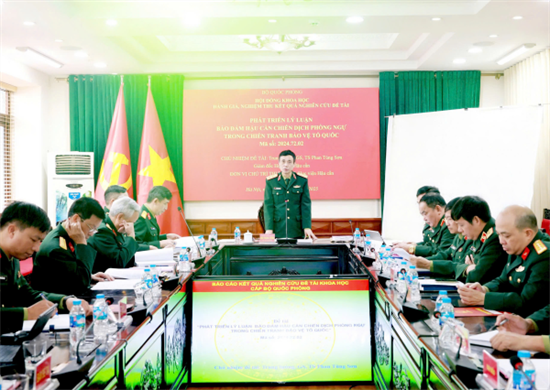 |
| The conference on approving a scientific project on logistics support in the national defence war |
Second, to develop plans and contingencies for the protection of sustainment activities and lines of communication, thereby ensuring the continuity of support under all conditions. On the basis of a comprehensive assessment of the factors and adversarial elements affecting logistical and technical support, as well as the intended concept of sustainment, it is necessary to proactively formulate plans and measures for the protection of bases, sub-bases, and logistical-technical facilities of the campaign; transportation networks; and sustainment activities, particularly overland movement. In so doing, it is essential to clearly define primary lines of communication, reserve and alternate routes, bypasses and contingency axes; key nodes and critical transport hubs; priority protection objectives; and plans for rerouting or diversion in the event of enemy interdiction or attack.
In establishing the transportation routes, an approach of “inheritance, expansion, and flexibility” should be adopted, maximising the utilisation of infrastructure, facilities, and transport networks prepared in peacetime. Close integration must be ensured between strategic, operational, and tactical lines of communication, as well as among road, inland waterway, and coastal maritime routes, alongside other appropriate modes of transport. Active exploitation of reserve routes, bypasses, and concealed lines within defensive areas is required to minimise dependence on a single axis of movement. At the same time, camouflage, concealment, deception measures, and the construction of dummy routes and decoy targets must be systematically organised in conjunction with pre-prepared infrastructure and defensive positions, thereby reducing the effectiveness of enemy reconnaissance and strikes.
Based on the designated lines of communication, appropriate protective forces must be proposed and organised, ensuring close coordination between the self-protection capabilities of logistical-technical forces and combat units, forces within the defensive area, and other elements (including low-altitude air defence, counter-unmanned aerial systems, and militia and self-defence forces). This will create a multi-layered, multi-tiered protective posture along lines of communication and at key nodal points. Consideration must also be given to the timely employment of mobile forces and logistical-technical reserves in contingencies involving enemy raids, sabotage, or interdiction of transport routes. Concurrently, full use should be made of sustainment, repair, and reserve systems prepared in peacetime, with the organisation of forces and means capable of rapidly remedying damage along lines of communication. Dispersed reserves and mobile stockpiles should be arranged in association with bases, depots, and transshipment points within the defensive area, thereby shortening transport distances, alleviating pressure on primary routes, and ensuring continuous, robust logistical and technical support in all aspects throughout the defensive campaign.
Third, to accelerate the application of science and technology to enhance the effectiveness of logistical-technical protection. The central focus should be on harnessing the achievements of national digital transformation, telecommunications infrastructure, information technology, and the defence and security industry to progressively modernise the management, command, and control of logistical-technical protection. Priority should be given to the development of digitalised database systems capable of providing real-time awareness of the quantity, quality, status, and location of depots, stations, lines of communication, and protective forces, thereby enabling the timely adjustment of plans for dispersion, rerouting, and manoeuvre in the event of enemy strikes. At the same time, greater application of technological solutions for camouflage, concealment, and deception is required, alongside the deployment of countermeasures against electro-optical reconnaissance, unmanned aerial systems, and electronic warfare at key logistical and technical sites.
Concurrently, dedicated reconnaissance, surveillance, and early-warning systems should be deployed specifically to support the protection of logistical-technical assets. The employment of unmanned aerial vehicles, ground-based sensors, and optical-infrared observation systems will facilitate the early detection of enemy reconnaissance activities, aerial strikes, and acts of sabotage targeting lines of communication and logistical-technical facilities. Proactive measures must also be taken to safeguard information security and to maintain the uninterrupted functioning of logistical-technical command systems under conditions of electronic suppression and cyber-attack. Particular attention should be devoted to the application of technology in support of mobile repair, rapid inspection, and damage diagnostics, thereby shortening recovery times for depots, stations, and transport routes subjected to attack, and ensuring continuous sustainment throughout the campaign. Implementation must combine modern equipment and advanced technologies with traditional and improvised measures, thereby creating a resilient and adaptable protective capability.
Fourth, to organise training and exercises in logistical-technical protection at all levels in a rigorous manner, closely aligned with the realities of modern warfare. Based on established protection plans and contingencies, training and exercises should be conducted regularly across all echelons, tailored to specific forces and defensive areas, with particular emphasis on complex, fast-evolving, and unpredictable scenarios characteristic of contemporary conflict. The primary focus should be on testing and refining command and control capabilities, inter-force coordination, and the handling of situations relating to logistical-technical protection under conditions of high-intensity defensive operations. Training and exercise content should centre on scenarios involving long-range enemy fire strikes, aerial attacks, the employment of reconnaissance and strike UAVs, electronic warfare, and cyber-attacks, combined with acts of sabotage targeting rear areas, bases, depots, stations, lines of communication, and sustainment activities. Particular attention must be paid to enhancing the decision-making and response capabilities of commanders and logistical-technical agencies at all levels, especially under conditions of disrupted communications, dispersed forces, and suppressed command systems. At the same time, due importance should be attached to rehearsing contingency plans for consequence management and the rapid restoration of sustainment capabilities following each engagement or phase of the campaign, including recovery and repair of equipment, reinforcement of shelters, depots, and stations, restoration of transport routes, redeployment of dispositions, and the improvement of coordination between logistical-technical forces and other relevant elements. Through such activities, shortcomings and deficiencies in plans, contingencies, and organisational arrangements can be promptly identified and addressed, ensuring their adjustment, supplementation, and refinement for flexible and effective application in all situations.
The protection of logistical and technical support in defensive campaigns constitutes a matter of considerable theoretical and practical significance. It is a field characterised by rapid evolution, directly influenced by advances in science and technology as well as developments in the art of warfare, and thus requires continued research, synthesis of experience, and timely refinement in line with the evolving requirements of logistical and technical sustainment in future wars of national defence (should they occur).
Senior Colonel, Dr. DANG DINH TOAN, Military Technical Academy