On strengthening the Party’s leadership over the implementation of the national defence and military strategies in the new era
The National Defence Strategy of Vietnam and the Military Strategy of Vietnam are documents of special importance, representing the concretisation of the Strategy for Fatherland Protection in the New Situation, reflecting the strategic thinking and vision of our Party and State regarding the cause of defence consolidation and Fatherland protection. Successfully implementing these strategies in the new era is the responsibility of all sectors, the entire political system, and the entire people, in which the Party’s leadership plays the decisive role.
Based on accurate assessments of the domestic, regional, and global situations, as well as the major trends of the times, the Party has issued various resolutions, conclusions, and directives in recent years to lead and direct the cause of defence consolidation and Fatherland protection, particularly the Resolution of the 8th Plenum of the Party Central Committee (9th tenure, 11th tenure, and 13th tenure) on the Strategy for Fatherland Protection in the New Situation.
To concretise this overarching strategy, the Party Central Committee has developed the National Defence Strategy of Vietnam and the Military Strategy of Vietnam (hereafter referred to as the two strategies). The promulgation of the two strategies reaffirms the consistent principle of the Party’s absolute, direct, all-round leadership over the armed forces and the cause of defence consolidation and Fatherland protection, ensuring uniformity between the goals of Fatherland protection and national construction and development, marking a new development in the Party’s strategic thinking.
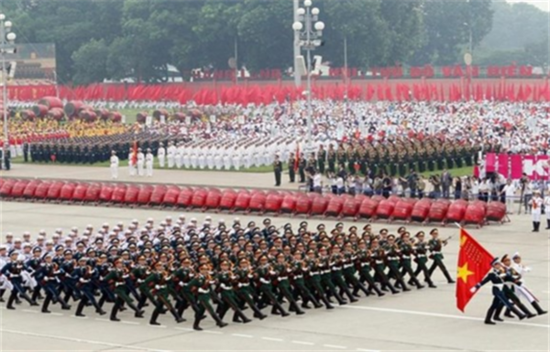 |
| Illustrative photo (VNA) |
Following the issuance of the two strategies, the Party Central Committee has directed all sectors and forces to thoroughly grasp and institutionalise them into legal documents for synchronised implementation nationwide. Ministries, sectors, and local authorities have developed scientific action programs and plans suited to their specific tasks and conditions. In the process, the leadership and direction of all-level party committees and party organisations have been enhanced. Thinking on national defence, partners and adversaries, and Fatherland protection has seen new developments. Political and social stability has been maintained; the economy has sustained high growth; foreign relations have expanded; the people’s living standards have improved; resources have been mobilised for defence tasks.
In particular, the Central Military Commission (CMC) and the Ministry of National Defence (MND) have proactively advised the Party and State on formulating military and defence policies and lines in accordance with the requirements of Fatherland protection in the new situation, building and strengthening all-people national defence and the posture of all-people national defence in association with the postures of people’s security and “people’s hearts and minds” as well as military region defence and defensive zones. Emphasis has been placed on adjusting the organisational structure to build an “adept, compact, strong” Vietnam People’s Army (VPA) with increasingly high quality and a high level of combat readiness for firmly protecting the Fatherland in all situations.
However, during the implementation of the two strategies, certain shortcomings have emerged. The awareness among a number of cadres, party members, and citizens regarding Fatherland protection has not been sufficient or profound. The leadership capacity and combativeness of some party organisations as well as their inspection and supervision of military and defence tasks have yet to be high or effective. In several ministries and sectors, the institutionalisation, policy-making, and leadership mechanisms for executing the two strategies have remained slow and incomplete in certain aspects. Situational assessment and forecasting have at times not been timely or consistent. The combination of socio-economic development and defence consolidation in certain sectors and localities has not been close or effective.
Currently, our country is entering a new era of development characterised by interwoven opportunities, advantages, difficulties, and challenges. The requirements for defence consolidation and Fatherland protection are becoming increasingly demanding. In order to maintain a peaceful, stable environment for rapid, sustainable development, it is imperative to further strengthen the Party’s leadership over the implementation of the two strategies. Within this article, several major measures will be put forward as follows.
First, intensifying dissemination and education to raise awareness and a sense of responsibility among sectors, forces, the political system, and the people in carrying out the two strategies. In response to the complex developments of traditional and non-traditional security challenges and hostile forces’ intensified sabotage efforts, maintaining and strengthening the Party’s leadership over the tasks of defence consolidation and Fatherland protection and the implementation of the military and national defence strategies are of vital importance. Party committees and party organisations at all levels should therefore step up dissemination and education so that cadres, party members, the armed forces, and the people clearly recognise the decisive role of the Party’s leadership in the implementation of the two strategies. The content of dissemination and education should be broad and comprehensive, yet centred on clarifying the Party’s leadership role over the revolutionary cause, the task of Fatherland protection, and the cause of national construction and development, popularising resolutions, directives, and guiding documents on the implementation of the two strategies, the people’s war line, and the policy on building strong, modern all-people national defence and a robust all-people national defence posture associated with the posture of people’s security.
Forms of dissemination should be diversified via mass media, press publications, and social networks; specialised pages and columns on national defence and security should be maintained; seminars, forums, and exchanges should be organised to discuss issues on defence consolidation and Fatherland protection. At the same time, defence and security education should be effectively conducted for all target groups, thereby contributing to building a firm “posture of people’s hearts and minds”. Due regard should be paid to promoting the combined strength of the political system and people from all walks of life in performing military and defence tasks and firmly protecting the Fatherland right at grass-roots level.
Second, accelerating Party building and rectification, enhancing the effectiveness and efficiency of party organisations’ leadership over the cause of defence consolidation and Fatherland protection, particularly within the people’s armed forces and the VPA as the solid foundation for the successful implementation of the two strategies. To that end, party committees and party organisations from central to grass-roots levels should continue to thoroughly grasp and effectively execute the Resolution of the 4th Plenum of the 13th Party Central Committee on intensifying Party building and rectification, and Regulation 37-QD/TW, dated 25 October 2021, by the 13th Party Central Committee on the things that party members are not allowed to do. It is vital to resolutely prevent and strictly handle signs of degradation in political ideology, ethics, and lifestyle, as well as manifestations of “self-evolution” and “self-transformation” among cadres and party members. The study and following of Ho Chi Minh’s thought, ethics, and lifestyle should be promoted. Efforts should be intensified to build truly “pure, strong, exemplary” party organisations within the armed forces with comprehensive leadership capacity and high combativeness. The Military Party Organisation must lead and direct the entire VPA to fulfil its core role in executing the two strategies and firmly protecting the Fatherland in the new era.
Emphasis should be placed on renewing leadership style and working methods, promoting collective knowledge, and upholding individual responsibility. It is essential to enhance the capacity to concretise and implement the two strategies in line with the functions and tasks of each level. Due attention should be paid to building a contingent of cadres, particularly key leaders and strategic-level cadres, with political steadfastness, pure morality, comprehensive knowledge, strategic vision, and great capacity to effectively implement the two strategies.
Third, continuing to renew methods of leadership and direction over the implementation of the two strategies. To that end, party committees and party organisations at all levels should keep thoroughly grasping and realising Resolution 28-NQ/TW, dated 17 November 2022, by the 13th Party Central Committee on continuing to renew the Party’s leadership and ruling methods over the political system in the new period. The content of the two strategies should be concretised and institutionalised into specific action plans and programs, while the system of military and defence policies and laws should be improved. There should be a clear road map for the process of institutionalisation and concretisation in accordance with the functions, tasks, and realities of each ministry, sector, locality, and force; uniformity and synchronisation between the two strategies, between central and local levels, and between the tasks of socio-economic development, defence - security consolidation, and foreign affairs should be guaranteed. In addition, administrative reform, the application of science and technology, and digital transformation should be stepped up. There should be a reform in the working methods and styles of agencies from central to grass-roots levels as well as from the CMC down to party committees and party cells within the Military Party Organisation. Inspection, supervision, preliminary and final reviews, and the development of military and defence theories should be conducted regularly, continuously, in order to clarify emerging and complex.
Furthermore, the scope of responsibility and mechanisms of leadership and management of each level and sector should be clearly defined. The results of implementing the two strategies should be linked to the annual review, assessment, and classification of party organisations, cadres, and party members. For the armed forces, particularly the VPA, it is necessary to clarify the responsibilities of party committees and commands at strategic level in management, direction, staff work, and implementation of the two strategies.
Fourth, correctly understanding and strictly implementing the mechanism of leadership and management over the execution of the two strategies. As our country is entering a new era of development with increasingly demanding requirements for defending the Fatherland, it is essential to properly understand and strictly enforce the mechanism of leadership and management for the effective execution of the two strategies. Accordingly, such a mechanism must strictly adhere to the principles of the Party’s absolute, direct leadership in all aspects, the State’s centralised, unified management, and the VPA’s role as the core, specialised force in the process of implementation. This procedure must operate within a unified, synchronised mechanism, with Party leadership as the foundation and the “posture of people’s hearts and minds” as the root. The Party defines its lines for military and defence tasks (developing national defence and military strategies) and its leadership mechanism through party organisations and party members. The State institutionalises the Party’s lines into a system of policies and laws, while comprehensively managing the cause of national defence and security. The VPA serves as the core force in implementing the two strategies.
Furthermore, the CMC and MND should play the leading role in cooperating with ministries, sectors, and relevant agencies in advising the Politburo and the Party Central Committee on directing the nationwide implementation of the two strategies. In the process, strict adherence to the Constitution, laws, and strategic orientations for Fatherland protection in the new era should be ensured. Unity in policy formulation and implementation should be maintained, while the effectiveness and efficiency of the Party’s leadership over military and defence tasks and the cause of safeguarding the Fatherland should be maintained and enhanced.
In the new era characterised by interwoven opportunities and challenges for defence consolidation and Fatherland protection, strengthening the Party’s leadership over the implementation of the two strategies is an urgent requirement and a decisive factor in firmly protecting the Socialist Vietnamese Fatherland.
Sr. Col. LE VAN HUONG
Vietnam Institute for National Defence Strategy and History