Military transportation work and emerging issues in a war to defend the Fatherland
Military transportation constitutes the central component of logistical and technical support, enabling the manoeuvre of forces and the transport and supply of food, weapons, and equipment to combat units in order to secure victory, while linking the rear with the battlefields. A war to defend the Fatherland (should it occur) would be a modern war; therefore, military transportation would assume a pivotal role and requires thorough study to ensure the most effective implementation.
Throughout the thousands of years of nation-building and defence, the Vietnam has experienced numerous wars against foreign invaders. In those wars, the timely transport of provisions and the manoeuvre of forces significantly contributed to generating overall strength and achieving resounding victories. As early as the feudal period, dynasties from the Ly, Tran, and Le to the Nguyen established transport networks to serve both the military and state administration. “Postal relay stations and road stations” were set up along strategic routes to ensure the timely supply of military provisions and weapons, thereby facilitating the rapid manoeuvre of forces and maintaining operational initiative.
During the resistance war against French colonialism, under the motto that “ensuring transportation was the central and urgent task”, military transportation work was widely and effectively implemented. People in base areas, together with members of guerrilla and self-defence units, simultaneously became the first transport soldiers, employing a wide variety of means, such as rudimentary carts, bamboo boats, and shoulder poles, to transport food, weapons, ammunition, and medicines for revolutionary armed forces in combat and force development. Particularly during the Battle of Dien Bien Phu, military transportation witnessed remarkable development, successfully addressing numerous issues—from the division of transport routes to organisation, command, management, and support, as well as the combination of motorised and rudimentary transport. Thousands of tonnes of weapons, ammunition, food, fuel, and equipment were transported from the rear to the battlefield, making an important contribution to the victory that was “resounding across the five continents and shaking the globe”.
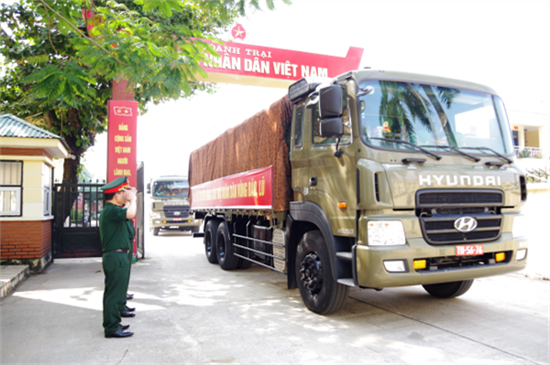 |
| Brigade 971 conducts disaster relief in 2025 |
During the resistance war against the United States, military transportation was not merely a logistical activity but also a genuine combat front. Transport units not only carried out transportation tasks but also directly fought to protect routes, counter enemy aircraft, clear bombs, repair bridges, and open roads. Most notably, the strategic transportation route of Truong Son – the Ho Chi Minh Trail was not only a military transportation and strategic logistical route but also a comprehensive battlefield. Unit 559 and other forces organised hundreds of logistical stations, transporting weapons, fuel, and food to the South day and night. Along the maritime route known as the Ho Chi Minh Sea Trail, the so-called “No-number ships” secretly delivered thousands of tonnes of weapons and medical supplies to distant battlefields, making a decisive contribution to the complete liberation of the South and the reunification of the country.
During the period of national construction and development, the military transportation sector and military transportation work have received sustained attention in terms of organisation and development in all aspects. They have continued to affirm their essential role as the central component of logistical and technical support, ensuring that the entire Army successfully fulfils routine and extraordinary tasks, particularly training, combat readiness, the protection of border and maritime sovereignty, participation in production and economic development, and national construction.
A war to defend the Fatherland (should it occur) would be a modern war, in which the adversary may possess superiority in firepower, employ high-tech weapons, advanced reconnaissance systems, and strong electronic warfare capabilities. Transport infrastructure, including roads, bridges, airports, seaports, logistics and technical depots and stations, and transportation activities, would be among the primary targets for enemy attacks and interdiction. This reality poses numerous new, complex, and difficult challenges for military transportation work. To successfully accomplish transportation tasks in a war to defend the Fatherland, it is necessary, even in peacetime, to synchronously implement solutions relating to force building, the establishment of transportation postures, and the development of the art of military transportation, etc. Within the scope of this article, several principal solutions are proposed for further study and discussion.
First, focusing on building strong military transportation forces capable of meeting the requirements of modern warfare. Transportation forces constitute the backbone and pillar of military transportation work. Therefore, their development must be carried out proactively from peacetime, ensuring comprehensive strength in politics, ideology, organisation, professional competence, technical capability, and adaptability to the environment of modern warfare. In this process, close coordination must be maintained between building the core military transportation forces with high levels of expertise and capability, and developing a broad-based people’s transportation force. Strategic and operational transportation should serve as the central focus, while tactical transportation forms the foundation, thereby ensuring connectivity and coherence across all levels and establishing a solid, flexible, and in-depth transportation posture suitable to the characteristics of a war to defend the Fatherland. To achieve this objective, the General Department of Logistics and Technical Support should conduct research and advise the Central Military Commission and the Ministry of National Defence on the organisation and development of military transportation forces at the strategic, operational, and tactical levels, as well as across different modes of transportation, including motorised, rudimentary, road, waterway, rail, and air transport in line with the organisational planning and the requirements for building a modern Army.
Alongside force development, further research and proposals are required to modernise transportation vehicles and equipment in synchronisation with the modernisation of the Army’s weapons and equipment. Priority should be given to researching and developing modern, highly mobile transportation platforms such as unmanned aerial vehicles (UAVs), unmanned ground vehicles (UGVs), transport robots, autonomous vehicles, and specialised transport means for urban operations as well as border and island areas. These efforts will enhance logistical support capabilities under conditions of modern and asymmetric warfare. At the same time, transportation forces must receive strengthened training; specialised training in transportation tactics, techniques, and professional skills should be regularly conducted, while improving the organisational, command, and management capacity of transportation agencies and units to meet mission requirements in all situations.
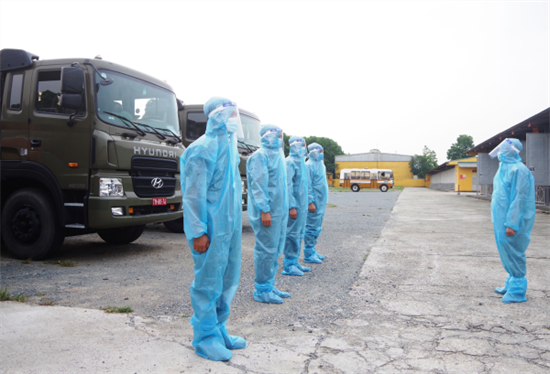 |
| Brigade 971 conducts vaccine transportation |
Second, building a strong military transportation posture. The military transportation posture must be organised in an integrated and solid manner, forming a comprehensive, continuous, and flexible support system that closely combines on-site support with forces mobilised from other areas. Implementing the Party’s line on all-people national defence, people’s war, and the concept of all-people logistics, the General Department of Logistics and Technical Support should conduct research, provide advice, direct implementation, and strengthen coordination with ministries, sectors, and localities to build the transportation potential and posture of the all-people national defence. This posture must be strong, modern, integrated, and in-depth, capable of rapidly transitioning from peacetime to wartime conditions, thereby ensuring support for national defence contingencies and combat operations, particularly in strategic directions and key areas.
During implementation, close integration between economic development and national defence must be emphasised in the construction of transport infrastructure. The planning of national highways, provincial roads, coastal and border roads, as well as systems of seaports, airports, and terminals should follow a dual-use orientation, serving socio-economic development while remaining ready to meet transportation requirements in contingencies. Transport routes designated for combat support must be regularly inspected, repaired, and upgraded, particularly strategic manoeuvre axes, reserve manoeuvre routes, bypass roads, strategic bridges and ferries, and river-crossing points; at the same time, contingency plans should be proactively developed for rapid recovery in the event of enemy attacks or disruption. In addition, the transport system within rear bases and logistics and technical bases must be constructed in an integrated, concealed, and solid manner, closely connected with the national transport network and defensive zones. At the same time, logistics–technical councils from the central to the grassroots level should be regularly consolidated and their operational effectiveness enhanced. These bodies should advise ministries, sectors, and localities on planning, constructing, and protecting transport infrastructure; building transportation reserve forces; and developing mobilisation plans for personnel and vehicles to ensure support during the first year and the initial stage of war (Plan B), thereby creating transportation potential and posture ready to support combat operations. It is also necessary to continue reviewing and improving coordination mechanisms and policies regarding the requisition, procurement, and mobilisation of transportation means, ensuring their suitability with the market economy and the requirements of a war to defend the Fatherland.
Besides, attention should be devoted to studying and rationally adjusting the disposition of transportation units at the strategic, operational, and tactical levels to ensure compatibility with combat deployment, the logistics and technical posture, and the terrain and transport characteristics of each locality. Alongside force deployment, planning and adjustment of the system of depots, stations, terminals, and trans-shipment points should be conducted in a dispersed, camouflaged, and fortified manner, closely associated with strategic, operational, and tactical transport routes. The combination of fixed and field facilities, as well as on-site and mobile elements, will help form a coherent, solid, and secure transportation network.
Third, flexibly applying and combining diverse modes and forms of transportation. In a war to defend the Fatherland, military transportation work requires not only strong forces and a solid transportation posture, but also a scientific, efficient, secure, and continuous organisational art of transportation. Accordingly, based on operational determinations and combat plans, especially strategic combat determinations, it is necessary to proactively develop and refine transportation plans, identifying appropriate transport modes for each mission, area, and support requirement. Road transport using military vehicles should serve as the primary means in order to ensure rapid manoeuvre, large carrying capacity, and wide operational reach, while closely combining it with rail, waterway, air, pipeline, and other transport means. At the same time, attention should be devoted to fully exploiting the advantages of multimodal transportation, ensuring the ability to organise transportation either in parallel or in succession through multiple modes. In this way, if one route or mode is attacked or blockaded, transportation can be quickly redirected or shifted to another mode without interrupting the overall flow of supply.
To effectively apply different forms and modes of transportation, transportation support must be well organised. Close coordination plans should be established between transportation forces and traffic support, technical support, and combat forces, particularly engineering, air defence, communications, reconnaissance, and military medical units, in opening routes, overcoming obstacles, protecting transportation lines, and promptly handling situations along transport routes. Transport formations and traffic support forces must be organised appropriately, with emphasis on camouflage and secrecy, and on the construction of shelters and defensive positions to counter enemy reconnaissance and attacks at troop assembly areas, along transport routes, and at loading and unloading points. In addition, technical support must be ensured through effective maintenance, repair, and recovery of vehicles; sufficient technical materials and spare parts must be prepared for each transport mode, thereby ensuring that transportation assets remain fully operational under all circumstances.
Fourth, establishing a closely coordinated and unified system for the command and management of transportation. To meet the requirements of modern warfare, it is necessary to build a unified, synchronised, and flexible system of transportation command and management from the strategic and operational to the tactical levels. Efforts should be intensified to research and gradually develop and refine automated transportation command systems, applying information technology, artificial intelligence, big data, and modern reconnaissance and surveillance means to support accurate and timely transportation command and management. Such systems will enable the rapid collection, processing, and analysis of information regarding combat situations, support requirements, the status of forces and vehicles, routes, depots, stations, and terminals, thereby assisting commanders at all levels in making scientific, flexible, and effective decisions in directing transportation operations. At the same time, comprehensive support for transportation command and management must be well organised, including the construction and consolidation of communications systems to ensure continuous, timely, and secure command information. Contingency plans, equipment, and reserve forces must also be prepared to maintain command capabilities in the event of enemy attacks, electronic interference, or cyber operations. Transportation command and management should be conducted in a centralised, unified, and flexible manner, coordinating and allocating forces, vehicles, routes, and transport schedules based on the requirements of strategic and operational missions. It is also necessary to proactively maintain a firm grasp of the situation, promptly handle emerging issues along transport routes, and adjust plans in a timely manner, prioritising key directions and critical missions.
Military transportation plays a particularly important role in logistical and technical support activities, sustaining the combat strength of the Army. Therefore, it should continue to be studied and improved in both theory and practical organisation, thereby steadily enhancing military transportation capability to meet support requirements in both peacetime and in a war to defend the Fatherland.
Lieutenant General, Prof., Dr. PHAN TUNG SON, Director of the Logistics Academy