Three breakthroughs to improve the quality of education and training at Naval Technical College
Thoroughly grasping the motto “The quality of training at schools is the combat readiness capacity of units”, Naval Technical College has focused its leadership and direction on resolutely, synchronously taking numerous measures, with particular emphasis on “three breakthroughs”, to improve the quality of education and training.
The Naval Technical College is a centre for training technical specialists at college, intermediate, and elementary levels, providing refresher courses, supplying human resources in the form of professional servicemen for the Military and the Navy, and training naval technical specialists for the Royal Cambodian Armed Forces.
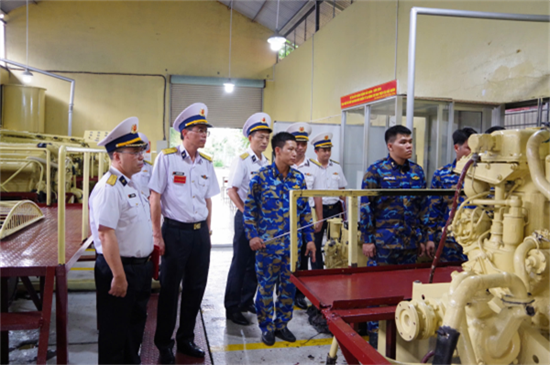 |
| Naval Service Command inspects the College’s education and training work |
Over the years, the task of protecting national sovereignty over seas, islands, and continental shelf, together with the building of a “revolutionary, regular, elite, modern” Navy, has imposed increasingly demanding requirements on education and training as well as on the development of technical human resources. Accordingly, the College’s forms and target groups of training have been expanded with multiple educational levels. When performing its tasks, apart from favourable conditions, the College has faced numerous difficulties. Its facilities and teaching - learning equipment have not kept pace with its task developments; the digital technology application skills of some cadres and lecturers remain limited; its information technology equipment and training management software have not been synchronously developed. All these things have significantly affected its education and training work.
Against that backdrop, the College’s Party Committee and Board of Directors have thoroughly grasped resolutions and directives of the Central Military Commission, the Ministry of National Defence, and the Naval Service on education and training, focusing on synchronously implementing various measures, among which three breakthroughs have been selected and promoted.
First, making a breakthrough in renewing training content, curricula, and methods and assessment of learning outcomes. In reality, the Naval Service is increasingly equipped with new-generation weapons and equipment; the College has expanded its target groups of training; however, the existing training content and programmes, as well as the structure of specialised knowledge blocks, have not been entirely appropriate, with some of them failing to keep pace with new naval technical requirements. That necessitates an urgent reform in training content and programmes. Hence, the College has promoted the implementation of the Project on “renewing training processes and programmes for cadres at all levels in the Military to meet task requirements in the new situation”, in accordance with its scale and forms of training, following the orientation of standardisation and modernisation.
To create a breakthrough in renewing training content and curricula, the College has directed its Training Department and faculties to encourage the creativity of experts and cadres with deep professional expertise and broad hands-on experience to proactively research and propose adjustments to training content and programmes suitable for each target group. Surveys have been conducted to collect feedback from unit commanders and graduates regarding the College’s training quality and these graduates’ ability to meet their task requirements, as the basis for developing and improving outcome standards for each target group.
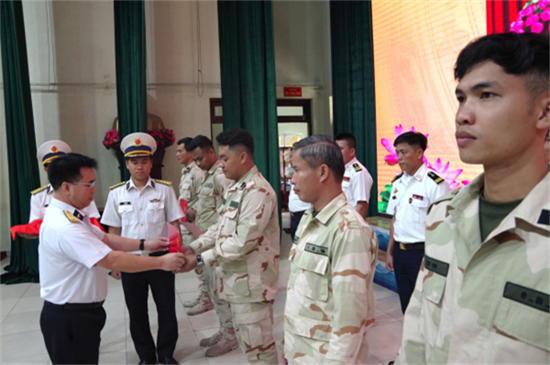 |
| Presenting certificate of graduation to Cambodian cadets |
In order to equip learners with both knowledge and practical skills, the College has appropriately shortened theoretical content and increased practical training time, emphasising practical training to enhance cadets’ professional proficiency and skills to operate and repair naval technical equipment and vehicles, especially new, modern weaponry. In particular, it has designed a reasonable internship programme for its cadets, increasing long sea voyages on ships, thereby enabling learners to directly access practical conditions, improving their practical skills, shortening the probationary period after graduation. As a result, training work has been renewed, “standardised, and modernised”, with a shift from training what the College has to training the content and specialisations that units actually need.
Renewing teaching methods is a deciding factor in the quality of training. Therefore, the College has resolutely directed a teaching reform, with learners being seen as the centre, flexibly, creatively applying advanced teaching methods, ensuring that theory could be closely linked with practice, enhancing learners’ self-study and self-research capacity, turning the process of education and training into a process of self-education and self-training. As a result, 100% of graduates show great political steadfastness, professional competence, and skills, becoming core forces in operating modern machinery and weaponry at their units. Besides, the College has renewed examination and testing work, with emphasis placed on practical competence and application of theory to practice, regularly reviewing, supplementing, and closely managing the system of question banks, examination papers, and answer keys, in accordance with confidentiality regulations. Examinations and assessments have been organised rigorously; inspection and re-inspection of end-of-module and graduation examinations have been strengthened to ensure compliance with regulations, objectivity, accuracy, and transparency as well as to prevent negative practices.
Second, making a breakthrough in building a contingent of teachers and educational managers. Fully aware of the particularly important role of cadres and teachers, the College has focused on consolidating the organisational structure of the contingent of teachers and educational managers, reviewing and perfecting the development planning of this contingent to ensure sufficient quantity, increasingly high quality, and synchronisation in structure, age, and specialisation. To “standardise” its staff members’ capacity, it has attached importance to fostering their political qualities, professional competence, and self-research capability, as well as the application of modern teaching methods, encouraging their proactive engagement in conducting scientific research and inspiring cadets’ motivation for study, improving their foreign language and information technology proficiency in line with the process of digital transformation in education and training.
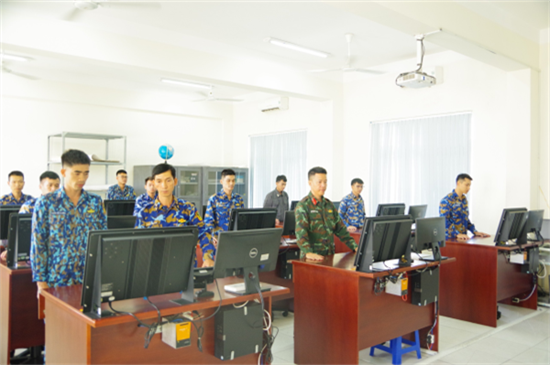 |
| Stepping up digital transformation in education and training |
In addition to recommending the Service to deploy its cadres and teachers for further education at academies and schools inside and outside the Military, the College has sent its staff members to attend methodology, information technology, and foreign language training courses and participate in technology transfer delegations according to the Service’s plans, creating a disciplined, united, professional working environment to foster talent, creativity, and dedication. It has established and effectively maintained models such as scientific research clubs, foreign language clubs, and specialised repair teams, creating forums to help cadres and teachers steadily improve their capabilities. Moreover, it has closely coordinated with units within the Navy to organise short-term field visits for its cadres and teachers, sending its teachers and cadets to units for internships to update knowledge on new weapons and equipment for integration into lectures, inviting experienced cadres and skilled technicians from units to share hands-on experience, deliver specialised lectures, and take part in graduation examinations. As a result, over 95% of cadres and teachers now hold university degrees; nearly 38% of specialised teachers possess postgraduate qualifications (2.6% are PhDs); 3.2% are senior teachers; nearly 50% of cadres and teachers have held commanding posts at units, with deep professional expertise, good pedagogical skills, and broad practical experience.
Third, promoting digital transformation in management and teaching, building a “smart school”. This is an urgent solution that creates a strong breakthrough in education and training, meeting the requirements of training high-quality, standardised, elite human resources for the Navy. To achieve high efficiency, the College has seriously implemented decisions, programmes, and plans on digital transformation from higher echelons and Decision 1960/QĐ-TM, dated 1 August 2025, by the General Staff promulgating the “Criteria for Smart Military Schools”. This has brought about fundamental, comprehensive changes in awareness and responsibility among cadres, teachers, and cadets regarding the College’s digital transformation tasks. To ensure high unity in the implementation process, the College’s Party Committee and all-level party committees have included goals and targets of digital transformation in their annual resolutions and effectively executed the Digital Transformation Plan for Education and Training for 2025, with orientation towards 2030.
To maximise scientific and technological achievements and apply digital technology in education and training, the College has proactively invested in its information technology infrastructure and internal network, adopting management and teaching software, promoting the application of information technology in various activities, with priority given to building a shared digital database system for 100% of subjects. Simulation technology has been gradually applied to renew teaching and learning methods, increase the visual and vivid nature of lectures, stimulate learners’ interest in self-study and research, and settle the drawbacks of traditional teaching methods. The College has completed and effectively deployed multiple-choice examination software and question bank management and randomised question generation software, thereby ensuring objectivity and preventing negative practices in examination and testing.
To date, 100% of departments and faculties have been connected to the internal military network; a learning management system and a shared digital learning resource repository, including lectures, textbooks, electronic documents, simulated practice exercises, and specialised digital learning resources, have been basically established and effectively applied in management, teaching, examination, and assessment across the College. Teachers have essentially combined theory with simulation and practice, creating a modern digital learning environment, meeting the goal of training professional technicians.
Thanks to the implementation of the above three breakthroughs, the Naval Technical College has achieved positive results in education and training, successfully fulfilling its functions and assigned tasks, increasingly affirming its prestige and position as a centre for training technical personnel - a core force of the Navy, contributing to building a “revolutionary, regular, elite, modern” Vietnam People’s Navy capable of firmly protecting national sovereignty over seas, islands, and continental shelf.
Sr. Col. DO NGOC HIEU
Commandant of the College