On assurance of communications for deception, posture creation, and manoeuvre in the deployment of forces to counter enemy airborne landings in strategic defensive operations
Deception, posture creation, and the manoeuvring deployment of forces constitute the prerequisite for conducting operations to counter enemy airborne landings within strategic defensive operations. This requires commanders, theatre headquarters, and participating combat forces to address a wide range of issues, among which the assurance of communications is a particularly important factor that must be thoroughly studied and effectively organised.
Countering enemy strategic airborne landings is a key mission aimed at defeating the enemy’s strategic efforts, protecting critical strategic areas, objectives and zones, and maintaining the integrity of our strategic defensive posture. As the “lifeblood” of the battlefield, communications assurance in operations to counter strategic airborne landings in general, and in deception, posture creation, and manoeuvring deployment of forces in particular, plays a decisive role in all battlefield activities and in determining combat outcomes.
In a war to defend the Fatherland (should it occur), operations to counter enemy airborne landings within the framework of strategic defensive operations would unfold across extensive areas under difficult and complex conditions, with situations developing rapidly and fiercely. This places demands on battlefield communications forces to thoroughly study and grasp enemy activities, the intentions of the theatre commander, and the state of communications, so as to formulate appropriate and effective plans for the employment of communications forces and means. These plans must ensure timely, secure and uninterrupted communications for the theatre command to exercise command and control, and to coordinate unified action among combat components and forces in each specific mission. This article focuses on issues relating to the assurance of communications for the theatre command in directing deception operations, posture creation, and the manoeuvring deployment of forces to counter enemy airborne landings in strategic defensive operations.
First, assurance of communications for the theatre command in directing deception operations and posture creation.
The enemy airborne landing force in strategic defensive operations may consist of a second-echelon force or a strategic reserve, with its core being specialised airborne assault units (airborne or air cavalry divisions and brigades), though it may also include infantry forces. Prior to landing, the enemy intensifies aerial and space-based reconnaissance activities, in combination with special forces, reconnaissance elements and domestic reactionary elements, in order to gather intelligence, detect operational intentions, and identify the disposition of theatre forces. At the same time, the enemy employs electronic warfare and cyber warfare forces to conduct technical reconnaissance, electronic and cyber-attacks, combined with firepower strikes, to paralyse communications systems, disrupt command and coordination, and undermine our preparatory posture for combat.
Deception operations and posture creation are usually conducted once signs of an impending strategic airborne landing are detected. Therefore, in order to issue timely command decisions for forces to conduct deception and posture creation, the theatre command must continuously maintain a firm grasp of developments, accurately assess and evaluate the situation, and sustain close coordination between deception and posture-creating forces and other forces within the strategic defensive operational formation - particularly coordination with the theatre’s main mobile forces and those directly tasked with countering strategic airborne landings.
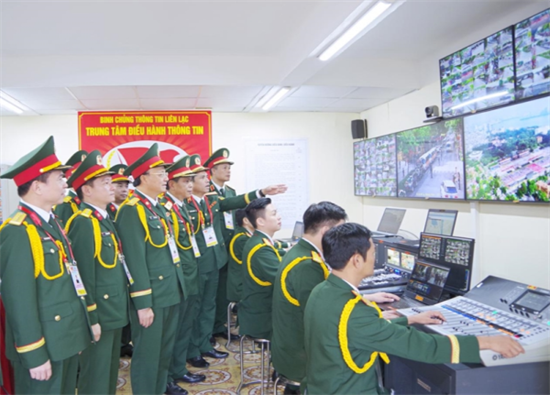 |
| The Signal Corps successfully ensured communications for the two major anniversaries of the country in 2025 |
In carrying out deception and posture-creation missions, communications are required to enable commanders to monitor enemy activity in the air and on the ground, detect the enemy early from assembly areas, track enemy movement along flight routes, and identify enemy forces at landing zones. Priority is given to ensuring robust, continuous communications for commanders of deception forces and posture-creation forces - especially those conducting deception in key areas - so as to preserve secrecy, achieve surprise, and prevent the enemy from discerning our operational intentions. Accordingly, communications forces must fully exploit fixed transmission networks, focusing on fibre-optic rings, branch lines, and wired communications routes within the communications system established for defensive operations in the operational area, while closely integrating them with mobile communications systems (deployed in reinforcement to deception and posture-creation units when counter-airborne operations are organised). To ensure situational awareness of the enemy, theatre communications forces employ radio networks of the intelligence and reconnaissance authorities, communications of the air defence-air force, and theatre communications systems already deployed in defensive operations, in order to maintain accurate knowledge of enemy forces from assembly areas, along flight routes, and at landing zones. Wired communications networks and military postal communications of the theatre are used in conjunction with communications of defensive areas to support command of deception forces, posture-creation forces, and defensive units. Radio communications operating in highly secure modes with strong resistance to electronic warfare are employed to support commanders of artillery and air defence forces in conducting fire strikes against enemy formations in assembly areas and during movement along flight routes, compelling the enemy to disperse and react, thereby creating favourable conditions for the theatre’s main forces to manoeuvre and deploy their formations covertly and safely.
At the same time, communications forces allocate a portion of their personnel and equipment to coordinate with electronic warfare and cyber warfare forces to conduct deception and posture creation directly within the electromagnetic domain. This is achieved by organising false electronic targets, such as dummy transmitter clusters (stations), simulated communication channels, transmission routes, and fabricated signals, in order to attract and deceive enemy electronic reconnaissance activities. Selected shortwave and very-high-frequency radio sets, microwave, satellite and switching stations, cables, and telephone equipment may be employed, in combination with physical decoy models deployed according to a unified deception plan, thereby enabling theatre forces to manoeuvre and deploy formations to counter enemy airborne landings in accordance with operational intent, while maintaining secrecy and safety.
Secondly, assurance of command-and-control communications for manoeuvring and deploying forces to counter strategic airborne landings.
When our forces organise manoeuvre and deploy combat formations, the enemy continues to conduct reconnaissance through multiple means, collecting and refining intelligence in order to designate targets for air strikes, missiles, and unmanned aerial vehicles. These actions are combined with firepower attacks against areas surrounding landing zones, manoeuvre routes, and locations suspected of hosting our manoeuvring and deploying forces; simultaneously, the enemy conducts high-intensity electronic jamming and cyber-attacks aimed at dominating and controlling the electromagnetic environment in the operational area, congesting transmission channels, and paralysing our communications systems and weapon control systems, etc. In carrying out tasks during this phase, the theatre commander continuously monitors developments and the outcomes of deception and posture-creation operations, adjusts operational decisions, and modifies manoeuvre and deployment plans accordingly. When the opportunity arises, orders are issued and forces are commanded to manoeuvre and deploy combat formations to counter enemy airborne landings in accordance with the established operational intent.
Communications actions must ensure that the theatre command is able to direct units to manoeuvre forces at the correct moment, deploy combat formations covertly and safely, and remain ready to strike the enemy in line with intent; at the same time, communications must ensure coordinated action between the theatre’s main manoeuvre forces, military regions, and the theatre’s air force, artillery, air defence forces, as well as local forces in the area of operations. To accomplish this mission, the chief of communications must promptly advise and propose measures for ensuring communications support. Communications forces closely integrate fixed communications systems (including those of defensive areas and pre-deployed theatre communications) with mobile communications systems (deployed as reinforcements during preparatory phases) to ensure reliable connectivity. In particular, radio communications employing shortwave and very-high-frequency networks and directions are used in appropriate operating modes, with concise codes and signals to maintain secrecy against enemy electronic reconnaissance. Theatre communications forces organise shortwave radio directions enabling the theatre command to communicate with campaign commanders, campaign staff agencies, and directly - bypassing intermediate levels - down to divisions, regiments, or units manoeuvring to counter enemy airborne landings; listening stations are established to be ready to introduce and connect communications for units as required. For very-high-frequency radio, network communications are organised from commanders of units participating in counter-airborne operations down to subordinate and attached units; the theatre may also establish direct, bypass communications to exercise command over units at specific moments. The theatre command directs subordinate service and branch units through shortwave and very-high-frequency radio networks and directions managed by the respective service and branch communications authorities. For wired communications, the theatre, military region, and provincial or municipal defensive-area communications networks are utilised to establish telephone lines to traffic-control adjustment points along manoeuvre routes; civilian telecommunications and public communications systems may also be exploited to ensure connectivity. Upon entering the combat deployment phase, communications forces at all levels rapidly complete the deployment of communications systems to ensure timely support for initiating offensive fire against the enemy in accordance with operational intent. Satellite communications employ mobile satellite vehicles (VSAT) to ensure communications for theatre command in directing units manoeuvring into combat deployment. In addition, all other suitable communications means should be fully exploited at each level, maximising the effectiveness of traditional communications methods: signal communications for marking and route guidance; military postal communications; and coordinated use of local militia and self-defence forces to escort and guide manoeuvring units into deployment areas according to plan.
In a war to defend the Fatherland (should it occur), given the enemy’s superiority in air operations and modern warfare equipment, together with the employment of high-technology weapons, methods of airborne assault are likely to undergo further development. Ensuring communications support for combat operations will therefore face numerous difficulties and challenges. Consequently, continued research aimed at supplementing and developing theoretical foundations for communications support in countering strategic airborne landings in general, and for deception operations, posture creation, manoeuvre, and force deployment in particular, is an urgent requirement. Such efforts must be further intensified in order to meet the demands of command and coordination in all operational contingencies.
Colonel, Dr. VU VAN NAM, Signals Officer College