The Military School of Military Region 4 (formerly the Military - Political School of War Zone 4) was established on 11 February 1946. Over 80 years of construction, combat, and development, generations of cadres, employees, and soldiers of the School have always upheld their noble virtues and heroism, surmounting countless difficulties and challenges, excellently fulfilling all assigned tasks, building the glorious tradition of “absolute loyalty, closeness to the battlefield, self-discipline, proficient teaching, good learning”. With its outstanding achievements, the School has been honoured by the Party and State with the title of Hero of the People’s Armed Forces (in 2011) and many other noble awards.
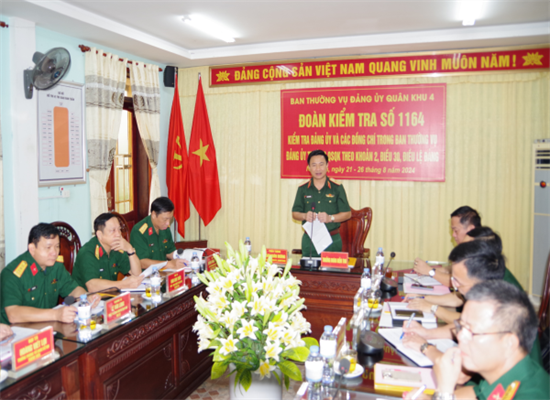 |
| Military Region 4 Command inspects the School Party Committee in 2024 |
In recent years, in response to the requirements of Fatherland construction and protection in the new situation, the School’s tasks have witnessed new developments. In addition to training cadres, non-commissioned commanding officers, and specialised personnel for units within the Military Region’s armed forces, the School has undertaken defence and security education for cadres from the 2nd group and students from 16 universities and colleges within the Military Region’s area according to the assignment of the Ministry of Education and Training (MoET). In the process, it has been confronted with numerous difficulties due to a large annual learner intake with diverse educational levels, age ranges, and working positions; there has been a shortage in its teaching staff; the professional qualifications of some teachers have yet to meet their task requirements; its infrastructure and teaching equipment system have been asynchronous. Nevertheless, with political resolve and scientific, proper solutions, it has successfully fulfilled its assigned tasks, while the quality of defence and security education for all target groups has been improved. Since 2020, it has provided defence and security education for over 5,600 cadres from the 2nd group and about 13,800 students; 100% of cadres from the 2nd group and 60% of students have achieved merit or distinction in this subject. These outcomes have been highly appreciated by the Military Region’s Defence and Security Education Council and competent agencies.
To achieve those brilliant results, first of all, the School has focused on promoting the role and sense of responsibility of party committees and commands at all levels, as well as the Centre for Defence and Security Education in defence and security education. It has thoroughly grasped resolutions, directives, and guiding documents by the Party, the Ministry of National Defence, the MoET, and higher echelons, as well as situational developments and its functions and tasks as the basis for issuing its own resolutions and action plans, delegating specific duties to members of its Party Committee and Directorate, requiring all-level party committees and commands, especially the Centre for Defence and Security Education, to promote their role and sense of responsibility.
In the process, the School has adhered to the Plan by the Military Region’s Council for Defence and Security Education, proactively coordinating with provincial military agencies and local units to review the 2nd group, working with partner universities and colleges on training schedules and learner intake for each phase. It has directed its offices, faculties, and Centre for Defence and Security Education to design education plans for each target group, well prepare accommodation, and provide logistics support for learners’ study and training. It has closely inspected all sections’ task performance, promptly drawing lessons, thoroughly settling shortcomings, ensuring that all courses would be organised under pre-set plans and achieve the highest possible quality.
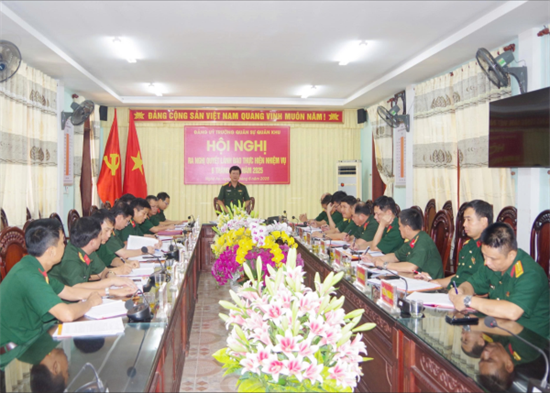 |
| A conference by the School Party Committee to issue its resolution for the second half of 2025 |
As cadres from the 2nd group possess broad experience in leadership and management at agencies and localities, the School has focused on improving the capabilities of its teaching and managerial staff. Based on the Project to “build a contingent of teachers and educational managers in the Military to meet the requirements set by a fundamental and comprehensive reform in education and training for the period of 2023 - 2030”, it has closely cooperated with competent agencies to give advice to the Military Region, while directly conducting the planning, training, and professional development of its cadres and teachers. Emphasis has been placed on developing a pool of teachers of defence and security education and managerial cadres within the Centre for Defence and Security Education. The School has adopted various forms and measures of training and professional development for this contingent, sending them to academies and schools both inside and outside the Military for further training, deploying them to grass-roots units to gain hands-on experience, increasing professional refresher courses, organising visits for them to research into defensive zone exercises.
Additionally, the School has regularly invited leaders from the Military Region, provinces, the Public Security Force, and the Border Guard Force to present specialised topics, update its teachers and managerial cadres on new knowledge, and share practical experience, thereby enhancing its staff members’ professional competence and meeting the increasingly high requirements of the subject. It has maintained Excellent Defence and Security Education Teacher Contests at various levels to assess and classify the quality of its cadres as the basis for making appointments and long-term development plans. As a result of these solutions, up to now, 13.3% and 83.4% of its teaching and managerial staff have held master’s degree and bachelor’s degree, respectively; 12 cadres and teachers have been recognised as Excellent Teachers at ministerial level; all staff members have been capable of undertaking specialised topics of defence and security education for target groups as prescribed.
To meet the increasingly high requirements of defence and security education and keep pace with the developments of Military building and Fatherland protection, the School has regularly updated and supplemented educational content and renewed teaching methods, tailored to each target group. Grounded on the prescribed framework program and guidance and direction from the Military Region’s Council for Defence and Security Education, it has directed its Training Department and faculties to step up research and develop a system of topics and lectures in compliance with regulations, ensuring appropriateness to each target group and close alignment with the Military Region’s defence and security tasks. It has removed outdated content and updated new issues, especially on defence and security arising from the adoption of a two-tier local government model, on the building of all-people national defence, people’s security, and defensive zones, on combination of socio-economic development and defence - security consolidation, as well as on leadership and direction over defence and military work at localities.
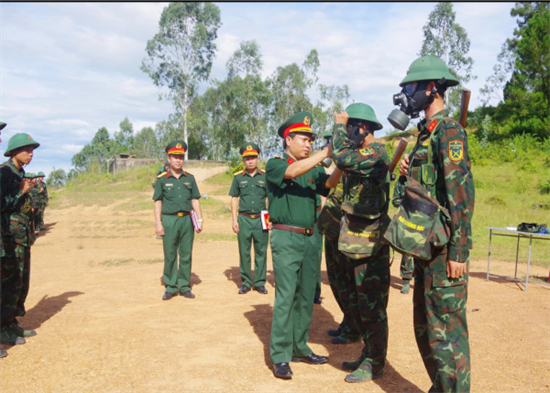 |
| Leaders of the School inspect a training session for cadets |
Besides, the School has stepped up teaching reforms via learner-centred, active approaches. In this regard, it has concentrated on applying information technology in teaching, combining traditional and modern teaching methods, and integrating presentation with group discussions and interaction between teachers and learners, thus removing one-way transmission of knowledge. It has actively renewed extra-curricular activities for each target group. For cadres from the 2nd group, it has regularly cooperated with agencies, units, and localities in organising research trips to defensive zone exercises, models of economic development combined with defence - security consolidation, as well as localities and units within the Military Region, enabling learners to broaden and apply their knowledge to the performance of defence and military tasks within their localities. As for students, it has directed the Centre for Defence and Security Education to closely coordinate with partner institutions to closely integrate education with management, strictly maintain daily, weekly routines, and foster discipline-abiding awareness, thus immersing students in a military environment and gradually forming a disciplined way of life. At the same time, it has organised culture and sport exchanges and other extra-curricular activities, such as contests upon completion of practice modules and field visits to military units, museums, and revolutionary relics, thereby generating interest in study and training, helping students acquire basic knowledge, promoting national pride and a sense of responsibility among students for the task of Fatherland protection.
In parallel with the above solutions, the School has increased investment in its infrastructure and modernised its equipment to better serve teaching and learning tasks. Accordingly, apart from effectively using its existing infrastructure and equipment, it has actively given advice to higher echelons on mobilising resources for upgrading the Centre for Defence and Security Education, ensuring standardised accommodation, and modernising training grounds, lecture halls, and teaching equipment. Priority has been given to upgrading operations room, specialised classrooms, smart teaching equipment, and modern teaching software and digitalising textbooks and materials as the basis for developing a shared data system for teaching and learning activities. The School has proactively reviewed and perfected confidentiality regulations for exploiting internal, military, and internet networks, creating a favourable environment for the application of information technology and artificial intelligence in teaching, learning, and science research. Up to now, its operations room, specialised classrooms, and training grounds have been fundamentally constructed; all teachers have been provided with network-connected computers and refresher courses on technology and artificial intelligence, thereby practically facilitating reforms in education and training in general, defence and security education in particular.
Bringing into play its 80-year tradition of construction and development as well as its recorded experience and achievements, Military Region 4’s Military School will continue renewing and improving defence and security education for all target groups, contributing to making political - spiritual potential, all-people national defence, and the postures of all-people national defence and people’s security across the Military Region increasingly strong right at grass-roots level.
Sr. Col. NGHIEM VIET DUC
Commandant of the School