Defence foreign affairs play a crucial part in the process of the country’s international integration, in which, the Vietnam People’s Army plays a core role. Given the requirements of building and safeguarding the Fatherland in the new era, it is necessary to further improve the effectiveness of this task with several synchronous solutions.
Defence foreign affairs include all diplomatic activities of the Party and State in the field of defence directly carried out by the Vietnam People’s Army. This is one of the important pillars of the Party-to-Party relations, State diplomacy, and people-to-people diplomacy, generating the overall power to safeguard the Fatherland from afar. The consistent goal of the defence foreign affairs is to reinforce the trust, prevent conflicts and address divergences with peaceful solutions based on the international law, assuring the highest national interest.
Based on the inheritance of the nation’s tradition of peaceful and flexible diplomacy and Ho Chi Minh’s diplomatic thought, especially the motto “firm in objectives, flexible in strategies”, the defence foreign affairs of Vietnam in the renovation period have been conducted consistently in the direction of independence, self-control, multilateralisation and diversification of international relations. Thoroughly grasping directives, resolutions and conclusions of the Party on the international integration and safeguarding the Fatherland in the new situation, the Army has proactively researched, forecast and consulted the Party and State with suitable solutions, firmly maintaining the peaceful and stable environment for the national development.
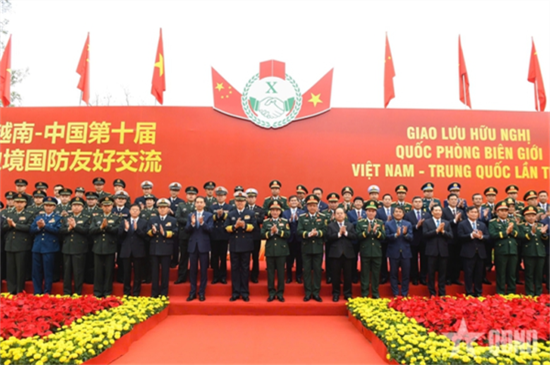 |
| The 10th Vietnam - China defence border exchange in 2026 (Photo: qdnd.vn) |
The pioneering and core roles of the Army in this field is expressed by proactively building and reinforcing the strategic trust with countries through the bilateral and multilateral defence cooperation; actively taking part in regional and international security forums; promoting exchanges and defence expositions; joining actively and effectively in the UN peacekeeping operations, humanitarian aids, disaster relief, etc. Together, the defence foreign affairs have also expanded the practical cooperation in military science research, human resource training, technology transfer, creating driving forces to impulse the modernisation of the Army and develop the defence industries, etc., thereby contributing to improving the status and prestige of the country, at the same time, spreading the noble image of “Uncle Ho’s Soldiers” among international friends.
Presently, the world and region are seeing fast developments, the strategic competition among major powers has been increased, and the traditional and nontraditional security challenges have been intertwined, creating higher requirements of safeguarding the Fatherland from afar. In this situation, in order to bring into play the core roles of the Army, and improve the quality and efficiency of the defence foreign affairs, contributing to successfully accomplishing the two strategic tasks of building and firmly safeguarding the Socialist Republic of Vietnam, the article proposes several main solutions as follows:
Firstly, promoting the grasp, clarification and effective implementation of policies and strategies on the defence foreign affairs. These are fundamental and strategically-oriented principles, the “compass” in consulting and implementing defence diplomatic activities. Accordingly, the party committees and commands at all levels should thoroughly grasp resolutions and strategies of the Party, State and Central Military Commission on the international integration and defence foreign affairs, especially, the viewpoints on consistently implementing the foreign policies of independence, self-control, resilience, peace, friendship, cooperation, development, multilateralisation and diversification of international relations; Vietnam is a friend, a reliable partner, an active and responsible member of the international community, being consistent in the defence policy of “4 Nos”.
On this basis, functional authorities advise and concretise into programmes and action plans with clear goals and practical roadmaps to the requirements; correctly identify the preferred partners, key cooperation areas and support resources. At the same time, they continue to review, supplement and complete the systems of documents, rules and regulations on foreign diplomacy in a synchronous, unified, and consistent manner with the international commitments and demand for safeguarding the Fatherland in the new situation; enhance the periodical inspection and evaluation; make timely adjustment when necessary, assuring all defence foreign activities to be put under the Party’s leadership, consistent of the principles of independence and self-control, maintaining the national interest and the defence cooperation effectiveness.
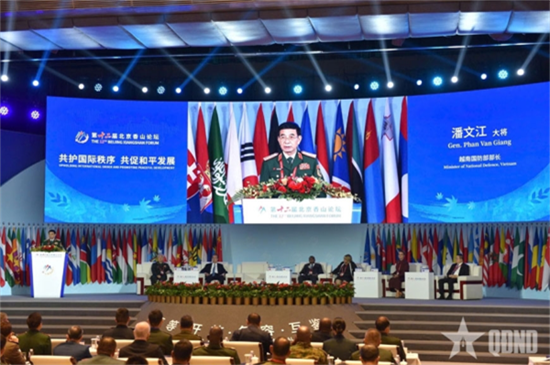 |
| General Phan Van Giang, Minister of National Defence speaks at the 12 Xiangshan Forum in Bejing in 2025 (Photo: qdnd.vn) |
Secondly, refining the organisation and staff of defence foreign affairs sector on a par with tasks. It is necessary to continue to review and strengthen all defence foreign affairs authorities in the way of being elite, compact, professional, efficient and effective; clearly define their functions, tasks, power and responsibility, assuring the unity and professionalism of consultation and implementation, at the same time, standardise the working process, build the communication system and database on managing and supervising the conduction of commitments and cooperation; promote the application of digital technology in managing documents and securing data; gradually complete the technical infrastructure to command and manage the defence foreign affairs towards regularity and modernisation. Especially, it is necessary to pay attention to building the contingent of defence foreign affairs cadres who are politically strengthened and absolutely loyal to the Fatherland, Party, State and People, have strong strategic thinking, good counselling capability and flexibility in solving complex situations. Strictly conduct the selection, training and further training in the standardised and in-depth manner; enhance their foreign language competence, knowledge of international law and negotiation skills; increase their practical experience through bilateral and multilateral activities, and overseas working environments, at the same time, make favourable remunerating policies for cadres in charge of defence foreign affairs.
Thirdly, improving the quality of research, forecast and strategic consultation on defence foreign affairs. All departments and units in the entire Army need to strictly coordinate with functional authorities inside and outside the Army to follow, grasp and analyse the changing trends of regional and international security, especially effects caused by the strategic competition among major powers, the adjustment of defence policies from countries, and new development of war types and non-traditional security. Based on the total and bilateral evaluation, they timely recognise opportunities, challenges and other factors that could make direct and long-term effects on the sovereignty and national interest.
Functional authorities need to timely propose to the Central Military Commission and the Ministry of National Defence to consult the Party and State about suitable guidelines and policies in specific time, object and issue; proactively construct and update solutions for solving complex and sensitive problems related to the sovereignty, borders, islands and seas, and relations with important partners. They also need to renovate the research methods towards closely combining the traditional analysis with the application of digital technology, database completion, simulation and long-term trend analysis, assuring that the forecast is based on scientificity, and consultation is based on strategic vision avoiding neither passiveness nor unexpectedness in any situations.
Fourthly, enhancing the defence cooperation, heightening the status and prestige of the Army and country in the international arena. It is necessary to proactively join in multilateral defence and security forums, within the ASEAN in particular; effectively bring into play the mechanisms of ADMM+, ARF and other regional security forums; basing on the national interest and real capacity to select proper contents, propose initiatives, take part in discussions and make contribution, manifesting as an active and responsible member in the international community, at the same time, widen the multilateral cooperation in responding to nontraditional security threats, enhancing the sharing of experience, and improving the capability of collaboration and problem-solving skills.
Together, it is of importance to strengthen the bilateral defence cooperation in a practical, effective and focused way; give priority to neighbouring countries, regional countries, powerful countries, strategic partners, comprehensive and traditional partners; properly handle relations, maintain the strategic balance, create the intertwined interests, making contribution to consolidating the favourable diplomatic environment to build and safeguard the Fatherland; carefully prepare the forces, training, logistics and techniques, actively take part in the UN peacekeeping operations, expressing the international responsibility, and reinforcing the trust among friends and people in other countries to the Vietnam People’s Army.
Fifthly, strengthening the interdisciplinary coordination, closely combining the defence foreign affairs with Party-to-party relations, State diplomacy and People-to-people diplomacy. At first, it is necessary to review and complete the coordination mechanism between the Ministry of National Defence and Ministry of Foreign Affairs, Ministry of Public Security and other related organs in sharing information, strategic advisory and handling with foreign-related defence and security issues; set the consistent coordination process to assure the aligned viewpoints, messages and national interest; increase the regular and unexpected inter-agency meetings when arising complex or sensitive problems; proactively build plans on communication and guiding domestic and international public opinion, avoiding any passiveness or suddenness.
Together, it is necessary to promote the people’s defence exchanges, twinned units, enhance the coordination in search and rescue, humanitarian aids, disaster and disease recovery; through real activities to gradually cement trust, improve mutual understanding with the militaries and the people of other countries, especially the neighbour ones; closely combine the defence foreign affairs with the communication, foreign propaganda, fight against wrong and distorted views on defence policies of Vietnam. It is the synchronous and smooth coordination among diplomatic pillars that creates the overall power to contribute to maintaining the peaceful and stable environment for the cause of building and safeguarding the Fatherland in the new situation.
Senior Colonel, Dr. BUI THANH CAO, Deputy Director of the Institute of Military Social Sciences and Humanities