Disaster response, search and rescue operations are “combat missions in peacetime”. Successfully carrying out this crucial task requires a comprehensive approach involving various measures; among them, ensuring adequate and timely logistic support is of paramount importance.
Disaster response, search and rescue operations are a component of civil defence and a vital task for the Military. For the past time, with the spirit of overcoming difficulties and dangers, and “all for the People”, units throughout the army have clearly demonstrated their role as the vanguard, core force, and reliable support for Party committees, governments, and the People in responding to and overcoming the consequences of natural disasters, conducting search and rescue operations, protecting the lives and property of the State and the People, further enhancing the fine traditions and essence of "Uncle Ho's Soldiers," strengthening the close bond between the military and the People, and building a solid “people's heart and mind” posture.
Contributing to these overall results is the work of logistics support. On a yearly basis, the entire Military maintains a regular reserve of thousands of tons of food, tens of millions of litres of oil and petrol, hundreds of thousands of sets of military uniforms, and hundreds of thousands of units of medicine and medical equipment for the performance of this task. In 2024 alone, the Military Logistics sector distributed over 1,200 tons of rice, roughly 900 tons of dried food, more than 200,000 boxes of instant noodles, 150,000 sets of medicine, and tens of thousands of tents, lifebuoys, and life jackets to support People in disaster-stricken areas. Many mobile logistics forces directly transported and supplied essential goods promptly to isolated areas, contributing to minimising damage and helping People quickly stabilise their lives.
It is forecast that in the coming time, climate change and extreme weather conditions will continue to cause many natural disasters and incidents, with the risk of strong storms, flash floods, landslides, building collapses, and flooding, negatively impacting socio-economic development, infrastructure, military and defence operations, and directly affecting the lives of the People and the cause of national construction and defence. In this context, disaster relief, search and rescue operations always place high demands on logistical support. This is not only an urgent and regular task, but also a political responsibility of the entire Military, making a significant contribution to minimising damage, stabilising People's lives, and maintaining national security and defence. To improve the effectiveness of logistical support for disaster response, search and rescue operations, this article proposes some basic solutions as follow:
Firstly, strengthening the leadership and guidance of Party committees and commanders at all levels regarding logistical support for disaster response and search and rescue operations. To this end, along with thoroughly and seriously implementing the resolutions, directives, circulars, and plans of the Party, the State, the Central Military Commission, the Ministry of National Defence, and the General Department of Logistics and Technical Support regarding the tasks of disaster response, and search and rescue, Party committees of agencies and units should have issued resolutions to lead the implementation of logistics support for this important task. These resolutions should then be concretised into realistic and feasible logistics plans and targets, and promptly supplemented and adjusted to suit each specific situation. Simultaneously, focus should be placed on building “lean, efficient, and strong” logistics and technical forces at all levels, with a rational, synchronised and flexible structure, capable of both fulfilling regular logistics support tasks and serving as the core force for responding to natural disasters and conducting search and rescue operations when necessary.
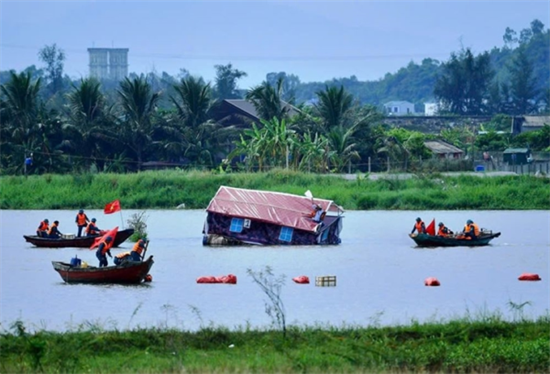 |
| Armed forces of Military Region 4 conduct search and rescue drill in Nghe An province |
Secondly, proactively developing and perfecting logistical support plans for disaster response and search and rescue operations at each level and in each specific situation. In recent times, the implementation of a two-tiered local government model and the merger of provinces and cities have led to changes in administrative boundaries and adjustments to the functions and responsibilities of agencies and units, especially local military commands. Therefore, to effectively carry out logistical support for disaster response and search and rescue operations, agencies and units should quickly develop and finalise support plans. This includes close coordination with local Party committees, governments, and relevant agencies and departments to clearly define the boundaries and areas of operation; and clear responsibilities to each force and department in providing logistical support to the forces conducting tasks at different levels of natural disasters and in each specific situation, etc.
To make it effective, in addition to preparing essential supplies, necessities, rescue vehicles, and medical equipment to respond promptly to situations, agencies and units should identify and allocate reserve resources to proactively handle emerging situations and ensure sufficient resources for response activities. They should develop plans for sourcing, receiving, and distributing equipment and materials; and effectively manage and use equipment for the tasks of disaster prevention, mitigation, and recovery. On the other hand, logistics and technical agencies should maintain strict rescue duty regime, regularly coordinate with other forces to grasp the situation related to rescue operations in the area to promptly handle any incidents. Moreover, they should continue to research and innovate methods of logistics support; and closely coordinate with other forces in exploiting local logistics resources. Strengthen training to improve professional knowledge and practical skills for officers and soldiers. Regularly conduct training and exercises according to plans to enhance the response and support capabilities of logistics and technical units in all situations.
Thirdly, flexibly applying measures to support forces during task performance. When conducting disaster response and search and rescue operations, military units often deploy different groups, such as: mobile forces; on-the-spot response forces; reserve forces; support forces (information, mobile support, logistics - technical, etc.). In addition, there may be mobilised and coordinated forces in the area (local militia, police, and border guard posts in the area). Based on the scale of the force deployed, the time, location, and tasks of each force, and the actual situation of the natural disaster occurring in each area, logistics and technical agencies should direct the operation of kitchens, design meal structures, and have measure for food supply accordingly.
The current problem is that, due to the impact of climate change, natural disasters occur continuously and last for many days, over a wide area, isolating many regions with complex situations; the scope of search and rescue is wide, troops are dispersed into many small units and hard to deploy etc. To effectively ensure logistics support, especially material support, it is necessary to closely combine on-site support with mobilisation from other locations, with on-site support being the primary focus. Units, especially the military commands of provinces and cities, should proactively advise Party committees and authorities to actively build logistical potential and defence posture in their areas, ready to support for various situations according to the “four on-the-spot” motto. Along with that, the Logistics and Technical sector should advise on the production and procurement of modern equipment, such as: unmanned vehicles, amphibious trucks, transport robots, etc., to enhance mobility and support capabilities across various terrains, weather conditions, and situations.
Fourthly, focusing on measures to prevent and control diseases and ensure environmental hygiene in areas affected by natural disasters. Accordingly, before carrying out disaster prevention and control and search and rescue operations, the logistics and technical agencies should inspect and replenish sufficient reserves of food, supplies, and medicines. To improve the effectiveness of mission execution, agencies and units, with the Logistics and Technical sector as the core, should research and put into use field water filtration equipment and disinfectants, implement measures to ensure clean water supply. In addition, there should be mobile medical teams in conjunction with local health services to receive and treat the injured and sick. Environmental sanitation measures and waste collection and treatment should be strengthened. After completing their missions, agencies and units should regularly monitor and track potential disease outbreaks within their barracks and in the neighbourhoods to take timely corrective and preventative measures.
Given the increasingly unpredictable climate and weather patterns, disaster response and search and rescue operations are becoming more difficult and complex. The task of ensuring logistical support for these operations presents many challenges that require further research, supplementation, and improvement in both theory and practice.
Senior Colonel, Dr. HA THANH NAM, Logistics Academy