Hanoi University of Science and Technology enhances its autonomy in defence and security education
Defence and security education for students is a strategic policy of our Party and State, aimed at fostering patriotism, love for socialism, and national pride, equipping students with basic knowledge of defence and security and necessary military skills, rendering students fully aware of their rights, obligations, and responsibilities in Fatherland construction and protection.
Therefore, over the years, the Council, Party Committee, and Board of Directors of Hanoi University of Science and Technology (HUST) have consistently attached great importance to effectively organising the subject of Defence and Security Education, regarding this subject as a crucial part of HUST’s education strategy, contributing to developing a “both red and expert” technical workforce capable of meeting the requirements of national construction and protection. Since 2022, HUST has designed the Project on “autonomy in delivering the subject of Defence and Security Education”, which has been approved by competent agencies, with clear goals, road map, solutions, and responsibilities to each office and unit in order to ensure synchronisation, feasibility, and alignment with its practical conditions.
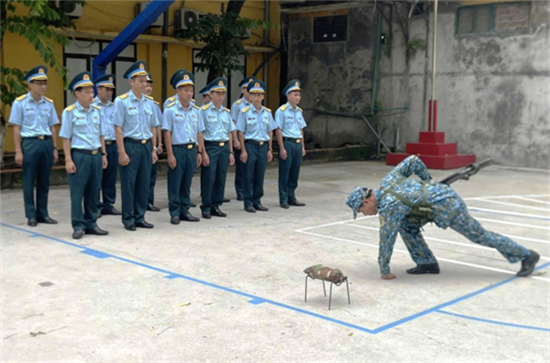 |
| A refresher course for teaching staff |
To achieve the goals of the Project, in addition to restructuring its affiliates, HUST has focused on renewing its methods of managing and organising the subject of Defence and Security Education in line with the autonomous model, regarding this as a foundational solution for the quality and effectiveness of the subject. Based on resolutions and directives of the Party, State, Ministry of National Defence (MND), and Ministry of Education and Training (MoET) on defence and security education, HUST has reviewed, supplemented, and completed its management and operation regulations in a scientific, transparent, efficient manner, stepping up decentralisation and delegation of authority with clear responsibilities, ensuring uniformity in command and operation, promoting the proactiveness and creativity of each unit, especially the Faculty of Defence and Security Education - the core force in giving advice on organising and managing this subject.
Amid frequent changes in the teaching staff for defence and security education, who are mainly seconded officers, HUST has paid special regard to consolidating the organisational structure of the Faculty of Defence and Security Education, raising the leadership and management capacity of the Faculty’s cadres, establishing coordination mechanisms between the Faculty and relevant offices to guarantee harmony between teaching plans for the subject and its overall education and training mission. Leveraging its strength as a leading institution in technical and technological education, it has efficiently applied information technology and digital transformation in managing education and training activities. Training plans, teaching - learning activities, facilities, e-learning materials, lecturer profiles, student records, and learning results have been synchronously integrated into HUST’s training management system, ensuring transparency, accuracy, timeliness, and efficiency in the process. Moreover, HUST has seriously carried out inspection, review, and evaluation, regularly gathering students’ feedback via QR codes, thus allowing its units to promptly adjust and supplement solutions, contributing to improving its training quality and autonomy.
Apart from a reform in management and administration, HUST has focused on building a teaching contingent sufficient in number and standardised in quality to meet the criteria for autonomy in defence and security education. Currently, the teaching staff of HUST’s Faculty of Defence and Security Education is mainly composed of seconded officers from the Air Defence - Air Force Service and contracted visiting lecturers. To build a sufficient and well-structured teaching workforce, HUST has actively coordinated with Air Defence - Air Force Academy in selecting seconded officers with great political qualities, capabilities, and experience in teaching, training, and managing students, while recruiting full-time lecturers and using contracted visiting lecturers appropriately to its training demand in each phase. Notably, to meet its long-term development requirements, it has perfected its personnel planning, establishing a road map for teaching staff development, gradually reducing the number of seconded officers under the guidelines of the MND and MoET, ensuring that by 2030 only five seconded officers will remain as the core force.
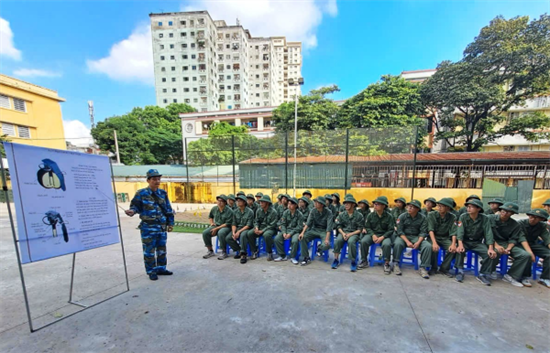 |
| Theoretical session for students |
Alongside consolidating its teaching workforce, HUST has attached great value to improving the quality of its lecturers via various forms of training and professional development, gradually standardising their qualifications and expertise. In addition to sending its lecturers to undertake intensive training and participate in refresher courses and scientific workshops held by the MoET, MND, and military and public security schools, it has regularly organised in-service training sessions, maintaining regulations on lesson plan approval, effectively holding teaching rehearsals and excellent lecturer competitions, thereby enhancing its teaching staff’s pedagogical skills and professional expertise. It has also built a democratic, united, disciplined work environment, ensuring adequate policies and incentives to attract high-calibre lecturers, motivating its teaching staff to pursue self-study and self-improvement. As a result, all lecturers of the Faculty of Defence and Security Education has now had master’s degree or above and met pedagogical standards; they have held commanding positions at grass-roots units.
Given the requirements set by a fundamental, comprehensive reform in education and training in general, the subject of Defence and Security Education in particular, HUST has promoted innovation in training content and methods suited to the training of various groups of students. With a learner-centred approach, the Faculty of Defence and Security Education has proactively reviewed, adjusted, and updated educational content consistent with the framework curriculum issued by the MoET, while flexibly applying it to the competencies and specialities of technical and high-quality students. Accordingly, topics about the Party’s lines and viewpoints, and the State’s policies and laws on national defence and security have been designed to be concise, easy to understand, and closely linked with scientific and technological advances. Hi-tech warfare, cybersecurity, cyberspace operations, and technological application have been updated to enable students to access modern knowledge of national defence and combine theory with practice in accordance with their specialities.
Furthermore, HUST has actively renewed its teaching methods towards learners’ proactiveness, creativity, critical thinking, and application skills. Lecturers have been encouraged to employ experiential learning, scenario simulation, group discussion, and technology-integrated teaching. For practical modules, HUST has adhered to the principle of progressing from simple to complex, flexibly using training models, sample videos, and sample images combined with lecturer demonstration, to allow students to grasp basic manoeuvres and skills before squad-level and platoon-level coordinated training. In the process, lecturers have always closely maintained discipline on training grounds and thoroughly assessed each student’s capacity to give personalised guidance. For modules such as line-up regulations, infantry combat techniques, grenade throwing, and shooting, lecturers have divided students into many small groups to increase practice, while conducting close inspection and supervision to correct students’ mistakes and ensure the required standards.
Strengthening and upgrading infrastructure and equipment, and creating a standardised military pedagogical environment are essential criteria and foundational conditions for improving autonomy in defence and security education. Hence, HUST has actively mobilised and effectively utilised resources to modernise training infrastructure and equipment in a synchronised, comprehensive manner, with priority given to lecture halls, specialised classrooms, training grounds, and teaching aids. To date, it has completed a modern system of training infrastructure and equipment fully meeting the required standards. Training grounds and zones have been scientifically designed to suit real training conditions and the urban environment. Classrooms have been equipped with computers and projection devices. A dormitory zone has been established, with adequate living and study conditions for 750 students in each training phase.
At the same time, HUST has focused on building a standardised, exemplary military pedagogical environment in accordance with the particularities of a university of science and technology. Following regulations of the MoET and MND, it has issued operational regulations and rules for studying and training with clear responsibilities of cadres, lecturers, and students, establishing a disciplined environment in the entire process of organising the subject. With reference to regularity building, the Faculty of Defence and Security Education has closely worked with the Training Department and other competent offices to reach agreement on organisational structure from squad to company levels and maintain a military-style environment for learning, training, and living. Lecturers and managerial cadres have been required to set good examples in conduct, lifestyle, and working methods for students to follow. To help students quickly adapt themselves to the military-style environment and fulfil their duties, HUST has established a Defence and Security Education Support Board and adopted QR-code systems to allow students to easily access information, give feedback, and receive timely support. It has also actively organised cultural, artistic, sport activities and defence and security education competitions to create a positive learning environment, strengthen solidarity, foster teamwork, and encourage students to improve themselves and comply with discipline and regulations.
Thanks to the synchronised solutions mentioned above, HUST has always successfully fulfilled its goals and tasks and enhanced its autonomy in the subject of Defence and Security Education. Since 2022, it has provided defence and security education and issued certificates for more than 30,000 students, with over 99.85% completing the subject within the designated period; 65% of them have achieved merit or distinction. These brilliant achievements will enable HUST to reach the goal of “breakthrough development in education and training” in the new development era.
Sr. Col. NGUYEN VAN HOAT
Head of the Faculty of Defence and Security Education