Following Uncle Ho’s teachings, Military Hospital 109 improves the quality of health care and protection for troops and the people
Deeply imbued with the teachings of President Ho Chi Minh: “A good physician must also be a gentle mother…”; “Love the patients, …cure diseases and safeguard the people’s health; that is a noble mission”, Military Hospital 109 has been promoting its proud tradition and implementing comprehensive measures to continuously improve the quality of medical examination and treatment for troops and the people.
Military Hospital 109, under the Department of Logistics and Technology of Military Region 2, is a Grade I hospital and final-referral hospital of the Military Region, tasked with providing health care and protection for troops and the people in the Northwest region. At the same time, it serves as a clinical training base for cadets of the Military Medical Academy and nursing trainees of Military Region 2’s Military School. Over more than 70 years of building, fighting, and development, the Hospital has gradually affirmed its position and reputation, becoming a trusted health care provider for the armed forces and the people in the area.
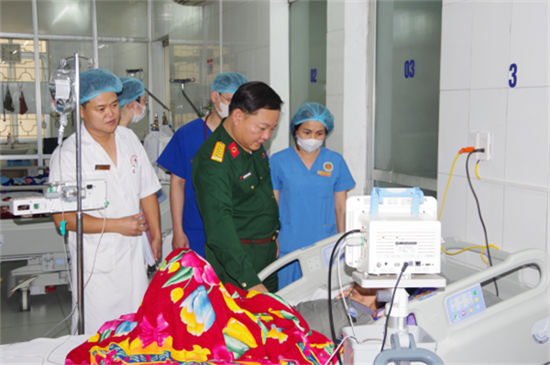 |
| Hospital leadership encourages a patient at Department A12 |
In recent years, more demanding requirements have been imposed on the work of health care and protection for troops and the people. Meanwhile, the Hospital performs its tasks in a large area with poor transport infrastructure; the health care system has yet to fully meet the medical needs of the people in general, especially in remote and mountainous areas. Epidemics and weather conditions remain unpredictable; the number of medical personnel is still insufficient; the quality of some specialised fields remains limited; some types of equipment and machinery have deteriorated and become outdated. These factors directly affect the Hospital’s professional performance.
Against that backdrop, the Hospital has focused its leadership and direction on implementing coordinated and comprehensive solutions. In this regard, promoting the study and following of Ho Chi Minh’s ideology, morality, and lifestyle has been seen as an important driving force to enhance its overall capacity and meet its task requirements in the new situation. Thoroughly grasping President Ho Chi Minh’s instructions that “cadres are the root of all work” and recognising the particularly important role of medical staff, the Hospital’s Party Committee and Board of Directors have resolutely made breakthroughs in developing high-quality human resources. Closely following its functions and tasks and guidance from higher authorities, the Hospital has proactively reviewed and developed personnel planning and training programs to standardise its workforce, focusing on building a pool of leading specialists and young professionals in emerging, modern fields. It has diversified training and professional development methods, closely combining the selection and dispatch of cadres to training courses at institutions both inside and outside the Military with on-site training, under the mottos “senior staff mentor junior staff” and “experienced doctors provide assistance for young doctors”, in order to build a contingent of medical staff with “political steadfastness, pure medical morality, and great professional competence”.
To improve professional qualifications and gradually master new and advanced techniques, the Hospital has attached importance to organising internship and professional exchange programs for its medical staff at major hospitals such as Bach Mai Hospital, Military Central Hospital 108, enabling them to gain experience and access new techniques, especially in surgery, emergency resuscitation, infectious diseases, and the treatment of complex diseases. It has also focused on formulating incentive policies and creating favourable conditions to attract and develop human resources; in the 2025 - 2030 period, more than 20% of doctors shall hold postgraduate qualifications, and 50% shall hold Specialist Level II or PhD qualifications. It is working to gradually standardise its successor workforce, demanding that “heads of medical departments hold Specialist Level II qualifications or equivalent”.
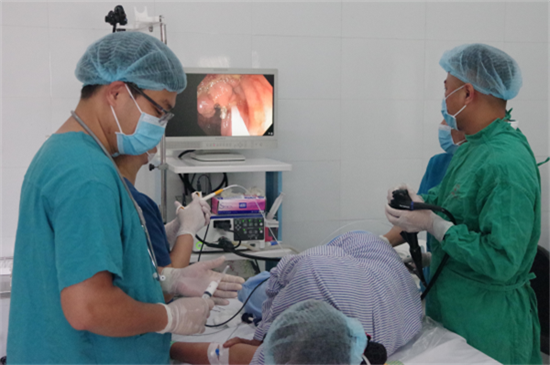 |
| Medical examination for patients |
Apart from human resource development, the Hospital’s Party Committee and Board of Directors have attached significance to stepping up research, mastery, and development of advanced techniques. Building on its initial successes in researching and developing new, complex techniques such as knee replacement, total hip replacement, percutaneous vertebral body cement augmentation, phacoemulsification surgery, tympanic membrane repair, the Hospital will continue to invest in research and development in key specialties, including surgery, oncology, trauma and orthopaedics, otorhinolaryngology, nephrology and dialysis, thereby improving the quality of patient admission and treatment across all levels. In the 2025 - 2030 period, it strives to provide medical examination for more than 280,000 patients, admit around 50,000 patients for treatment, maintain a bed occupancy rate of about 140%, an average treatment duration of 7 - 10 days and a recovery rate of 70% or higher, thus better performing the task of health care and protection for troops and the people.
Bearing in mind President Ho Chi Minh’s teachings: …“resolutely delve deeply into science, technology, and professional expertise, promote creativity, dare to think and to act,…”, the Hospital has focused on modernising its facilities and medical equipment and accelerating digital transformation. This is identified as a key breakthrough to address the deterioration and obsolescence of equipment and machinery and resolutely prevent any negative impact on the quality of medical examination and treatment as well as the adoption of specialised techniques. Accordingly, the Hospital has mobilised and effectively utilised resources to gradually upgrade its medical equipment systems towards modernity and integration. Priority has been given to acquiring high-tech diagnostic imaging, laboratory, surgical, and emergency resuscitation equipment, creating favourable conditions for deploying advanced specialised techniques and achieving breakthroughs in diagnosis and treatment. In particular, the Hospital has proactively made a proposal to higher authorities regarding the use of “surplus Social Insurance Fund of the Ministry of National Defence” to continue supplementing modern specialised equipment under an appropriate road map, laying a solid foundation for the development of high-tech medical capabilities and progressively building itself into a health care facility with strong professional capacity, serving both immediate and contingency missions.
Furthermore, the Hospital has invested in upgrading its information technology infrastructure, focusing on developing a synchronised and secure internal network, data storage servers, and technological equipment to ensure stable operation of modern medical data systems. This provides a solid foundation for building and refining hospital management software, deploying “electronic medical records”, “electronic troop health records”, and specialised data management systems, improving management efficiency, reducing administrative procedures, facilitating the monitoring, treatment, and care of patients.
To assist patients in registering for online medical examination, accessing remote health consultations, and making cashless payments, the Hospital has continued to promote the effectiveness of models under Project 06 of the Government on developing applications of population data, electronic identification and authentication for national digital transformation in the 2022 - 2025 period with a vision to 2030. These include cashless payments based on QR code, patient reception using ID cards, chip-based citizen identification cards, and VNeID and VssID applications, and transfer of medical examination and treatment data to electronic health records. In addition, the Hospital has placed emphasis on communication with health insurance participants regarding the application of technology in medical examination and treatment, promoting the role of the “digital skills advisory team” in helping medical staff with the use of software and new technological tools. It strives to ensure that 100% of its staff members will be proficient in using information technology in both managerial and professional activities. At the same time, it has concentrated on building a culture of professional conduct and maintaining strict adherence to the “Code of Conduct in Military Hospital 109”, resolutely saying no to behaviours such as “uncivilised attitudes towards patients and their families” and “indifference to patients’ suffering”. In that spirit, the standards, “pure medical morality, deep medical theoretical knowledge, proficient medical techniques, and medical professional steadfastness” have continued to be concretised for every cadre, doctor, and medical employee in performing their duties.
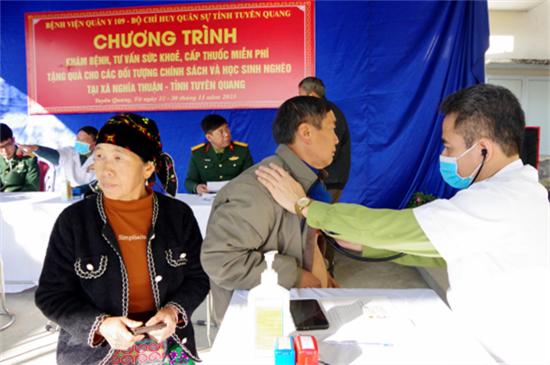 |
| Medical outreach program for locals of Tuyen Quang province |
Amid the unpredictable developments of epidemics and weather conditions in the area, following President Ho Chi Minh’s teachings that “disease prevention is as necessary as treatment…”, the Hospital has improved its capacity to respond to large-scale natural disasters and epidemics, promoting communication and education on environmental sanitation and disease prevention, effectively integrating military and civilian health care services. In recent years, in addition to fulfilling its medical examination and treatment tasks, the Hospital has actively participated in epidemic prevention and control and provided medical support in the area. Based on lessons learnt from recent epidemic responses, especially during the Covid-19 pandemic, the Hospital has reviewed, updated, and refined response plans for large-scale disasters and epidemics in line with local conditions and professional requirements. It has organised training and drills for disaster and epidemic emergency scenarios, thereby enhancing the coordination and response capability of its medical staff. Due attention has been paid to strengthening the capacity of its “Basic Emergency Surgical Team” and “Mobile Military Medical Team for Epidemic Prevention and Control”, ensuring adequate supplies of medicines, materials, technical equipment, and mobile means to respond to emergencies.
In order to address difficulties faced by local health care systems in epidemic prevention and control in the area, the Hospital has directed its departments and units to foster coordination with local party committees and authorities to provide free medical examination and medicines for policy beneficiaries, ethnic minorities in remote and mountainous areas, and border communities. It has also promoted cooperation in training human resources, providing professional, technical, and epidemiological surveillance support.
Bringing into play the results and experience achieved, in the coming time, Military Hospital 109 will continue stepping up the study and following of Ho Chi Minh’s ideology, morality, and lifestyle, regarding this as an important driving force for all cadres, doctors, and medical employees to uphold tradition and improve their capacity of health care and protection for troops and the people, thereby meeting their task requirements in the new situation.
Sr. Col., Meritorious Physician, Specialist Level II Doctor NGUYEN HUY HOANG
Director of the Hospital