Defence diplomacy in the cultural field constitutes an important part in the overall defence diplomacy, contributing to the realisation of the goal of protecting the Fatherland far and early through peaceful means. In the context of deep international integration, this field has seen developments both in scope and depth, and posed new requirements that need further research and improvement to enhance effectiveness, meeting the demands of the mission in the new context.
Adhering to and implementing the foreign policy of “independence, self-reliance, self-sufficiency, self-strengthening, peace, friendship, cooperation, and development; multilateralisation and diversification of foreign relations; developing foreign relations in the new era on par with the historical, cultural, and national stature”, in recent years, the Central Military Commission (CMC) and the Ministry of National Defence (MND) have proactively, flexibly, and effectively deployed the work of international integration and defence diplomacy, making it one of the pillars of Party diplomacy, state diplomacy, and people-to-people diplomacy. In particular, defence diplomacy in the cultural sphere has gradually affirmed its role and position in the overall defence diplomacy, linked to the requirements of building strategic trust and leveraging cultural “soft power” in protecting the Fatherland early and from afar.
Defence diplomacy in the cultural field has seen many “highlights” characterised by the values of “Uncle Ho's Soldiers”. Notably, since 2014, Vietnam has officially deployed its military forces to the United Nations peacekeeping operations, marking a new stage of international integration in defence. Through a range of activities, such as “Cultural Weeks” at UNISFA (Abyei region) and UNMISS (South Sudan), Vietnam not only affirms its international responsibility but also spreads the image of the country, its people, and the qualities of “Uncle Ho Soldiers” in the new era. Moreover, the performance of the “Cultural Army” in the International Army Games and friendship border defence exchanges have become an effective channel for promoting national cultural identity, contributing to strengthening “people's heart and mind posture”, and building the borders of peace, cooperation, and development; enhancing national prestige and position, and deepening the content of defence diplomacy in the field of culture.
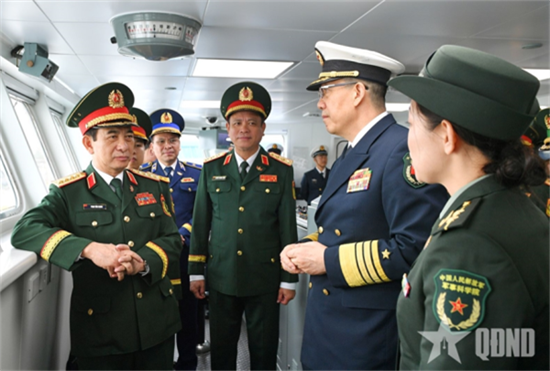 |
| General Phan Van Giang, Minister of National Defence talks with his Chinese counterpart, Senior Lieutenant General Dong Jun, in his visit to a China naval ship (Photo: qdnd.vn) |
Despite outstanding achievements, in the context of deep integration and the sophisticated subversive activities of hostile forces on the ideological and cultural front, this work still reveals certain limitations. This necessitates the need to innovate and improve the effectiveness of defence diplomacy in the area of culture, making it flexible and substantive while remaining steadfast in principles and political conviction. In particular, it is necessary to focus on the following key solutions:
Firstly, improving mechanisms and policies, and strengthening the management of defence cultural diplomatic activities. It has been shown in practice that the current management and coordination mechanisms are still limited and have yet to keep up with the rapid changes in the new operating environment. Therefore, it is necessary to continue to thoroughly adhere to the viewpoint of “exercising the unified leadership of the Party and the centralised management of the State over foreign activities”; concretising the spirit of Vietnam “being a friend, a reliable partner, and an active and responsible member of the international community” as a guiding principle throughout the organisation and implementation of defence diplomacy activities in cultural field.
Furthermore, it is necessary to concretise the resolutions and conclusions of the Party and the CMC on international integration and defence diplomacy into inter-agency coordination regulations and operational procedures. Proactively research and apply modern management methods in monitoring, evaluating, and inspecting activities. Clearly establish operational procedures and coordination mechanisms at all levels and sectors, ensuring uniformity in direction and implementation. Develop a set of evaluation criteria that quantify the effectiveness, reach, and cooperative value of each type of activity, linked to the requirements of strengthening strategic trust, promoting the national image, and enhancing the effectiveness of defence diplomacy in the cultural sphere.
Secondly, innovating the content and form, and improving the quality of defence cooperation and cultural exchanges. As shown in practice, defence diplomatic activities in the cultural field are still scattered, lack focuses, and are mainly about introductions and performances. Therefore, it is necessary to shift strongly from “exchanges” to “substantive and sustainable cooperation”, associated with strategic goals and long-term effectiveness. There is a need to focus on reviewing and making programmes tailored to each partner, field, and level of cooperation to identify priorities. Content should be practice-based standardised, focusing on training, professional exchange, scientific research, and building a military cultural environment in line with the signed agreements. Each programme should specify its content, roadmap, and outputs, ensuring feasibility and the value of substantive cooperation.
It is also necessary to continue innovating organisational forms towards flexibility and modernity; enhance the application of digital technology in online exchanges, digital exhibitions, and the promotion of military culture; combine on-line and off-line activities to expand interaction spaces and save resources; improve the quality of in-depth activities such as scientific seminars on defence culture, exchanging experiences in building a cultural environment in the military, cooperating in preserving and promoting military cultural heritage; and the activities of military forces in the United Nations peacekeeping operations. Select and develop some typical activities into highlights with regional and international influence. During implementation, it is necessary to “focus on promoting the image of Vietnam, its people and the image of “Uncle Ho's soldiers” in the new era, while proactively absorbing the quintessence of international culture, maintaining identity and ideological foundations in integration.
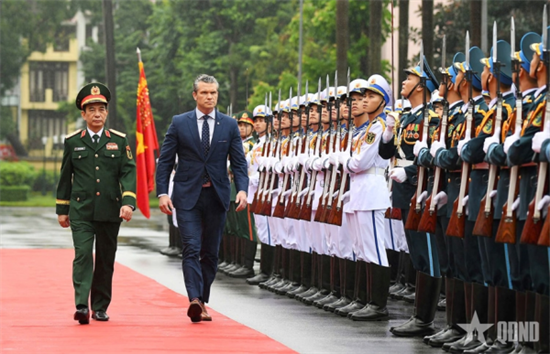 |
| General Phan Van Giang receives Mr. Pete Hegseth, U.S Secretary of Department of War in November 2025 (Photo qdnd.vn) |
Thirdly, improving the capacity of human resources for defence cultural diplomacy. Currently, the foreign language proficiency, cross-cultural communication skills, and organisational and operational capabilities of some officials have yet to meet the requirements of increasingly deep integration. Therefore, it is necessary to focus on develop defence diplomacy in general, and defence cultural diplomacy, in particular, modern and professional with a contingent of cadres owning strong political conviction, good morality, and high professional expertise”.
Accordingly, it is necessary to innovate the content and programmes of training towards in-depth, practice-based approaches; segmenting target groups to design appropriate content to make it practical and effective. Strengthen specialised foreign language training; focus on developing cross-cultural communication skills, digital and communication capabilities, and organisational, operational, and situational handling skills in the international environment through practical exercises, drills, and direct participation in cooperative activities. Simultaneously, there is a need to build a core specialised team with specific mechanisms to attract, utilise, and develop experts knowledgeable in international law and practices, capable of advising, coordinating, and managing activities, thereby gradually enhancing their professionalism and meeting the demands of increasingly deep integration.
Finally, strengthening linkages, coordination, and grassroots engagement in defence cultural diplomacy. It is necessary to enhance substantive coordination between military agencies and units with local Party committees, governments, and functional forces in holding defence cultural diplomatic activities. These activities should be held in border areas, border gates, islands, and strategic locations where direct cultural exchanges occur; the defence cultural, artistic, and sports exchanges should be held on a regular basis with close link to the requirements of foreign affairs tasks.
It is necessary to develop substantive coordination models between units, localities, and foreign friendly forces, in which fraternal exchanges, people-to-people exchanges, and “Cultural-Defence Festival” models in border areas are the core. These models should be connected with livelihoods, healthcare, and socio-cultural development activities so that not only a mutual understanding and trust are strengthened but a sustainable social foundation for defence relations is created as well. This will help strengthen the cultural space for foreign relations at the grassroots level, gradually consolidating the “cultural posture” within the all people national defence posture.
Improving the effectiveness of defence cultural diplomacy is an important measure to increase national defence potential, strengthen the national overall strength, expand foreign relations, and create a peaceful and stable environment for national development. This is a strategic, both urgent and enduring task, and a breakthrough in generating strength and capabilities for the cause of protecting the Fatherland early and from afar. Therefore, it is necessary to deploy solutions synchronously, unanimously and continuously among all levels, sectors, and the entire military, thereby maximising the soft power of culture in building and firmly defending the socialist Fatherland of Vietnam.
Colonel, Dr. DO LINH GIANG, Head of the Department of Cultural Management, Military University of Culture and Arts