Engineering Officer College is an education, training, and science research centre of Engineering Corps and the entire Vietnam People’s Army (VPA). Over the past 70 years of construction and development (26 December 1955 - 26 December 2025), generations of cadres, lecturers, cadets, employees, and soldiers of the College have strived to surmount all difficulties, actively engaging in the movement of "good teaching, good learning, good working", successfully completing all assigned tasks. Up to now, the College has trained thousands of engineers and technical personnel for the whole VPA and thousands of engineering cadres for the armed forces of Laos and Cambodia. Its science research work has also obtained positive results, greatly contributing to developing the theories and art of engineering support.
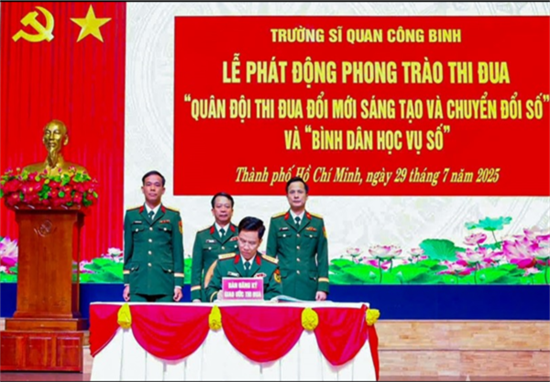 |
| Launching movement on innovation, digital transformation, and digital literacy across the College |
With such brilliant achievements, the College was conferred the title of Hero of the People’s Armed Forces in the Renewal Period (2008) by our Party and State, along with numerous orders and other high distinctions. It was also awarded First-class and Third-class Issara Orders by the Lao People’s Democratic Republic, as well as the First-class and Second-class Motherland Defence Orders by the Royal Government of Cambodia.
In recent years, in response to the requirements of VPA building, national defence consolidation, and Fatherland protection, as well as a fundamental, comprehensive reform in education and training, Engineering Officer College has adopted various measures to enhance its overall capacity and build an “exemplarily, typically” comprehensively strong College. Priority has been given to reforming and improving education and training, as an overarching objective determining the College’s short-term and long-term development.
First, developing a pool of lecturers and educational managers capable of meeting the requirements of education and training. To address a shortage of teaching staff and ensure its personnel reserves, the College has effectively implemented the project on “building a contingent of teachers and educational managers in the VPA in the period of 2023 - 2030 and beyond”. Annually, surveys have been carried out to identify potential candidates for the Engineering Corps Command to assign them to Engineering Officer College. The College has also sent its educational managers with pedagogical aptitude for training at military academies and schools and then deployed them to its faculties.
For the better development of its teaching staff, the College has attached importance to training and cultivating their pedagogical competence, foreign language proficiency, information technology skills, and especially teaching methodology, promoting democracy by collecting cadets’ feedback on its lecturers’ teaching performance, regularly holding excellent lecturer competitions, thus providing opportunities for its lecturers to develop their professional capacity, laying an important foundation for accurately assessing the quality of its teaching staff and deciding on personnel promotion, appointment, and rotation. At the same time, it has strengthened the deployment of its lecturers for field assignments to enable them to broaden their hands-on experience in line with personnel planning, management, and utilisation in various forms so as to shorten the duration of each deployment and increase the number of deployments and participants.
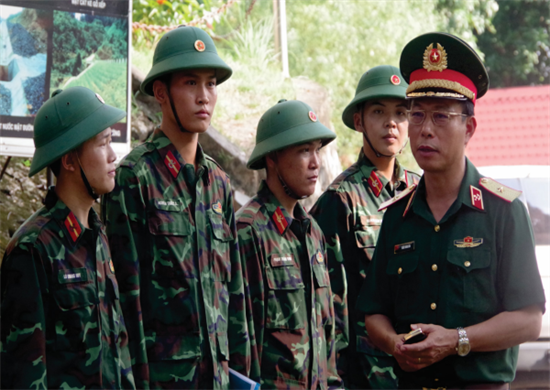 |
| Engineering Corps Command inspects training work at the College |
In addition, the College has placed emphasis on building a specialised corps of cadet management and administrative cadres with sufficient qualities and competencies by enhancing professional training in management and command, fostering a sense of responsibility, and renewing their work styles. As a result, all cadres and lecturers of the College have now held undergraduate or postgraduate degrees, and they had undertaken commanding positions at grass-roots units. Annual evaluations show that over 95% of its cadres successfully or excellently complete their duties. Since 2020, 132 lecturers across the College have been recognised as excellent lecturers at grass-roots level, while 55 others have been awarded the title of excellent educator by the Ministry of National Defence; all of them have played a pivotal role in raising the College’s education and training quality.
Second, renewing training curriculum, content, form, and methods. This has been regarded as a breakthrough solution, aiming to guarantee a scientific, fundamental, comprehensive, practical, and effective reform in education and training. The College has grasped and concretised Resolution 1657-NQ/QUTW, dated 20 December 2022, by the Central Military Commission on "renewing education and training to meet the requirements and tasks of VPA building in the new situation", Circular 159/2021/TT-BQP, dated 8 December 2021, by the Ministry of National Defence on promulgating the University-level Education Framework Program for Engineering Officer College and the Project on "renewing training processes and programs for all-level cadres in the VPA, meeting the task requirements in the new situation" in accordance with the particularities of the engineering speciality.
The College’s faculties have proactively carried out surveys on cadets’ task performance in units after graduation as the basis for supplementing and adjusting their training content and programs appropriate to practical requirements, with priority given to increasing practice in skills, tactics, and construction at sea and on islands, as well as in anti-terrorism. Besides, the College has provided cadets with more night-time and physical training close to actual combat in line with the motto: "The training quality of schools is the combat readiness of the unit". Over the past 5 years, it has completed four sets of learning outcomes for international undergraduates, four sets of learning outcomes for engineering undergraduates, one set of learning outcomes for police cadets majoring in construction, and one set of learning outcomes for engineering command undergraduates. In addition, ten new programs have been designed, including two undergraduate programs for police cadets, one training program on electrical and hydraulic systems of engineering vehicles for the Lao People’s Army, one reserve officer program, four detachment-level officer programs, one intermediate political theory program, and one program in higher education pedagogy.
Simultaneously, the College has renewed its teaching and learning methods by embracing openness and orientation, raising problems for cadets to handle situations, combining knowledge transfer with practical capacity, and transforming the training process into a self-training one. Identifying the things mentioned above as the key points to improve the quality of education and training, it has directed its departments and faculties to strictly maintain methodological activities, thereby fostering its teaching staff’s pedagogical methods. The College’s Board of Directors has intensified visiting lectures, classroom observation, and inspection; as a result, teaching methods of its lecturers have been adjusted to be relevant to each subject. In particular, the strict implementation of model teaching routines at all levels, especially at department and faculty levels, has enabled lecturers to learn from each other and improve their own pedagogical capacity. The College has required each lecturer to renew, research, and apply active teaching methods and information technology in their lectures. Up to now, the College's teaching staff has basically no longer adopted the one-way, passive way of imparting knowledge, thereby enhancing learners’ critical thinking and practical skills. Annually, cadets’ learning outcomes have been considerably improved; many cadets have achieved merit or distinction. Besides, cadets’ graduation exercises have always been highly rated.
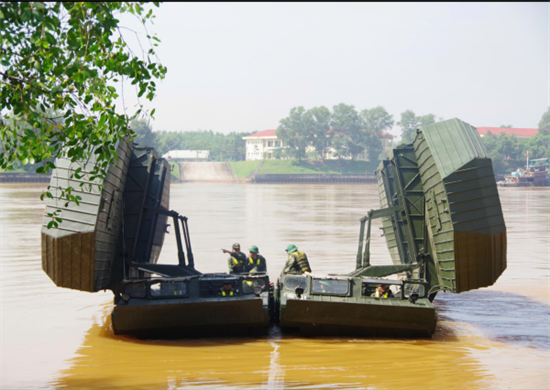 |
| Training on GSP ferry |
Third, effectively managing and using modern equipment for education and training. In essence, engineering training must be associated with specialised machinery and equipment. However, most of the machinery and equipment serving the College’s training and education activities have been damaged and need upgrading, repairing, supplementing, or replacing. The College’s Party Committee and Board of Directors have proactively given advice to the Engineering Corps and the General Staff's competent agencies on making focalised investments, with priority given to upgrading specialised classrooms, laboratories, training grounds, and workshops, and acquiring modern and synchronous teaching and learning equipment. The College has also provided sufficient textbooks and reference materials for education, training and science research, laying a solid foundation for cadres, lecturers, and cadets in their teaching, learning and research.
Over the past five years, the College has developed eight regular lecture halls, two seminar rooms, one map room, two engineering - mechanics laboratories, one foreign language lecture hall, three pedagogical halls, and nine specialised lecture halls for its faculties, along with five rooms for thesis defence, one room for essay-based examinations, two physical training grounds, and two company-level physical training areas, while procuring nearly 100 computers, printers, scanners, and projectors. Moreover, it has constructed new facilities supporting river-crossing training, a non-explosive obstacle training ground, and the Southern engineering training ground. It has upgraded its digital library, lecture-hall operating camera system, and Training Operation Centre, renovating its engineering-specialised training grounds, refurbishing its swimming pool in accordance with required standards, gradually increasing the quantity and quality of its facilities and teaching equipment, meeting the rapid scientific and technological development and the building of a “smart school capable of approaching the Fourth Industrial Revolution”.
Fourth, stepping up and integrating science research with education and training. The College has developed and synchronously implemented plans and programs for science research and education activities. It has actively encouraged its lecturers, cadres, and cadets to engage in science research and upgrade teaching aids and equipment. Research activities has been directed towards serving education and training and addressing urgent demands arising from training and combat readiness practices of engineering units.
In addition to building and promoting the pivotal role of its cadres and lecturers, especially those with senior professional degrees, the College has placed emphasis on fostering science research among cadets through the “Creative Youth Award”, considering it as an effective form of self-training. It has adopted appropriate policies and mechanisms to encourage all personnel, particularly heads of departments and leading lecturers to participate in science projects and research initiatives and contribute to compiling and upgrading materials, textbooks, information systems and reference resources. Since 2020, it has compiled and approved 19 textbooks and teaching materials at General Staff level, one textbook at General Department of Politics level, and 50 textbooks and teaching materials at College level, digitalising thousands of pages of textbooks, accepting 107 grassroots-level research projects and initiatives, two projects at General Department of Politics level, and 15 projects and initiatives at General Staff level.
Upholding its 70-year tradition of construction and development, Engineering Officer College will devote more efforts to overcome all difficulties, enhance good teaching and good learning, and successfully fulfil all education and training tasks. By 2030, it will strive to become a smart, modern College with high reputation among military schools and within the national education system.
Sr. Col., Associate Prof. NGUYEN DUY CANH, PhD
Rector of the College