Building a cultural environment within grass-roots military units: key issues and solutions
Building a cultural environment at grass-roots units across the Vietnam People’s Army (VPA) is a key component of ideological work aimed at laying a firm political and spiritual foundation and contributing to building a politically strong VPA. In the current context, this task has been encountering a number of issues that require proper awareness and solutions from relevant stakeholders and participating forces to further improve its quality.
Cultural environment constitutes an integral part of the living environment, encompassing a system of material and spiritual values that impact individuals and reflect social relations in each historical period, locality, and field.
Within the VPA, the cultural environment plays a crucial role as the direct milieu for nurturing and fostering political willpower, ethical qualities, regular lifestyle, disciplinary spirit, conduct, and responsibilities of revolutionary soldiers. A rich and healthy cultural environment also directly contributes to maintaining and strengthening internal unity and military - civilian solidarity, as well as improving the training quality, combat readiness, and task performance of a unit.
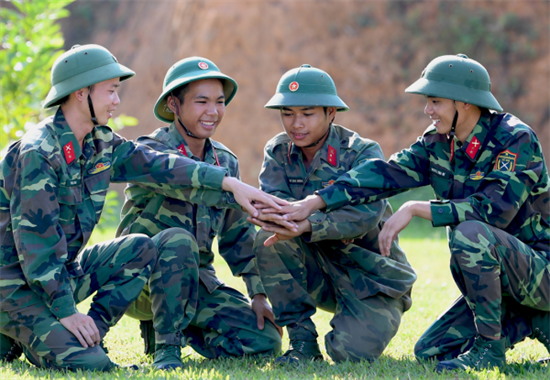 |
| Young party members of Regiment 174, Division 316, Military Region 2 demonstrate their resolve prior to an exercise (photo: qdnd.vn) |
In recent years, under the leadership and direction of the Central Military Commission (CMC) and the Ministry of National Defence (MND), with the General Department of Politics playing a direct and consistent role, the building of a cultural environment at grass-roots units has yielded significant results. Party committees and commands at all levels have paid increasing attention to directing cultural activities; many innovative models and approaches have been adopted; cultural institutions in many units have been developed in a relatively synchronised manner; movements to build cultural units and “regular, green, clean, beautiful” barracks have been widely promoted. Cultural, artistic, and sport activities have been regularly maintained, thus contributing to improving troops’ spiritual life, strengthening unity, and enhancing units’ task performance.
Despite the achievements, the building of a cultural environment at some grass-roots units still reveals certain limitations compared with practical requirements. In the context of digital transformation and increasingly intensive and extensive international integration, as our country enters a new era of development and the VPA focuses on building itself into a revolutionary, regular, elite, modern force, new issues have emerged. These require proper awareness and solutions to further improve the quality of this important task.
From practical experience, this article puts forward several key solutions to improve the quality of building a cultural environment at grass-roots military units today as follows.
First, raising awareness and a sense of responsibility of relevant stakeholders and participating forces.
One of the factors determining the quality of cultural environment building at grass-roots units is the unity in awareness and action among relevant forces. However, in recent times, some party committees and commands in certain units have not fully recognised the importance of this task yet. Leadership and direction, at times and in certain places, have yet to be regular or close; the roles and responsibilities of cadres and soldiers in the process of cultural environment building have not been fully brought into play.
Our Party affirms that culture is the foundation, a vital internal resource, a great driving force, a pillar, and the regulatory system for the country’s rapid and sustainable development. For our VPA, culture is not merely spiritual life, but also a factor that directly contributes to fostering political steadfastness, fighting will, and ethical qualities of revolutionary soldiers. Therefore, building a cultural environment must be placed within the overall task of building a politically strong VPA - the fundamental factor determining our Military’s combat strength. This is particularly true at grass-roots units, where training and combat readiness work and the task of providing support to the people are directly carried out, and where soldiers - mostly young people with enthusiasm and aspiration but limited life experience and easily influenced by diverse information and harmful cultural products - are directly managed, educated, and trained. For that reason, building a cultural environment becomes even more critical.
To address this issue, party committees and commands of grass-roots units should thoroughly grasp the Party’s resolutions and directives on culture development, especially the CMC’s policies on building a politically strong VPA and the General Department of Politics’ directives on cultural environment construction. This must be considered a key aspect of routine leadership and direction, closely linked with building “pure and strong” party organisations and comprehensively strong units. At the same time, dissemination and education should be strengthened; responsibilities should be clearly assigned; the role of all cadres and soldiers should be promoted. Inspection and supervision mechanisms should be clearly defined and linked to annual evaluation of the task performance of each individual and organisation.
All manifestations of regarding this work as a mere movement-based or seasonal activity, or as the sole task of political agencies, political cadres, and mass organisations must be resolutely opposed.
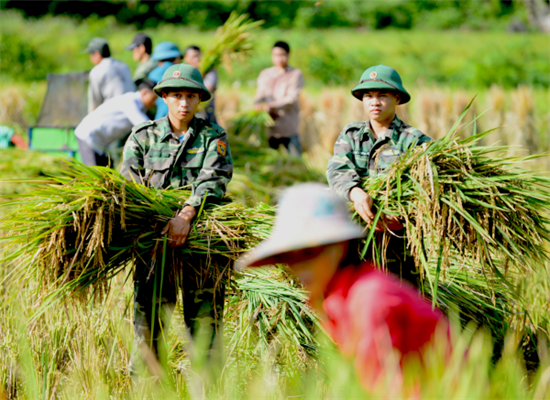 |
| Cao Bang provincial border guards help the people with harvesting (photo: qdnd.vn) |
Second, cultivating and promoting the cultural value system of “Uncle Ho’s Soldiers” in the new context
A core point of cultural environment building is the cultivation and promotion of the distinctive cultural values of the VPA embodied in the noble qualities of “Uncle Ho’s Soldiers”. This is not only a precious spiritual heritage, but also an ethical foundation and cultural standard for each serviceman.
However, amid profound social changes - where pragmatic lifestyle and an overemphasis on material values are on the rise - preserving and promoting the traditional values of the nation and the VPA presents new requirements. Without regular cultivation, these values risk fading. Therefore, it is necessary to continue concretising and promoting the cultural values of “Uncle Ho’s Soldiers” in the new era, in conjunction with studying and following Ho Chi Minh’s thought, ethics, and lifestyle. Accordingly, cultural activities within units should focus on fostering absolute loyalty to the Party, the Fatherland, and the people, a high sense of discipline, and a healthy lifestyle among cadres and soldiers. Furthermore, cadres and soldiers must possess professional expertise, master modern science and technology, and demonstrate a spirit of solidarity and compassion, together with wholehearted devotion to the Fatherland, the people, and their comrades. Through these efforts, the noble values of “Uncle Ho’s soldiers” will become standards of conduct and lifestyle among all cadres and soldiers.
Besides, great importance should be attached to traditional education to foster pride in the glorious history of the Party, the State, the VPA, and each unit. When soldiers deeply understand these traditions and their responsibilities, they will be strongly motivated to train and wholeheartedly serve the Fatherland and the people.
Third, building a rich and healthy cultural life.
A healthy and sustainable cultural environment must be built on both material and spiritual foundations. Hence, fostering a rich and healthy cultural life at grass-roots units is of great importance. In recent years, many units have invested in cultural institutions and operated these institutions effectively, contributing to improving their troops’ spiritual and cultural life. However, in certain grass-roots units, especially those stationed in remote areas, conditions and facilities for cultural activities remain limited, while the content and forms of such activities are sometimes not really diverse or attractive.
To address this issue, greater attention should be paid to developing a system of cultural institutions tailored to the particularities of each unit. Simultaneously, it is essential to renovate the content and methods of organising spiritual and cultural activities in a practical, creative manner, suitable for young soldiers. Art performances, sport competitions, cultural exchanges with local communities, and youth forums should be organised flexibly and effectively in order to enrich troops’ spiritual life and cement internal unity and military - civilian solidarity.
Additionally, units should concentrate on regularity building, discipline management, and internal unity and military - civilian solidarity consolidation. Movements to build “regular, green, clean, beautiful barracks” should be further promoted, with emphasis placed on harmoniously combining aesthetic, educational, and functional elements. Traditional symbols, slogans, culture and sport zones, and flower and bonsai gardens should be arranged scientifically to create a distinctive cultural space for each unit. Alongside this, cultural, artistic, physical training, and recreational activities should be organised systematically to encourage troops to engage in healthy cultural pursuits, thereby preventing social evils and minimising disciplinary violations.
Fourth, building a “cultural shield’ for cadres and soldiers.
Thanks to the development of the socialist-oriented market economy and the process of increasingly deep and wide international integration, social life is undergoing profound positive changes. However, alongside improvements in material conditions, the negative aspects of the market economy have brought about multi-dimensional impacts on the spiritual life of cadres and soldiers. Notably, the rapid development of the Internet and social media has created a vast information space containing both positive values and toxic elements. Hostile forces are thoroughly exploiting cyberspace to disseminate harmful cultural products, distort truths, and sabotage our Party, State, and VPA, aiming to gradually erode the trust and revolutionary ideal of our cadres and soldiers. This poses a significant challenge to building a cultural environment at grass-roots units today.
Against this backdrop, the current requirement is to proactively build a “cultural shield” for cadres and soldiers. Priority should be given to enhancing the quality of political, ideological, and moral education and providing correct orientation regarding aesthetic values. This ensures that every soldier possesses political willpower and the ability to identify and combat wrong information and toxic cultural products. Each soldier must be not only a recipient of information, but also a pioneering “fighter” on the ideological and cultural front.
In addition, units should promote the role of specialised agencies and cadres in charge of information management and orientation, while building a positive communication environment within themselves. Developing high-quality media products suited to the characteristics and needs of young soldiers will contribute to forming a rich and healthy cultural environment, thereby mitigating the negative impacts of harmful information streams and cultural products.
Fifth, applying digital technology in building a cultural environment.
Currently, the entire VPA is accelerating digital transformation, aiming to turn troops into “digital soldiers” and build “digital units”. In this context, building the cultural environment at grass-roots units must incorporate digital applications, especially in dissemination and education. This includes developing e-libraries, e-learning systems, and thematic videos, and exploiting internal local area networks (LAN), electronic bulletin boards, and unit web portals. Digital technology should also be applied to manage cultural institutions, organise online activities, and preserve units’ traditions. These efforts will progressively create a digital cultural space suited to the practical conditions of each unit. Besides, units should also focus on enhancing digital competence among cadres and soldiers and improving their ability to exploit and filter information and protect themselves against the negative impacts of social media.
In conclusion, building a cultural environment at grass-roots military units is both an urgent requirement and a long-term strategic task, closely linked to the building of a politically strong VPA. The issues outlined above serve as initial insights; units should continue to research and apply them in accordance with their particularities, thereby contributing to improving the quality of building a cultural environment across the VPA in the new era.
Sr. Col. NGUYEN THANH TRUNG, PhD