“Better fewer, but better” - Lenin’s viewpoint in relation to today’s task of building a compact, strong, modern Vietnam People’s Army
V.I. Lenin’s viewpoint, “Better fewer, but better”, holds profound theoretical and practical significance in the organisation and building of the apparatus of a new type of state, as well as in the formation and organisation of a revolutionary army. This viewpoint remains fully relevant today, particularly in the process of building a compact, strong, and modern Vietnam People’s Army (VPA). Therefore, continuing to study and creatively apply this viewpoint is of great importance in the present context.
The work entitled “Better Fewer, But Better” (1923) by V.I. Lenin is one of the legacies of profound theoretical and practical value in the organisation and construction of the Soviet state apparatus.
According to V.I. Lenin, in the process of improving the state apparatus, it is essential to follow the principle of “better fewer, but better”; one must not pursue quantity, but instead pay special attention to quality, because “only by thoroughly purging our government machine and reducing it to the utmost everything that is not absolutely essential in it, shall we be certain of being able to keep going”. Lenin emphasised that in the course of building and reforming the state apparatus, it is necessary to analyse and assess the situation objectively in order to make appropriate decisions, to have strong political will, to proceed decisively but prudently and without haste, while correctly identifying the key breakthrough stages, and maximising internal resources and human factors. These are principled, methodological issues for the sake of a streamlined, efficient, and effective new-type state apparatus.
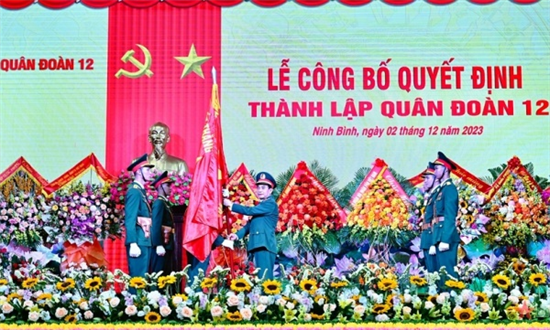 |
| Gen. Phan Van Giang presents the Determined to Win Military Flag to Army Corps 12 - the first compact, strong, modernised army corps of the VPA (photo: qdnd.vn) |
Consistent with this viewpoint, in the building of the army, although Lenin did not directly set out specific content or requirements, he affirmed the need to focus on building a revolutionary army of the working class with appropriate size, quality, and structure, and strong combat capability. Through his comprehensive analysis of the factors constituting the army’s fighting strength - from political and spiritual elements, weapons, and equipment to soldiers’ sense of discipline - Lenin always stressed the particularly important role of the human factor, especially high-quality human resources in military activities. As he stated, “...modern warfare, like modern technology, demands men of highest quality”. This is the fundamental and foremost element in building a compact, strong, and modern army.
Thoroughly grasping and creatively applying Lenin’s viewpoint of “better fewer, but better”, being deeply imbued with Ho Chi Minh’s thoughts and the Party’s lines on reorganising VPA, in recent years, Party committees and commanders at all levels throughout the armed forces have “...resolutely restructured the VPA to make it compact and strong, clearly defining the functions and duties of each position, especially within operational and strategic bodies, and resolving the issue of overlapping responsibilities”. To date, the Military has basically completed the restructuring process towards a compact and strong organisation, laying a solid foundation for building a revolutionary, standardised, elite, and modern VPA, becoming a shining example in implementing the Party and State’s policy of organisational streamlining. The VPA’s organisational structure is now uniformed and rational, with a balance among its components, no functional overlap, and a reduction in intermediate levels and service units, thereby creating a solid basis for enhancing overall quality and combat strength, and meeting the demands of national defence and safeguarding of the Fatherland in the new situation.
In the time ahead, to fulfil the requirements and tasks of building a compact, strong, and modern VPA, Party committees, commands at all levels, and the entire Military must continue to thoroughly understand and creatively apply V.I. Lenin’s principle of “better fewer, but better”. Within this article, a number of basic solutions are proposed for further discussion and implementation as follows.
First, continuing to thoroughly grasp the value of V.I. Lenin’s “better fewer, but better” teaching in realising the policy of building a compact, strong, and modern VPA. The application of this principle must begin with awareness. Accordingly, Party committees and commands at all levels should strengthen communication and education work so that cadres, party members, and the masses clearly understand the revolutionary and scientific nature of Lenin’s viewpoint, as well as its practical value in today’s process of VPA building. It is essential to clarify the essence of “better fewer, but better” - this is not merely guidance on organisation, but also a methodological and leadership orientation that values quality, effectiveness, fighting spirit, discipline, solidarity, and confidence over mere numbers or formalities. These efforts will enable cadres and soldiers to understand that in any revolutionary organisation, what matters most is not the size, but the quality, integrity, capability, loyalty, and dedication of its members to the common goal.
The study and application of Lenin’s viewpoint should be closely linked with Ho Chi Minh’s thoughts and the Party’s lines on Party building, political system development, and VPA building. This will help cadres, party members, and soldiers clearly perceive the relationship between “better fewer, but better” and the requirement of building a revolutionary, standardised, elite, and modern VPA. They must share a unified understanding that streamlining the organisational structure does not mean mechanical downsizing, but rather a process of selection and reorganisation to improve overall quality and combat capability. At the same time, it is necessary to maintain consistent ideological orientation, promptly identify and refute distorted or mistaken interpretations of Lenin’s viewpoint, thus avoiding the confusion of “better fewer, but better” with simplistic personnel reductions, structural contraction, or the neglect of human factor. By doing so, the Military can ensure a unified, correct understanding, creating a firm ideological foundation for building a compact, strong, and modern VPA.
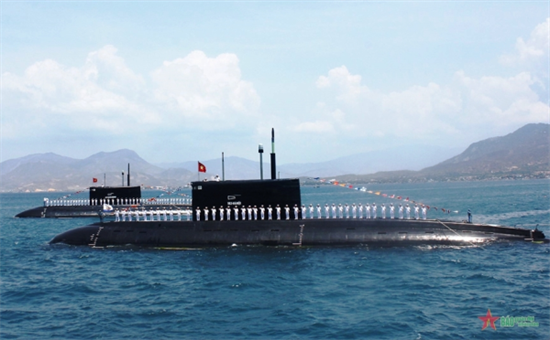 |
| Submarine 182 - Hanoi and Submarine 183 - Ho Chi Minh City at Cam Ranh military port, Khanh Hoa province (photo: qdnd.vn) |
Second, being steadfast in the principle of building a politically strong VPA while continuing to refine the Military’s organisational structure to make it more compact, strong, and modern. Building a politically strong military is a core principle that ensures the VPA always remains a loyal and reliable fighting force of the Party, State, and people. It is essential to tie political consolidation with the ongoing process of organisational restructuring, ensuring that the VPA is streamlined, strong, and modern, and possesses a uniformed, rational structure among its components and forces, in line with the motto “men come first, guns follow”. This will guarantee organisational compactness, qualitative strength, and the preservation and enhancement of the Party’s absolute, direct leadership in all aspects over the VPA’s activities. It is also necessary to build the Military Party Organisation as well as all-level Party committees and organisations to be exemplary and strong. Special attention should be paid to enhancing the leadership capacity and combat strength of Party committees and organisations, promoting the pioneering, exemplary role of cadres and party members. Party committees and commands at all levels should innovate and improve political education and ideological orientation, ensuring that cadres and soldiers remain firm and steadfast in their political stance, objectives, and ideals. They should be fully aware of the current situation and their assigned tasks, recognise both advantages and difficulties, and clearly define their responsibilities and determination to successfully accomplish all missions.
Efforts should be concentrated on completing the restructuring and adjustment of the VPA’s organisation, achieving uniformity and rational balance among all components and forces, further reducing intermediate levels and service units, effectively implementing plans of the Ministry of National Defence for force adjustments, maintaining stability and enhancing the VPA’s combat strength. Agencies and units across the VPA should regularly review, adjust, and consolidate their structures in an objective, comprehensive, focalised manner, in accordance with their functions and missions. This will generate strong progress in organisation, staffing, and equipment, ensuring appropriate unit sizes and gradual qualitative improvement to meet the requirements of defending the Fatherland in the new situation.
Third, focusing on improving the quality of education and training, with particular emphasis on developing high-quality human resources as the foundation for building a compact, strong, and modern VPA. Guided by the motto “Modernising people before modernising weapons and equipment”, agencies and units across the Military should develop systematic plans for human resource development, especially high-calibre personnel, to meet both immediate and long-term needs. Appropriate criteria should be established to serve as the basis for evaluating, training, fostering, promoting, and appointing cadres in a suitable, effective manner. The quality of military recruitment and admission must also be enhanced, with breakthrough solutions to attract talented and highly qualified individuals to serve in the Military.
In line with the Party’s consistent viewpoint that “Education and training are the foremost national policy, decisive to the nation’s future”, Party committees and commands at all levels across the Military should prioritise improving the quality of education and training for the contingent of cadres, regarding this as a key driving force and a deciding factor in the overall quality and combat strength of each unit in particular, and of the cause of building a compact, strong, modern VPA in general. First and foremost, education and training within the Military must undergo comprehensive and uniformed reforms, with clear focus and priorities, to bring about genuine breakthroughs in cadre quality. The aim is to build a pool of all-level cadres that is balanced in terms of quantity, quality, and structure, in alignment with the modernisation road map for weapons, technical equipment, and the branches and services.
Consideration should be given to developing a system of military academies and research institutes in a streamlined, strong, modern fashion, with a corps of educators and education managers who are exemplary in ethics, intellect, teaching methodology, and professional conduct. Based on the principle that “The school’s training quality translates to the combat readiness capability of the unit”, military schools must proactively review, renew, and standardise training processes and curricula in line with the principles of “theory tied with practice” and “training schools linked with the battlefield”. This includes reducing theoretical workload, increasing practical training and exercises closely aligned with operational plans, and strengthening the cultivation of leadership and management skills and fighting spirit in complex environments.
The content of education and training for cadres at all levels must be comprehensive but focus on combining the cultivation of political qualities, ethics, professional competence, and command and management skills with strengthening political courage, consolidating a scientific worldview, and fostering firm confidence among learners. At the same time, training programs should regularly update new knowledge in areas, such as state management, economics, society, law, scientific and technological achievements, cyber warfare, and artificial intelligence, etc.
For the sake of practical effectiveness, teaching and learning methods should be actively renewed, with a shift from one-way transmission to inspiring self-discipline, initiative, and creativity among learners. Information technology, simulation technology, and modern teaching aids should be widely applied. Also, it is essential to impart practical experience to enhance the mastery of modern weapons and equipment, mobile platforms, and operational capability under new conditions.
Through those efforts, the Military will develop high-quality human resources as a solid foundation for building a compact, strong, and modern VPA capable of firmly safeguarding the Fatherland in the new era of national development.
Col. DOAN HONG DUAN, PhD
Infantry Officer College No.1