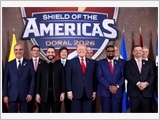
Latin America in the vortex of strategic competition among major powers
Thursday, October 15, 2026, 20:51 (GMT+7)
According to researchers, in the long term, great-power competition has exerted and continues to exert pressure on Latin American countries’ ability to exercise autonomy in formulating their development policies.
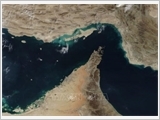
The Strait of Hormuz - A convergence point for energy, military, and political concerns
Monday, September 28, 2026, 10:23 (GMT+7)
Recent escalating tensions in the Strait of Hormuz have highlighted that, amidst intensifying great-power competition, the value of a geostrategic area is determined not merely by geographical position or military might, but increasingly by the capacity to influence and control the flows of energy, trade, technology, and global supply chains.
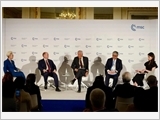
Global political–military landscape through the lens of the Munich Security Conference 2026
Saturday, April 18, 2026, 10:31 (GMT+7)
Munich Security Conference 2026 has laid bare a stark reality: the unipolar world order of the post–Cold War era is disintegrating, while a stable multipolar order has yet to take shape. In this high-risk transitional period, the combination of traditional military strength with flexible diplomacy, alongside economic and technological capabilities, will determine each nation’s position.
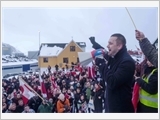
Greenland: a focal point of geopolitical competition
Monday, March 30, 2026, 09:26 (GMT+7)
Despite being a sparsely populated autonomous territory with harsh natural conditions, the island of Greenland has recently emerged as a new focal point for geopolitical competition. This is particularly true following the assertive statements and manoeuvres by US President Donald Trump. This development reflects a shift in the strategic focus within major powers’ calculations, presenting challenges for both the region and the broader world
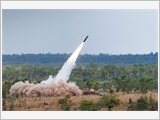
Message from Exercise Talisman Sabre 2025
Friday, September 19, 2025, 17:09 (GMT+7)
Talisman Sabre 2025 also demonstrates the strategic preparedness of multinational engagement, advanced technological and tactical capabilities of countries in the region; ensuring the firm commitment of Australia, the United States and other partners to maintain the stability of a free and open Indo-Pacific.

The global political and security landscape viewed from the 2025 Munich Security Conference
Friday, April 11, 2025, 21:50 (GMT+7)
The 2025 Munich Security Conference took place against a backdrop of rapid and unpredictable changes in the global political and security landscape. The conference addressed numerous topics and issues related to current global security, indicating that the world is accelerating its transition from a unipolar to a multipolar order
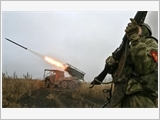
A review of the global political and military landscape in 2024
Sunday, December 29, 2024, 14:44 (GMT+7)
In 2024, the global political and military landscape underwent significant changes due to the impacts of various hot spots, conflicts, and strategic competition among major powers, particularly the Russo-Ukrainian conflict, the escalating war in the Middle East, tensions on the Korean Peninsula, and increasing signs of US-China rivalry

Great power competition in Indo-Pacific
Friday, August 16, 2024, 07:58 (GMT+7)
Overall assessment of great powers’ Indo-Pacific strategies reveals that despite their different expression, all great powers put the Indo-Pacific at the heart of global security and interests of each country. Accordingly, strategic competition among great powers in Indo-Pacific is a unique issue characterised by cooperation, deterrence, and containment.
Rejecting the argument that “in essence, Ho Chi Minh’s ideology is nationalism”
Wednesday, September 20, 2023, 07:04 (GMT+7)
Throughout his revolutionary career, Ho Chi Minh consistently stood with the working class, and creatively applied and developed Marxist-Leninist principles in the reality of the revolution in Vietnam. His ideology is “an in-depth and comprehensive system of viewpoints on fundamental issues of the Vietnamese revolution; it is the result of the creative application and development of Marxism-Leninism in the specific condition of our country, it inherited and advanced the nation’s traditional values, and also absorbed the essence of human culture. It is an invaluable intellectual asset of our Party and People, forever guiding our people’s revolutionary cause to the ultimate victory, and completely distinct from the distorted allegations of nationalist ideology made by the hostile forces.
The Arctic as a place of great power competition
Saturday, September 24, 2022, 10:36 (GMT+7)
Although it is considered the second largest desert in the world after Antarctica, access to the Arctic promises many geopolitical and economic benefits to concerning countries because of its outstanding potential. Therefore, the competition for influence in this deserted region has been ongoing for decades and is getting fiercer.