In recent years, Vietnam has achieved significant progress in ensuring human rights, while also making active contributions to the United Nations’ human rights mission. These achievements serve as compelling evidence affirming the sound policies and lines of our Party, as well as the efforts and resolve of the entire political system, thereby refuting all distortions of the current human rights situation in Vietnam.
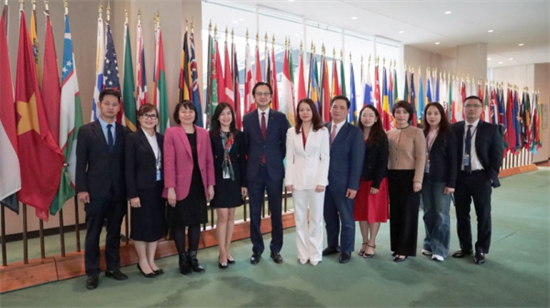 |
| Vietnamese delegation at the election of members of the United Nations Human Rights Council for the 2026 - 2028 term (photo: nhandan.vn) |
In its World Report 2025, Human Rights Watch put forward a number of distortions of human rights in Vietnam. The organisation baselessly alleged that “the Vietnamese authorities have repressed human rights activists” and “suppressed the people’s fundamental freedoms”, such as freedom of expression, freedom of association, freedom of peaceful assembly, freedom of movement, and freedom of religion. It further voiced support for individuals it labels as “human rights defenders” - who, in reality, are those acting against our Party, State, and people. The organisation also claimed that Vietnamese courts conducted “unfair trials” based on fabricated charges, while criticising what it described as “harsh detention conditions” for these individuals. Moreover, it attacked Vietnam for rejecting recommendations under the Universal Periodic Review (UPR) mechanism and for refusing to amend domestic legislation, among other accusations.
The distortions mentioned above are made with the sole intention of undermining the credibility of the Party and State of Vietnam, denying the human rights achievements of our country, manipulating public opinion, inciting unrest, and ultimately abolishing our Party’s leadership over the revolutionary cause. However, reality shows that Vietnam has made significant progress in ensuring human rights, which has been recognised and highly valued by the international community. The clearest evidence of this is that on 14 October 2025 (New York time), at the United Nations (UN) Headquarters, Vietnam was re-elected to the UN Human Rights Council for the 2026 - 2028 term, receiving 180 votes of support - the highest within the Asia-Pacific Group.
1. Undeniable achievements in ensuring human rights
Under the leadership of our Party, Vietnam has, in recent years, overcome numerous difficulties and challenges, achieving major accomplishments in ensuring and protecting human rights. These outcomes reflect the efforts and determination of the entire political system in pursuing development goals centred on human beings, striving towards “a Vietnam without poverty and hunger”, where human rights are fully recognised, respected, protected, and guaranteed, and where everyone has the opportunity to develop comprehensively and contribute to the country’s overall progress. These achievements are demonstrated in the following key aspects.
First, Vietnam has consistently regarded the safeguarding of human rights as both its goal and driving force of development. This principle is fully enshrined in the Constitution and legislation, and effectively implemented in practice. The 2013 Constitution dedicates 21 articles to human rights and 15 articles to citizens’ rights. Notably, Clause 1, Article 14 states: “In the Socialist Republic of Vietnam, human rights and citizens’ rights in the political, civil, economic, cultural, and social fields are recognised, respected, protected and guaranteed in accordance with the Constitution and the law”. The explicit provisions on human rights are reflected across various dimensions: equality before the law (Clause 1, Article 16), prohibition of discrimination (Clause 2, Article 16), rights of overseas Vietnamese (Article 18), the right to life and protection of life by law (Article 19), inviolability of the body (Clause 1, Article 20), inviolability of private life, and the confidentiality of correspondence, telephone calls, and telegrams (Article 21), among others. These clear legal guarantees demonstrate our State’s strong commitment to protecting and promoting human rights in all areas.
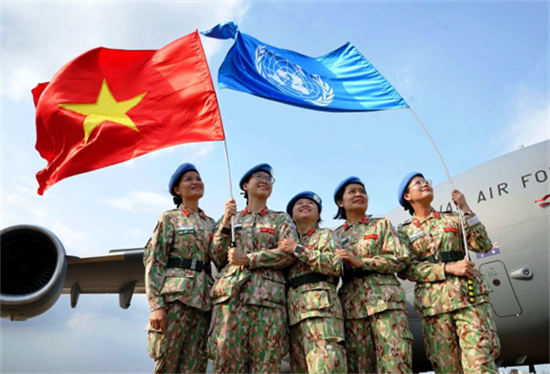 |
| Female cadres of Vietnam’s level 2 field hospital No.3 deployed to UN peacekeeping Mission in South Sudan (photo: thanhnien.vn) |
In the process of building and perfecting a socialist rule-of-law State as set out in Resolution 27-NQ/TW of the Party Central Committee (13th tenure), dated 9 November 2022, Vietnam continues to promote the mechanism in which “the Party is the leadership, the State is the manager, and the people are the masters”, and the principle “the people know, the people discuss, the people do, the people inspect, the people supervise, and the people benefit”. Besides, the legal framework on human rights continues to be improved through numerous specialised laws covering a wide range of areas and population groups. This has helped establish a unified, coherent, feasible legal environment for the protection of civil, political, economic, social, and cultural rights, and create favourable conditions for all citizens to enjoy their human rights. This proves that human rights and citizens’ rights have increasingly been placed at the top of our State’s priorities, clearly reflecting the commitment of our Party and State to ensuring the people’s mastery and promoting social progress. Particularly, the year 2025 marked a significant milestone in legislative activities with amendments to the Penal Code. These amendments embodied our Party and State’s humanitarian policies by abolishing the death penalty for eight offences, and converting the death sentence to life imprisonment for individuals sentenced before 1 July 2025 who had not yet faced execution. This is clear evidence of our Party and State’s strong efforts to ensure human rights, in line with Vietnam’s conditions and global progressive trends.
Second, the system of social security policies in Vietnam is coherent, feasible, and mutually reinforcing, helping to promote the human rights of all citizens, especially vulnerable and disadvantaged groups. Core social security policies are logically formulated and closely inter-connected; they operate independently within each sector, while also supporting one another across sectors. These include policies on poverty reduction, employment, housing, social welfare, allowances for those with meritorious services to the nation, social insurance, health insurance, unemployment insurance, green growth and sustainable development, among others. Social security policies also prioritise vulnerable groups, such as women, children, the elderly, persons with disabilities, and the poor. As a multi-ethnic and multi-religious nation, Vietnam, through its social security policies, also pays special attention to ethnic minority communities and ensures that more than 27 million religious followers can exercise their fundamental human rights within the framework of national law and in accordance with international human rights standards.
The comprehensive implementation of these social security policies has contributed to facilitating the realisation of basic human rights, raising living standards and improving the quality of life for all citizens. The effectiveness of social security policies not only reflects our Party’s sound lines on ensuring human rights, but also demonstrates the significant efforts of our Party and State in fulfilling Vietnam’s international human rights commitments. The overarching goal of formulating and enforcing social security policies is to promote the country’s socio-economic development; ultimately, it is also to advance human rights, just as Prime Minister Pham Minh Chinh has affirmed: “The greatest human right in Vietnam is to ensure that more than 100 million people can live in freedom, prosperity, happiness, security, safety, and social harmony”.
Third, Vietnam has recorded impressive achievements across nearly all fundamental areas of social life. Thanks to the implementation of progressive laws and policies on human rights, our country has attained positive, tangible results in ensuring human rights in practice. In 2024, Vietnam’s economy had reached a scale of more than USD 470 billion, ranking 32nd in the world and placing the country among the world’s top 20 in terms of trade and foreign investment attraction. The living standards of the population have improved markedly. Notably, Vietnam has made remarkable progress and is recognised as one of the countries with the fastest poverty reduction rates in the world, having fulfilled the UN Millennium Development Goal on poverty eradication ahead of schedule. From a situation where over 70% of the population lived below the poverty line in the 1980s and more than 58% of households were poor in the early 1990s, the multidimensional poverty rate has now fallen to just 1.93%. Average per capita income in 2025 is expected to reach approximately USD 5,000 - 47 times higher than in 1986.
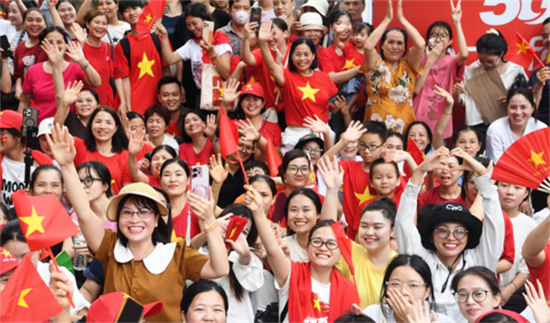 |
| Happy atmosphere during the celebration of the 80th anniversary of the National Day of the Socialist Republic of Vietnam in Ba Dinh, Hanoi |
In addition to economic achievements, other sectors, such as education, healthcare, and labour - employment have also seen notable progress. Health insurance coverage now exceeds 95.5%, surpassing the national target. Vietnam has also achieved universal secondary education, and the literacy rate among those aged 15 to 60 stands at around 98%, significantly higher than the global average. Life expectancy has reached 74.5 years, above the world average. The unemployment rate, at about 2%, is among the lowest internationally. Vietnam’s Human Development Index (HDI) in 2023 was 0.766, ranking 93rd out of 193 countries and placing the country in the group with high human development.
These positive indicators demonstrate that the human rights of the Vietnamese people have been fully ensured across the fundamental domains of social life, providing undeniable evidence that refutes all distortions and misleading claims about human rights in Vietnam. Alongside these impressive achievements, Vietnam has also become a safe, attractive destination for international visitors, fostering and projecting the image of a nation that cherishes peace and justice, while spreading the values of human rights more widely to the global community.
2. International contributions to the promotion and protection of human rights
Alongside its remarkable achievements in ensuring human rights domestically, Vietnam has also made significant contributions to international human rights efforts, actively participating in global forums and the UN’s human rights mechanisms. In recent years, thanks to its impressive record in fulfilling human rights commitments, Vietnam has consistently earned strong trust from other countries around the world and has been elected to numerous important international bodies. In 2022, Vietnam was elected Vice-President of the 77th Session of the UN General Assembly, representing the Asia-Pacific region (for one-year term). In 2023, Vietnam served as Vice-President of the UN Educational, Scientific, and Cultural Organisation (UNESCO). In 2024, the UN Economic and Social Council elected Vietnam to the Executive Board of UN Women for the 2025 - 2027 term. In 2025, Vietnam was re-elected to the UN Human Rights Council for the 2026 - 2028 term, receiving the highest number of votes among Asia-Pacific candidates. Being elected for a third time to the Human Rights Council - the UN’s most important specialised body on human rights - demonstrates the high level of trust and confidence placed in Vietnam by the international community, reaffirming the country’s growing reputation and standing on the global stage. This is a fact that no hostile force can distort or deny.
As an active member of the Human Rights Council, Vietnam has demonstrated an influential voice in promoting and protecting human rights globally, particularly through its notable national initiatives. Many initiatives proposed by Vietnam have been adopted by consensus at the Human Rights Council. These include: the initiative to draft a resolution commemorating the 75th anniversary of the Universal Declaration of Human Rights and the 30th anniversary of the Vienna Declaration and Program of Action, the draft resolution on promoting livelihoods in the context of climate change in 2023, and the 2024 resolution on climate change and human rights with a focus on fair transition, among others. These initiatives illustrate Vietnam’s active and responsible engagement in addressing global issues and challenges related to human rights, contributing to the UN’s mission of advancing human rights worldwide.
Furthermore, as a signatory to 7 out of the 9 core international human rights treaties and a member of 25 conventions of the International Labour Organisation (ILO), Vietnam actively engages in UN human rights mechanisms, such as the UPR of the Human Rights Council, treaty body reporting procedures, and other international human rights forums. To date, Vietnam has participated fully in all four cycles of the UPR, as well as presented national reports on the implementation of major treaties, such as the International Covenant on Civil and Political Rights (ICCPR), the Convention on the Rights of the Child, the Convention against Torture, among others. Through these international human rights mechanisms, Vietnam has highlighted its human rights achievements to UN member states, earning recognition from the international community as a model that inspires and motivates other nations, particularly in the field of poverty reduction.
The remarkable achievements outlined above have been made possible thanks to the comprehensive leadership of our Party, whose sound lines and policies have ensured the protection of human rights. They also reflect the efforts and determination of the entire political system in realising fundamental human rights across the civil, political, economic, social, and cultural spheres. These contributions not only highlight Vietnam’s positive imprint on the global human rights landscape, but also provide solid practical grounds to refute distortions and misleading allegations about the human rights situation in our country.
The reality of human rights protection in Vietnam affirms the nation’s strength, resolve, intellect, and sense of responsibility as it works alongside other countries to address global challenges in the interests of peace, development, and well-being of all humanity. This is a truth that cannot be denied.
LE XUAN TUNG, PhD
Institute for Human Rights, Ho Chi Minh National Academy of Politics