Great contributions of Friedrich Engels to the development of scientific socialism
Friedrich Engels’ thought is an important component, which integrates with the profound theoretical treasure of Marxism. The deep theoretical values and lasting practicality found in his ideological legacy have not only illuminated the path of the proletarian revolutionary movement and the advancement of progressive humanity, but also continue to affirm their vitality and contemporary significance in the ongoing process of building socialism in Vietnam. Therefore, hostile forces, reactionaries, and political opportunists are constantly seeking ways to distort, deny, and misrepresent the scientific and revolutionary nature of socialism; aiming to weaken the people’s trust, especially that of the younger generation in the socialist path and in the leadership role of the Communist Party of Vietnam.
Friedrich Engels was an outstanding thinker who, together with Karl Marx, founded scientific socialism - the solid theoretical foundation for the revolutionary movement of the working class. Not only did he contribute to building a comprehensive Marxist theoretical system, but he also persistently defended, developed, and brought revolutionary ideas into practice. Engels’ enormous contributions elevated socialism from utopian ideas into a scientific doctrine, guiding the path toward liberation of nations and the working class across the world.
In this article, scientific socialism is understood in a broad sense, encompassing the entire Marx-Engels ideological system. This article focuses on analysing and clarifying Engels’ important contributions in four main areas: philosophy, political economy, scientific socialism, as well as the development, protection, and dissemination of the revolutionary doctrine of the working class in reality. Thereby, the article affirms his central role in building and developing the revolutionary theory of the working class.
1. In the field of philosophy
Engels made great contributions to developing and enriching dialectical materialism - the philosophical foundation of scientific socialism. He clarified the dialectical relationship between matter and consciousness, affirmed the absolute objectivity and constant movement of the material world, and refuted the idealist viewpoint that posited a pre-existing “metaphysical consciousness” governing reality. More importantly, Engels emphasised the decisive role of practice - not only in the process of cognition but also in transforming the world. This marked a significant advancement, helping to shape the scientific and revolutionary worldview of Marxism.
Together with K. Marx, F. Engels profoundly developed the dialectical methodology in studying nature, society, and human thought, replacing the metaphysical and one-sided approaches that had dominated earlier philosophy. He also played an essential role in systematising, presenting, and disseminating Marxist philosophy through many classical works such as “Anti-Dühring”, “Ludwig Feuerbach and the End of Classical German Philosophy”, and “Dialectics of Nature”.
In “Anti-Dühring”, Engels strongly criticised the idealist, metaphysical views and the internal contradictions within Dühring’s ideological system - a typical representative of opportunism in philosophy. At the same time, he presented in a comprehensive and systematic manner the fundamental principles of dialectical materialism and historical materialism, thereby laying a solid theoretical foundation for scientific socialism.
In “Ludwig Feuerbach and the End of Classical German Philosophy”, Engels summarised the development of classical German philosophy from Immanuel Kant to G. W. F. Hegel and Ludwig Feuerbach. He criticised the idealist nature of Hegel’s philosophy and the metaphysical, abstract nature of Feuerbach’s materialism. From this, Engels affirmed the revolutionary nature and comprehensive superiority of Marxist philosophy, viewing it as the transformation from purely theoretical philosophy to practical philosophy - the philosophy of the proletariat and dedicated to the cause of human liberation.
Although “Dialectics of Nature” is an unfinished work, Engels made his first step in using materialist dialectical methods to explain natural processes, proving that the laws governing the movement of the natural world also follow dialectical logic. He also emphasised that nature cannot be separated from human society, as society is a highly developed part of nature, and the relationship between humans and nature is a dialectical relationship, with mutual influence.
Engels’ contributions in philosophy not only clarified and perfected the foundation of the Marxist worldview but also helped establish the scientific, revolutionary, and practical nature of scientific socialism. These ideas have become a solid theoretical foundation for the international proletarian revolutionary movement, serving as a guiding compass for the consciousness and actions of the working class in the struggle for social liberation.
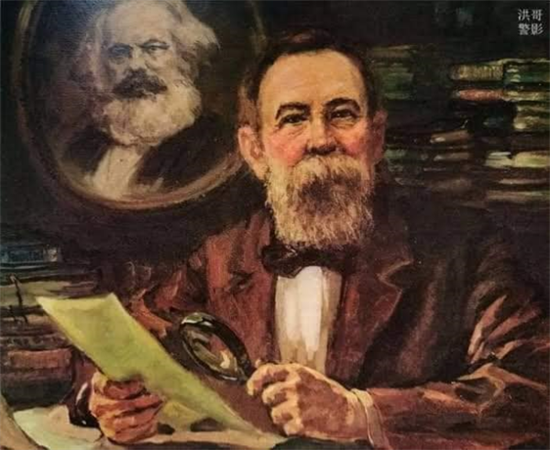 |
| Friedrich Engels (1820 - 1895) |
2. In the field of political economy
Although Engels did not directly construct an extensive economic theoretical system like Marx’s “Capital”, he made extremely important contributions to defending, developing, and popularising the core ideas of Marxist political economy - the theoretical foundation for analysing and criticising capitalism.
From the very beginning, as he and K. Marx studied and developed the foundational principles of Marxist theory, F. Engels participated in deeply analysing the exploitative nature of capitalism, clarifying its laws of motion and internal contradictions - which, according to him, were the root causes of cyclical socio-economic crises within the capitalist system. He particularly emphasised the contradiction between the social nature of production and the capitalist form of private ownership, viewing it as the inevitable contradiction that would lead to the collapse of capitalism and the emergence of a new socio-economic formation - socialism.
Engels also made many contributions in summarising and strengthening the theory of surplus value - the cornerstone of the entire system of Marxist political economic theory. He clarified the mechanism through which the bourgeoisie exploits workers by appropriating surplus value, thereby affirming the inevitability of the proletarian revolution aimed at abolishing capitalist private ownership, liberating the productive forces, and building a society without classes and without exploitation.
After K. Marx passed away in 1883, Engels devoted much of the last two decades of his life to editing, annotating, revising, and publishing Volumes II and III of the “Capital”. With his profound understanding of Marx’s research methods, theoretical system, and style of thinking, he successfully completed this historic task. As a result, essential topics such as the laws of reproduction and circulation of capital, capital accumulation and concentration, economic crisis cycles, and the relationship between finance capital and industrial capital were fully developed, contributing to the formation of a complete and long lasting system of Marxist economic theory.
Engels’ contributions to political economy not only helped safeguard and further develop Marxist theory, but also created important theoretical premises for the emergence and victory of numerous proletarian revolutionary movements in the twentieth century. His work contributed to transforming Marxist political economy from a purely academic field into a sharp ideological weapon serving the struggle for class liberation and social transformation.
3. In the field of scientific socialism
Alongside building philosophical and political-economic systems, Engels made important contributions to developing and completing the theory of socialism in the narrow sense, focusing on social, historical, and revolutionary strategic issues of the working class. These are the fields in which he demonstrated the greatest depth and prominence, where together with Marx, he laid a solid theoretical foundation for the international workers’ movement. Thanks to this, with a clear theoretical and practical foundation, socialism was elevated into a scientific doctrine, surpassing earlier emotional or moralistic perspectives.
Since 1845, in his work “The Condition of the Working Class in England”, Engels presented a truthful depiction of the miserable lives of English workers under capitalist domination. Therefore, he not only strongly condemned the exploitative nature of industrial capitalism but also emphasised the revolutionary role of the working class - the only force with the capacity and interest to overthrow capitalism and build a new society. By 1847, in the clear and concise question-and-answer format of “Principles of Communism”, Engels summarised the core arguments of communism, which served as a type of “revolutionary outline”, providing the direct theoretical basis for him and Marx to draft “The Communist Manifesto” (1848) - the first revolutionary manifesto of the working class on a global scale.
In “The Communist Manifesto”, Engels and Marx systematised three fundamental theses of scientific socialism: Firstly, the working class is the only force with the capability and historical interest to carry out the proletarian revolution. Secondly, the ultimate goal of the proletarian revolution is to abolish the bourgeois system of private ownership, advance toward public ownership of the means of production, and establish a society without classes, oppression, or exploitation. Thirdly, the proletarian revolution must be carried out through political struggle; in this process, revolutionary violence is necessary to overthrow the bourgeois state apparatus, establish the dictatorship of the proletariat, and create the transitional stage for building socialism and advancing toward communism.
In the final decades of the 19th century, when the international workers’ movement faced the risks of deviation and degeneration, Engels continued to make important theoretical contributions to protect the purity and revolutionary nature of Marxist doctrine. He comprehensively criticised the idealistic, one-sided and reformist views of Eugen Dühring - a typical representative of opportunism within the workers’ movement. Engels further clarified, disseminated, and promoted the value of many core theoretical issues of scientific socialism that Marx had presented in “Critique of the Gotha Programme” (1875), such as the world-historic mission of the working class, the role of the state during the transition from capitalism to socialism, principles of distribution in different stages of the new society, and the characteristics of the dictatorship of the proletariat.
With his immense, systematic, and consistent contributions, Engels played a decisive role in transforming socialism from a “utopian dream” into a scientific and revolutionary doctrine. His work became the ideological compass for the revolutionary movement of the working class and laid the theoretical foundation for the revolutionary struggles in the modern area.
4. In the development, protection, and dissemination of scientific socialism
Engels was not only a co-founder of scientific socialism alongside Marx but also an outstanding successor who made exceptional contributions to its comprehensive development, steadfast protection, and broad dissemination, turning this doctrine into a solid ideological foundation for the international proletarian revolutionary movement. After Marx passed away, Engels assumed an important historical role: systematising, completing, and further developing Marxist theory across multiple fields.
Beyond theoretical development, Engels was also a persistent and astute person in protecting the purity of Marxism against distortions from within the workers’ movement. He resolutely struggled against opportunist and revisionist tendencies such as Eugen Dühring and Eduard Bernstein - individuals who sought to dilute or distort the scientific and revolutionary spirit of Marxist doctrine. Engels not only criticised the errors but also systematically presented the foundational principles of dialectical materialism, historical materialism, and scientific socialism.
As an exceptional disseminator, Engels had the ability to express revolutionary ideas in a clear, logical, and convincing language. He helped transform Marxism, from a new and difficult-to-access doctrine into an ideology with powerful influence within the workers’ movement and among progressive forces around the world. Through a wide range of works, articles, letters, and speeches, he helped the working class to understand its historic position and revolutionary role, turning theory into concrete revolutionary action.
Alongside his theoretical work, Engels also directly participated in organising and leading international workers’ movements. Together with Marx, he was one of the founders of the First International - the first international revolutionary organisation of the working class. Later, he continued to play a crucial role in guiding and directing the Second International. Under his theoretical leadership, these organisations became centres that connected and unified the ideals and actions of the global workers’ movement.
Especially, Engels consistently emphasised the principle of creatively applying Marxism to the specific conditions of each country and each historical period. This line of thought shows that he was not dogmatic or doctrinaire Instead, he emphasised flexibility and alignment with revolutionary realities - a perspective with profound theoretical and practical significance for the development of socialist models in different countries during the 20th century. Thus, Engels was not only Marx’s ideal companion, but also a great thinker - a steadfast defender and disseminator of scientific socialism. Thanks to his foundational contributions, he helped Marxist theory transcend the bounds of an academic doctrine and become a guiding light for the struggle to liberate the working class and all humanity from every form of oppression, injustice, and exploitation.
Engels’ theoretical and practical contributions laid a solid foundation for the international workers’ movement and the socialist revolution all over the globe, making an important contribution to driving human history toward progress, justice, and humanity. The significant and historical value of these contributions are reflected not only in Engels’ role during his own time but also in their profound influence on the formation and development of modern socialism. His thought remains a valuable theoretical legacy, holding contemporary relevance as today’s world faces complex political, economic, and social upheavals. As V. I. Lenin affirmed: “To correctly evaluate Marx’s views, it is absolutely necessary to read the works of Marx’s like-minded colleague and closest collaborator, Friedrich Engels. It is impossible to understand Marxism and present it fully without paying attention to all of Engels’ works.”
In the current context, the research, dissemination, and creative application of Engels’ thought is not only an objective scientific requirement but also a strategic political task. It contributes to safeguarding and developing the Party’s ideological foundation, strengthening scientific confidence in Marxism-Leninism and Ho Chi Minh Ideology, while enhancing the “resistance capacity” of cadres, Party members, and the people against all schemes aimed at sabotaging the revolutionary cause of our Party and our people.
Associate Prof., Dr. PHAN TRONG HAO